

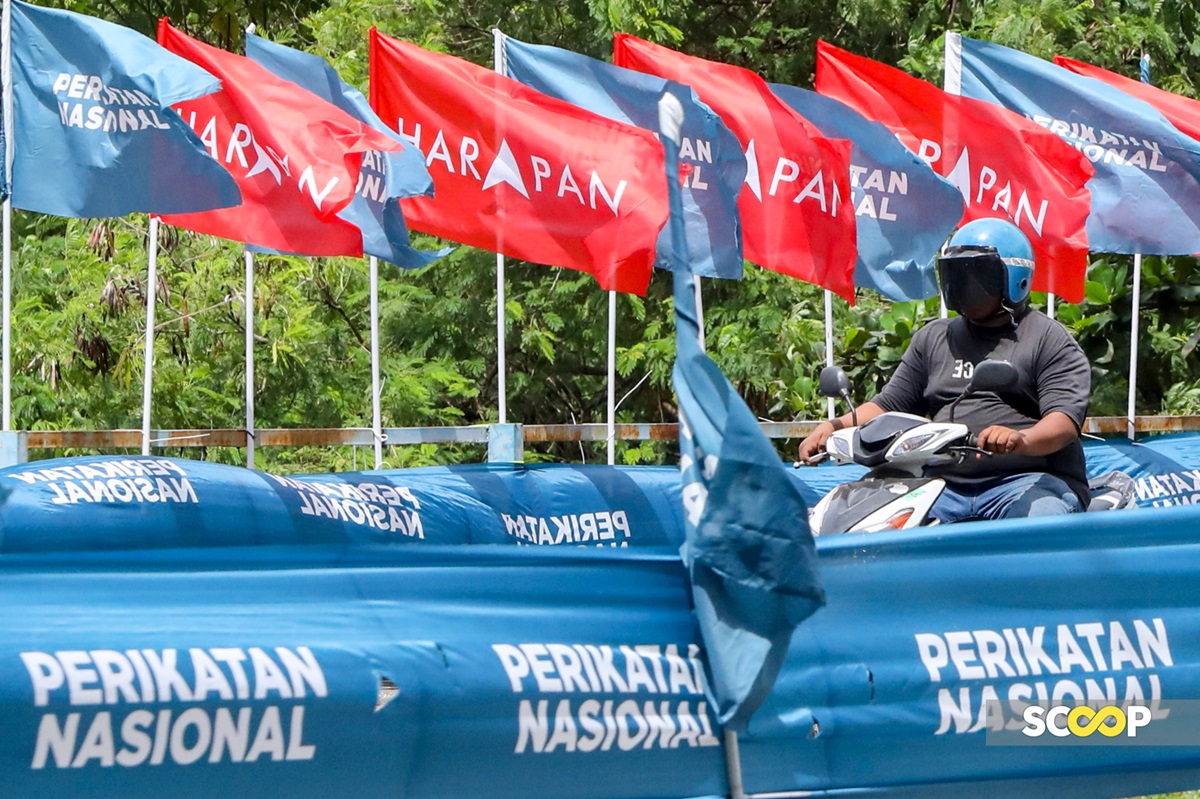
A. The background: oil and water don’t mix
1. Thank you, ISEAS – Yusof Ishak Institute, for inviting me to speak before such a distinguished audience.
2. First of all, I would like to congratulate the Singaporeans on your recent smooth and successful election.
3. Congratulations to Singapore – a well-developed and successful city-state. As for us, Malaysia, we still have a few things to juggle.
4. When I saw the topic – the political landscape of Malaysia – I asked myself, where should I begin? Perhaps the best way is to share with you a few key turning points in Malaysia’s political landscape.
5. Since independence, Malaysian politics has been dominated by Umno, through the coalition of Barisan Nasional (BN).
6. In the 2008 general election, after their landslide majority in 2004, for the first time, BN lost its two-thirds majority in the Parliament. BN lost control of Selangor, Penang, Perak, Kedah and Kelantan.
The result was largely attributed to growing public anger over the rising cost of living, government inefficiencies and alleged abuse of power.
7. 10 years later, in GE 2018: BN failed to form the federal government.
Not only did BN lose Putrajaya, but it also lost control of states like Perak, Kedah, Sabah, Melaka, Negeri Sembilan, and Johor, in addition to Selangor and Penang.
As a result of public outrage over the 1MDB scandal, Barisan Nasional was reduced to governing only 3 out of 14 states – Perlis, Pahang, and Sarawak. Johor was symbolic, especially when Umno was born in Istana Besar Johor.
8. Only less than two years later, in 2020, a historic shift happened – the government changed mid-term for the first time in our history, marking the fall of PH 1.0 government, giving rise to Perikatan Nasional.
9. The collapse of the Pakatan Harapan government was the result of a fragile coalition, where infighting among its component parties severely undermined unity and stability.
10. Much has been said about the so-called “Sheraton Move”. But the truth is, there was no such move – only a constitutional transition, carried out entirely within the legal framework of our parliamentary democracy.
11. PH rode to victory in 2018 on an anti-BN, anti-corruption sentiment. But it collapsed in less than two years. You may question me why?
The answer is simple: there was no trust between them, especially between Bersatu, PKR and DAP. To make matters worse, the leaders clashed and fueled tensions over the promised succession plan.
12. It also proved the deeper dysfunction within PH – the absence of a working consensus due to fundamental and ideological differences. One that was bound to collapse from the start.
As they say: Oil and water don’t mix.
B. The rise of Perikatan Nasional
13. The resignation of Tun Dr Mahathir Mohamad in February 2020 led to the appointment of Bersatu president Tan Sri Muhyiddin Yassin as the 8th prime minister of Malaysia. It was far from smooth sailing for the newly formed government, later to be called Perikatan Nasional (PN) government.
Barely days into office, we were thrust into an unprecedented crisis – the Covid-19 global pandemic.
14. Alhamdulillah, despite the odds, we managed to navigate through the storm with firm leadership, clear planning, and swift action.
15. The Perikatan Nasional government, as also acknowledged by the World Bank, implemented a series of strategic economic stimulus packages – Penjana, Permai, Pemerkasa, And Pemulih – designed to protect jobs, support small and medium enterprises (SMEs), and stabilise household incomes during the Covid-19 crisis.
16. Under PN’s leadership, Malaysia’s economy not only survived but began to recover. By 2022, the country recorded a remarkable GDP growth of 8.7% – the highest in Asean..
17. As a result, unemployment fell from 5.3% in May 2020 to 3.6% by the end of 2022, and the business community regained confidence.
18. This is proof that Perikatan Nasional is not just a coalition of convenience – we are a coalition of the capables.
19. Perikatan Nasional is led by individuals with decades of combined experience in the government.
20. Many of our leaders are former ministers, seasoned policymakers, technocrats, and crisis-tested administrators.
21. Present with us today:
Datuk Seri Takiyuddin Hassan – former law minister as well as former energy and natural resources minister
Datuk Sri Saifuddin Abdullah – former foreign affairs minister and also former communications minister
Datuk Wan Saiful Wan Jan – former National Higher Education Fund Corporation (PTPTN) chairman
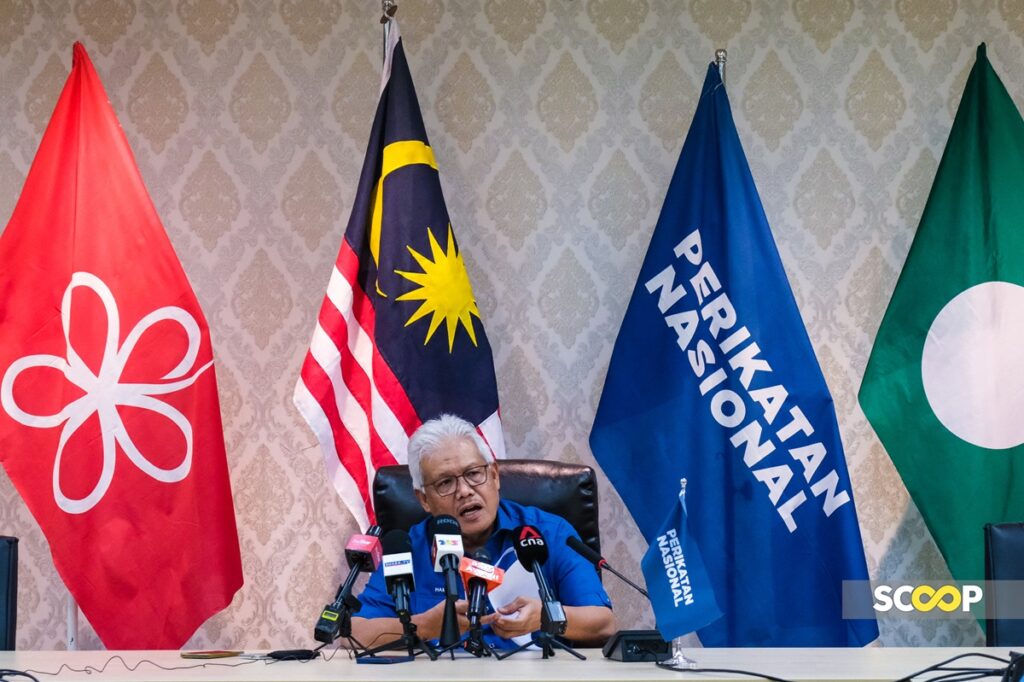
22. They are not first-timers. They are not new to the government. They are seasoned, proven leaders who have steered the country through crises, crafted national policies, and earned their “flying hours” in governance.
With sufficient flying hours, Perikatan Nasional is capable of piloting the aircraft both domestically and internationally.
23. Simply put – During its reign, Perikatan Nasional delivered. We governed with compassion and purpose. We saved lives, and we revived the economy.
As Winston Churchill said, “The price of greatness is responsibility.”
And in Malaysia’s toughest moment, Perikatan Nasional stood firm, and navigated the crisis with steady hands and clarity”
C. Historic election
24. After securing victories earlier in November 2021 in Melaka state elections and in March 2022 in Johor state elections, Umno grew increasingly confident of returning to power in the 15th general election. Riding on this momentum, Parliament was dissolved at the end of 2022, paving the way for GE15.
25. It was unlike any other election in our nation’s history. For the first time, we witnessed a fierce three-cornered contest across the board – Perikatan Nasional, Pakatan Harapan, and Barisan Nasional each going into battle independently.
26. Let me remind all of you, the president of Umno himself publicly swore in the name of God that there would be no cooperation between Umno and Anwar – No Anwar, No DAP, No Bersatu – That was a solemn declaration, a binding promise made before the Malaysian public.
Pakatan Harapan, at the same time, campaigned aggressively against BN, promising the rakyat to punish the Umno President and many other Umno leaders.
Their signature GE15 theme song was “Hoi Ho Ya Hoi” – a catchy tune adapted from P. Ramlee’s classic film Ali Baba and 40 Thieves, used to drill into the rakyat’s minds that Barisan Nasional was nothing more than a coalition of penyakau, penyamun, and perompak or in English, crook, robber and raider.
Perikatan Nasional campaigned on a promise of clean (bersih), stable (stabil), and compassionate (prihatin) government – in short, PNBEST. PN offered steady leadership focused on the rakyat, with our proven track record.
27. The results of GE15 were unprecedented.
28. For the first time in Malaysia’s political history, no single coalition held a simple majority (112 seats) to form the government. Malaysia had entered a hung parliament scenario – an unfamiliar and constitutionally challenging situation.
29. But here is what many continue to downplay or conveniently forget: Perikatan Nasional was the first to command a clear numerical advantage.
30. We secured and submitted Statutory Declarations (SDs) from 115 Members of Parliament. In fact, PN was offered the chance to form a government with PH and BN – a broad-based coalition that could have, in both form and substance, become a true unity government.
31. Perikatan Nasional chose to decline. Because such an arrangement would have been nothing more than another marriage of convenience, which is doomed to fail, just like PH 1.0 in 2020.
32. By definition, the current PH-BN government cannot be considered a true unity government. Their fundamental differences in principles and ideology are incompatible, and on many occasions, they cannot even agree on basic matters.
As the saying goes: “Lions don’t sleep with leopards – they clash.”
D. Football Match Analogy
33. The Malaysian Parliament is now halfway through their term. We are entering the second half.
34. But if you’ve been watching closely – you’ll know this has been a painful first half for the rakyat.
35. Let me share with you an analogy that everyone can relate to – a football match. We love the game. We understand the rules. We know the drama.
36. And just like in football, governing a country requires plan, discipline, chemistry, and results.
37. A football team can never win a game just by printing flashy jerseys and having bundles of slogans.
38. What matters is what happens on the field. And on the field, this team has been distracted by cameras and ceremonies.
39. Before the match, the captain roused the crowd. He fired up the fans and raised expectations sky high – promising a legendary performance.
40. He made the fans believe that history was about to be written. He stirred the imagination of loyal supporters, long thirsting for a trophy. Ini kali lah!
41. He made the fans sing in unison:
Cancel Student Loan!
Abolish tolls!
Cheap Petrol!
War on corruption!
42. They came on the field… the referee blew the whistle… They delivered one of the most disappointing performances during the first half.
43. Worse still, on the field, they started going against each other.
44. What really happened on the field during the first half? The captain wants to play every position. He wants to be the striker, the midfielder, the defender – and even the goalkeeper. Every move, every microphone, every camera – he must be at the center.
He doesn’t trust his team. He knows many of them do not have enough “flying hours”.
45. To summarise: the captain hogs the ball; strikers run backwards; defenders push forward without cover; there’s no game plan; no one trusts anyone; the infighting in the locker room is a mess.
Fans started losing faith. This football team is clearly heading for relegation.
E. The first half
46. No team can win a game when there is no chemistry, no discipline, and no clear vision.
47. When you have a dysfunctional team, you end up losing.
48. Maybe that is one of the reasons why an electoral reform NGO called Bersih – rated them a “D”.
49. In addition, nine former Bar Council Presidents also raised concerns over the state of governance.
50. A weak and ineffective government is a glaring red flag and a major turn-off in any part of the world.
51. A good government is built on clear decisions, strong leadership, and firm, consistent policies that guide the nation forward.
F. The future government
52. Perikatan Nasional is ready to serve. Our momentum is growing stronger.
53. Let me give you some numbers.
54. In the year 2022 (GE15), we won 74 parliamentary seats. We need only 4 more seats in Perak and 5 more seats in Pahang to form the government.
55. In the 2023 state elections, there were 245 seats being contested. Barisan Nasional only won 19 seats, Pakatan Harapan won 80 seats, while Perikatan Nasional won 146 seats, which is 60% of the total.
We also achieved a historic clean sweep 32-0 in Terengganu, won 43 out of 45 seats in Kelantan and 33 out of 36 seats in Kedah.
We only needed 7 more seats to form the government in Selangor and made remarkable inroads in Penang, as well as Negeri Sembilan.
Perikatan Nasional is clearly outperforming the electoral alliance between Barisan Nasional and Pakatan Harapan, even though it was an uphill battle for us, going up against the full weight and resources of Putrajaya in 2023.
57. As of the current situation, Perikatan Nasional commands a total of 208 elected state assemblymen (ADUN) nationwide, and we form the government in four states – Perlis, Kedah, Kelantan, and Terengganu.
58. At the federal level, and in states where we serve as the opposition, Perikatan Nasional remains committed to being a credible check and balance – a constructive opposition.
59. We will raise issues responsibly, backed by facts, data, and truth. We will support policies and actions that are good for the people and the county.
Whenever people call upon us, we are ready.
“Like a ship anchored in stormy waters, we stand steady – ready to sail when the winds of the people shift.”
G. Better game plan
60. The future is about the game plan. Perikatan Nasional has a better game plan for Malaysia. Our goal is clear: To fix what is broken – especially in the economy and politics.
Fixing the economy
61. For Malaysia’s economy, the vision is to bring us out of the middle-income trap, to become a high-income Nation, with a balanced and fair approach, while ensuring shared prosperity – guided by the Federal Constitution.
i. Reignite Malaysia’s economy.
62. Prior to joining politics, I was a businessman. I was involved in the property, construction and manufacturing industries, as well as financial sectors.
63. Through my experience, looking at Malaysia’s current state of economy, we can no longer afford to be complacent.
64. It is high time for us to reignite Malaysia’s economy – to revive it with purpose and direction, and to move forward smarter, faster, and more equitably.
65. A fresh, vibrant, and dynamic economy is within reach – if we have the will and the capability for structural reform to redefine our national priorities, adopt responsible fiscal discipline, and expand our revenue base in a sustainable and strategic way.
66. We must redefine our national priorities by ensuring balanced spending between development and welfare, protecting the vulnerable group with compassion.
67. Our focus must shift to high-impact investments and capacity building – in education, women and youth empowerment, digital infrastructure, and technical skills – to prepare our country for the future.
68. We will be the government that adopts a responsible fiscal discipline policy with a clear focus on reducing the nation’s overdependence on debt.
69. This requires reforming the tax system for greater efficiency, eliminating leakages and wastage, and streamlining government services through digitalisation and cutting red tape
70. In order to expand our revenue base, Malaysia must tap into new and sustainable sources of wealth such as renewable energy and critical minerals like rare earths.
71. At the same time, we must move up the global supply chain – especially in the semiconductor sector, where we are currently too reliant on intermediary roles – to capture higher value-added opportunities.
72. We will introduce bold measures to incentivise productivity, as a key strategy to drive economic output, enhance national competitiveness, and generate higher income and tax revenue.
ii. Creating a new investor appetite
73. To attract quality investments and compete globally, Malaysia must create a new investor appetite grounded in confidence, transparency, and efficiency.
74. Our “ease of doing business” ranking has slipped to 12th place – we aim to return to the top 10 by simplifying licensing, cutting approval times, and aggressively combating corruption.
75. At the same time, we are committed to restoring investor confidence by ensuring political stability, as well as clear and consistent policies – because investors value predictability, not uncertainty.
76. Additionally, we will drive capital market innovation by introducing new and diverse financial instruments in both the capital and equity markets, offering a fresh flavour to investors, both domestic and international.
iii. Reducing over-reliance on foreign factors
77. To build a resilient and self-sustaining economy, Malaysia must reduce its over-dependence on external input – whether in food production or labour.
78. A nation that cannot feed itself and relies excessively on imported manpower is vulnerable to global shocks and supply disruptions.
79. By 2023 alone, Malaysia imported over RM75 billion worth of food – a figure that is both staggering and unsustainable.
80. Perikatan Nasional is committed to strengthening food security by boosting the domestic agro-industry, modernising agricultural practices, and empowering young agropreneurs through targeted incentives and training.
81. Our goal is clear: to move towards food self-sufficiency and reduce our reliance on food imports.
82. While foreign workers have played an important role in our development, over-reliance on them is no longer sustainable.
83. We will reduce this dependency by investing in automation, upskilling the local workforce, and promoting vocational and technical training.
84. At the same time, we will protect workers’ rights by encouraging collective bargaining to ensure fairness and dignity for all.
iv. Embracing the future with technology
85. Perikatan Nasional envisions a Malaysia that is ready for the future, with PN in the driver’s seat.
86. We will embrace robust technological changes by making artificial intelligence (AI), green energy, and the digital economy the core pillars of our national transformation agenda.
87. This means investing in emerging technologies, promoting local tech innovation, and ensuring our education and workforce policies are aligned with the demands of a rapidly evolving global economy.
88. Our commitment is to build a prepared Malaysia for the future that is smart, competitive, and sustainable while preserving humanity.
Fixing politics
89. Our multiracial society is our proudest asset – but also our toughest test. When unity is taken for granted, diversity can turn from strength to struggle.
90. I would like to reflect that the last major political reset was in 1970, after the unfortunate racial tragedy of May 13, 1969. It was followed by decades of peace and growth.
91. I believe that the peace and growth we enjoyed at that time were made possible because the rakyat trusted the government – and with that trust, they were willing to tolerate, accommodate, and respect one another across racial, religious, and cultural lines.
92. PN’s mission is to instill political stability in Malaysia that will allow the country to grow, to be united, and to prosper.
93. Today, we need a new reset to achieve social cohesion.
94. The foundation for political reset lies on leadership that is not only accepted by the majority, but must also be respected by all.
95. Malaysia needs leaders who are:
Honest – One who is direct and brave in speaking the truth, guided by the principle of candor.
Inclusive – Someone who wholeheartedly represents all races, religions, and regions.
Fair – A leader who can ensure not only justice be done, but also seen to be done.
96. It is a kind of leadership which is firm but fair, inclusive with principles.
A new national consensus
97. Perikatan Nasional believes – now more than ever – that we need to build a New National Consensus.
98. A consensus that is not limited to one race, one religion, or one region. But one that unites the political class, the religious voices, the civil society, and above all, the rakyat.
99. In my opinion, this new consensus must be built upon three cornerstones:
i. a common goal;
ii. shared prosperity; &
iii. compassionate governance
100. For the first cornerstone – a common goal to drive nation-building beyond partisanship. Malaysia must move past the age of political survivalism. We must reject the politics of revenge and rekindle the spirit of shared nationhood.
101. This is not about who wins the next election – it is about whether Malaysia remains respected and sovereign in a multipolar world.
102. This common goal must not be mere rhetoric. It must be made into a national doctrine.
103. For the second cornerstone – shared prosperity – it is paramount to make sure no community is left behind.
104. Malaysia’s development goals must be redefined.
105. We cannot afford a Malaysia where the colour of your skin, or your postal code, determines the quality of your life.
106. For the third and last cornerstone – a compassionate governance rooted in “Prihatin”, “Humanity” and “Dignity”.
107. Compassionate governance means treating citizens as partners, not burden.
H. Commitment for a better Malaysia
108. We offer a serious, sober, and structured alternative. Not theatrics.
109. We are not here to recycle old slogans, or to play the same broken tune with new lyrics.
110. We come with a clear plan, a clear moral compass, and a clear national purpose.
111. We believe Malaysia can be better.
112. Let me be clear: Malaysia is not a failed state.
113. Malaysia just needs institutional correction, economic coherence, and political recalibration.
114. If we fail to act now, we risk losing not just talent to foreign countries – but faith, confidence, and conviction to disillusionment.
115. But if we unite behind this New National Consensus – rooted in political humility, national honesty, and economic fairness – I believe Malaysia will rise again in the eyes of the world.
116. We have the team, the track record, and the tenacity to take Malaysia forward.
117. Perikatan Nasional will focus on substance, not grandstanding. We will choose governance, not gimmicks. We will build a nation that our children will be proud of.
118. We will fix the economy. We will fix the politics. And above all – we will shape the future.
“A better Malaysia is not a dream – it is a commitment.” – May 27, 2025
The above is opposition leader Datuk Seri Hamzah Zainudin’s speech as part of a seminar organised by the Yusof Ishak Institute (ISEAS) in Singapore on May 22, 2025