

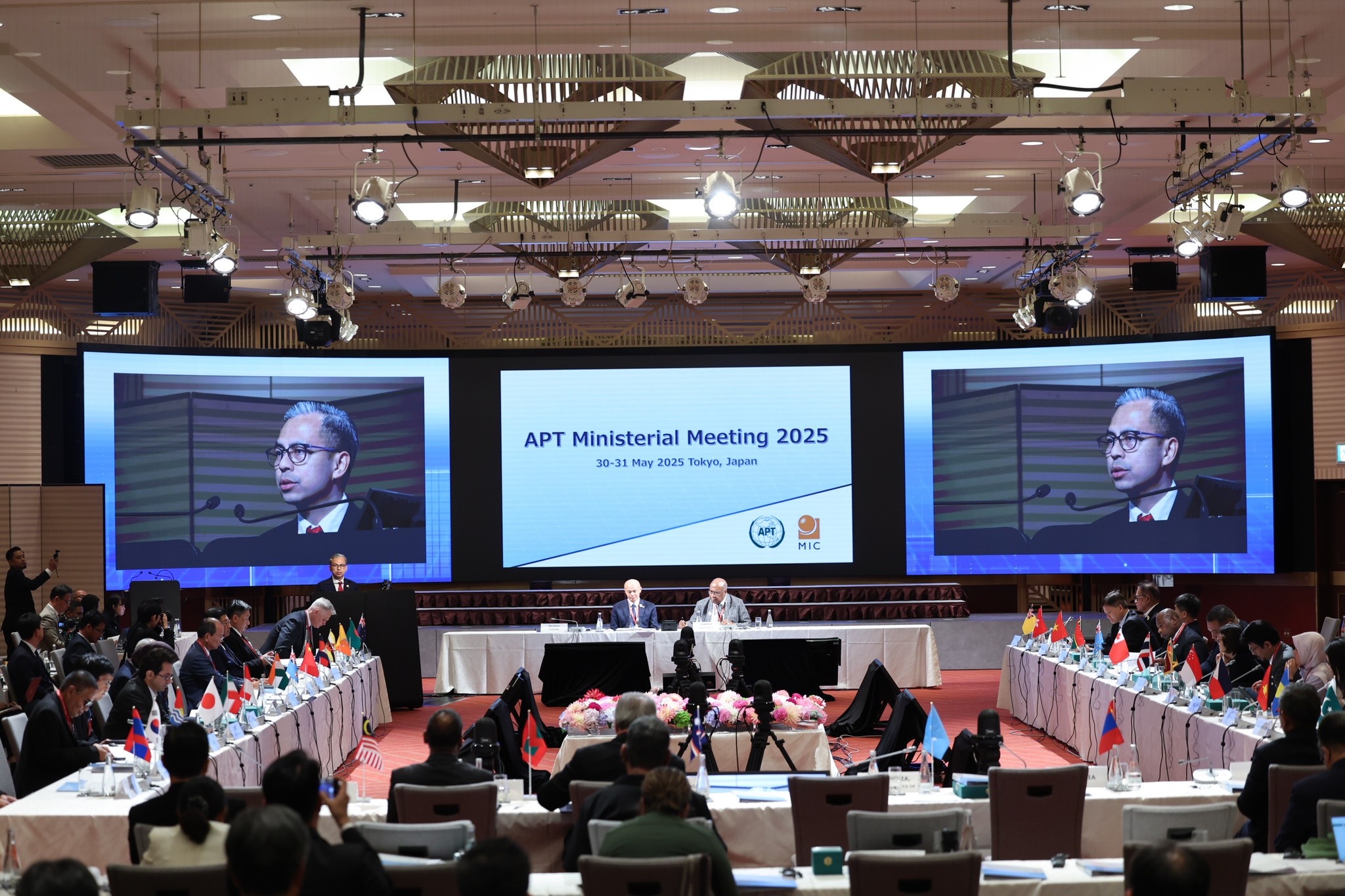
TOKYO — The Kuala Lumpur Declaration on the Safe and Responsible Use of Social Media Platforms for Asean will be formally adopted at the 47th Asean Summit in October, Communications Minister Datuk Fahmi Fadzil announced today.
He said the declaration, initiated and led by Malaysia, was endorsed during the 17th Conference of Asean Ministers Responsible for Information (AMRI) on May 7.
“Through this declaration, Asean is strengthening its collective commitment to promoting responsible online behaviour among citizens and building a people-centred, digitally resilient community,” he said in a ministerial statement delivered at the 2025 Asia-Pacific Telecommunity Ministerial Meeting (APT-MM) in Tokyo.
Fahmi also revealed that Malaysia is exploring the creation of an Asean Toolkit for Online Safety, intended to consolidate practical resources and best practices from member states to address country-specific online safety challenges.
“This toolkit will serve as a reference document for sharing knowledge and experiences, allowing member states to learn from one another and enhance regional efforts to combat fake news, misinformation, disinformation, and mal-information — all of which fuel online harm and exploitation,” he said.
To promote accountability among online platforms, Fahmi said Malaysia has introduced a Regulatory Framework for Internet Messaging Services and Social Media Providers, requiring service providers with eight million or more users in Malaysia to apply for an Application Service Provider (ASP) Class Licence under the Communications and Multimedia Act 1998.
“This policy, in effect since January 2025, ensures that major platforms comply with our national laws and assume greater responsibility in managing harmful content,” he said.
He reaffirmed Malaysia’s broader commitment to universal access, technological equity, and environmental sustainability in the digital space.
“Malaysia remains fully committed to working with regional partners to build a secure, inclusive and trusted digital environment. Through cooperation, mutual trust and ongoing capacity-building, we can ensure that no one is left behind in the digital age,” he said.
Fahmi also proposed that the Asia-Pacific Telecommunity consider holding an annual senior officials’ workshop to better understand the specific challenges faced by member states.
“This would help us formulate aligned strategies and consider legislative advancements that can change the way we confront these challenges together,” he added.
The APT, established in 1979 through cooperation between the United Nations Economic and Social Commission for Asia and the Pacific (UNESCAP) and the International Telecommunication Union (ITU), serves as an intergovernmental platform for regional collaboration in the telecommunications and ICT sectors.
This year’s APT-MM, themed “Harnessing Emerging Technologies for Sustainable, Inclusive and Equitable Digital Transformation in the Asia-Pacific”, is being attended by representatives from 31 member states and 19 affiliate members, including government agencies, regulators and private sector entities.
The meeting will conclude with the launch of the Tokyo Statement 2025 on Saturday, which will outline six regional priorities: digital relations, innovation and entrepreneurship, trust and security, inclusivity and capacity development, sustainability, and enhanced cooperation at both regional and international levels. — May 30, 2025