

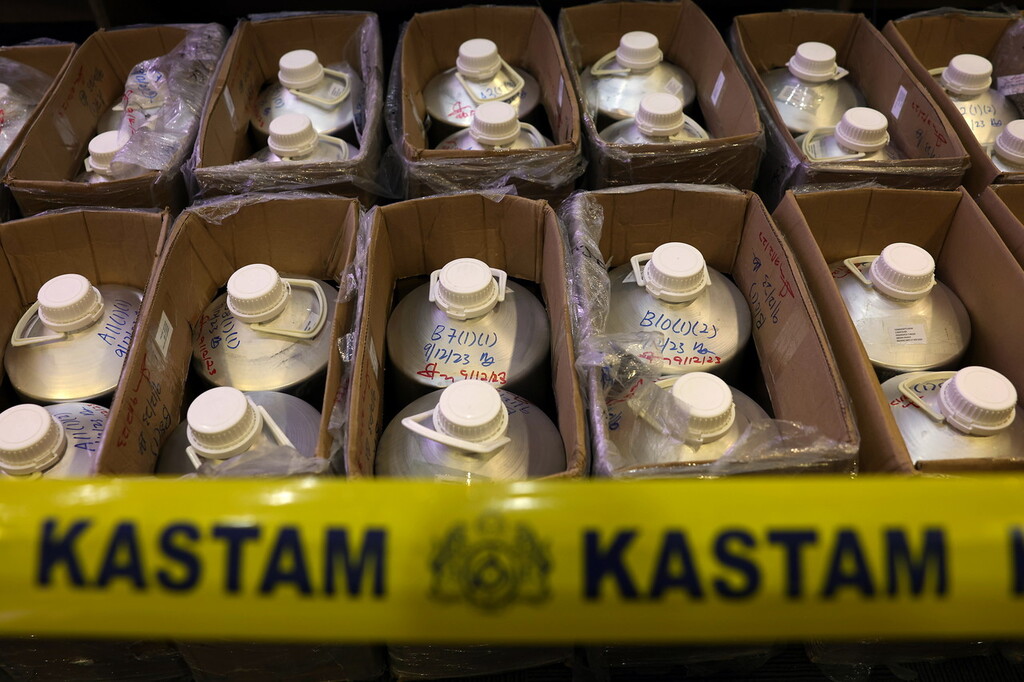

KUALA LUMPUR – Police are widening their dragnet to cover 157 districts across the country in an urgent nationwide operation to trace the spread of fentanyl — a dangerous synthetic opioid that is now making inroads into Malaysian communities.
The intensified crackdown follows a sharp spike in fentanyl-related detections in the Klang Valley and Johor, which have emerged as key hotspots in what authorities are calling an “alarming and fast-moving” drug threat.
Speaking to Scoop, Assistant Director of the D9 Narcotics Crime Investigation Department, Superintendent Dr Mohd Dazuki Mohd Sukar, said the scale of the threat is far more severe than initially believed.
“The abuse of fentanyl — what people now call the ‘zombie drug’ — is spreading like wildfire. It’s 100 times more potent than morphine, and it’s creeping into the heart of the Klang Valley and Johor,” said Dazuki when contacted.
“We’ve analysed urine samples from suspected addicts, and what we’re seeing is deeply alarming. Fentanyl is no longer isolated — it’s prevalent among those being detained, especially in these two regions.”
What began in 14 districts has now spread to nine more, with both urban and affluent areas affected.
“We’re not just talking about urban backstreets — this includes elite neighbourhoods like Bukit Tunku and Damansara, right down to Johor’s Iskandar Puteri, Pasir Gudang, and Batu Pahat.
“We’ve even found traces in wastewater samples taken from areas like Lembah Subang, Desa Aman, and Bukit Tunku. These aren’t random zones — they’re residential pockets where illicit use is strongly suspected.”
To map the extent of the crisis, police are ramping up urine testing in all 157 districts over the next 18 months in a bid to establish nationwide surveillance.
“We need a clearer picture. Our current samples are just the beginning. We’re stepping up urine collection. Within 18 months, we’ll have comprehensive national data.
“We’re factoring in cost, time, and geography. This isn’t just about blanket testing — it’s about identifying hotspots and responding with surgical precision.”
The effort is being bolstered through a strategic partnership with Universiti Kebangsaan Malaysia (UKM), providing forensic support and enabling law enforcement to conduct real-time analysis and receive scientific validation of drug presence.
“This collaboration with UKM isn’t paperwork — it’s a weapon. It enhances our detection speed, sharpens our surveillance, and helps us track drug trends with surgical accuracy.
“We’ve got over 100 types of drug tests running — fentanyl is just one of them. We’re connected to global enforcement agencies. We’re no longer playing catch-up.”
He stressed that the evidence gathered is critical for both enforcement and prosecution.
“This is not guesswork. The evidence is scientific, precise, and has real courtroom impact. But it’s not just for prosecutors — it’s also for communities. We want to arm the public with real-time data so they can intervene early — before fentanyl reaches their doorstep.”
Recent wastewater tests in the Klang Valley confirmed the presence of fentanyl in public sewage systems.
“That’s not theory — that’s fact,” he added.
Professor Dr Jaya Kumar, a senior lecturer at the University of Malaya’s Faculty of Medicine, warned that fentanyl poses a unique and insidious threat due to its potency and stealth.
“Fentanyl was developed for hospital operating theatres and severe chronic pain. It was never meant for the streets,” he said.
“Just a tiny speck can shut down your lungs, knock you out, and end your life.
“People don’t realise — they’re chasing a high, but what they’re holding is a chemical-loaded gun aimed at the brain.
“This drug doesn’t forgive. There’s no such thing as a safe dose when it’s used illegally.”
He noted that fentanyl acts rapidly and often without warning.
“It moves silently through the body and takes hold fast. What we’re facing isn’t merely a narcotic — it’s a biochemical hazard.
“Its structure keeps mutating. Variants keep emerging. The law can’t keep up with its shape-shifting form.”
Jaya warned that users are often unaware they are consuming fentanyl, as it is increasingly being mixed with heroin, methamphetamine and cocaine.
“That’s how the deaths happen. One pill. One puff. That’s all it takes.
“This isn’t a slow decline. It’s sudden respiratory failure, pulmonary oedema, liver damage, and full metabolic collapse.
“Once fentanyl enters your bloodstream, the question isn’t ‘if’ — it’s ‘how soon’,” he said.
Authorities recently seized a batch of pills suspected to contain fentanyl during a raid in Johor, after two individuals suffered overdoses believed to be linked to the drug.
Checks by Scoop in Bangsar also found police conducting public urine tests in selected areas as part of their street-level surveillance operations. — June 13, 2025