

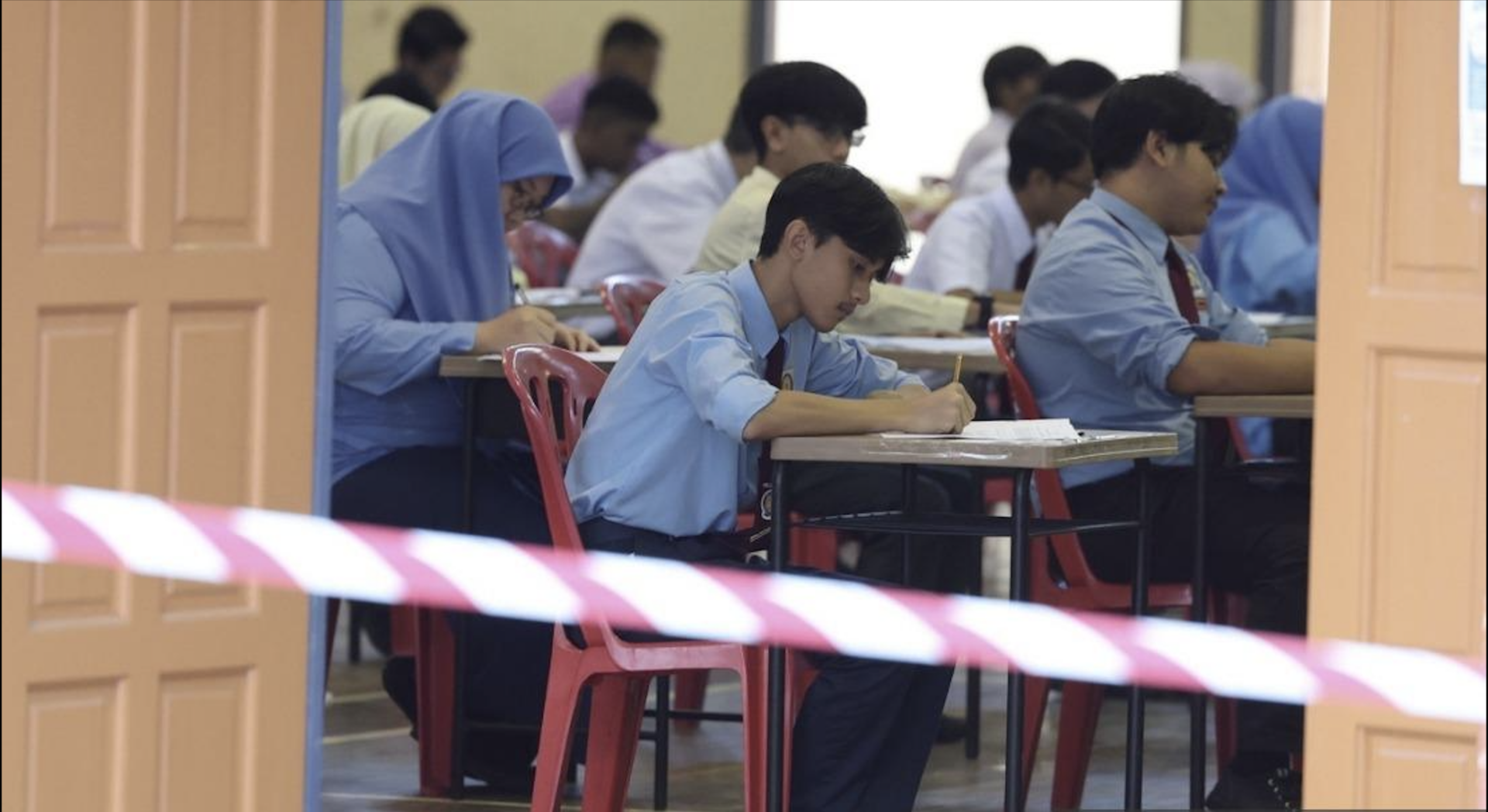

KUALA LUMPUR — “22.4% failed Mathematics? That’s not just a statistic, that’s a red flag,” said Dr Muhammad Sofwan Mahmud, senior lecturer in Mathematics Education at Universiti Kebangsaan Malaysia (UKM), warning that the alarming trend could jeopardise Malaysia’s ability to build a skilled workforce in the years ahead.
His concern comes in response to the 2024 SPM Analysis Report, which revealed that 84,025 out of 375,115 candidates failed the subject.
“It’s a sign that something is deeply wrong and needs urgent, collective action from everyone involved in education,” he told Scoop when contacted.
Sofwan said the situation is made worse by Malaysia’s declining international performance in Mathematics. According to the Trends in International Mathematics and Science Study (TIMSS) 2023, Malaysian students scored 411, 50 points lower than in 2019.
“Malaysia is not just falling behind in national exams—we’re slipping on the global stage too. In TIMSS 2023, we only scored 411 points, a drop of 50 compared to 2019. Meanwhile, countries like Singapore, South Korea and Japan are far ahead.”
He attributed the high failure rate to a chronic weakness in students’ foundational understanding of Mathematics.
“Secondary students are still struggling with basic operations—addition, subtraction, multiplication, division, fractions, percentages—even simple algebra. When they’re already confused about the basics, how do we expect them to grasp more advanced content?”

These weaknesses, he said, are often left unaddressed in early education, causing the learning gap to widen as students progress through school.
“Then we throw in HOTS—Higher Order Thinking Skills—into the mix. But how can they think critically when the basics aren’t even there? It becomes a burden, not a challenge. A pressure, not an opportunity.”
Sofwan called for regular curriculum reviews to ensure the Mathematics syllabus stays relevant and aligned with both technological advancements and real-world needs.
“The syllabus is too packed and introduces abstract concepts too early. Worse, it doesn’t keep pace with technological change or reflect what the working world actually requires. Students often ask, ‘How is this useful in real life?’ That disconnect is at the heart of the problem.”
He stressed that reform must go beyond content and include teaching methods, assessment models, and pedagogical support tailored to different learning styles.
“There’s no one-size-fits-all approach to learning maths. Everyone has their own style. But what works best, for most, is something fun, concrete, and relevant to their lives.”
“Maths isn’t just about memorising formulas or doing repetitive drills. It should nurture logic, creativity, and problem-solving.”
To that end, he advocated for the use of games, visual aids, simulations, and collaborative learning as tools to make mathematical concepts more engaging and accessible.
Crucially, Sofwan stressed that Mathematics education must start early.
“All of this doesn’t start in Form 1—it starts in preschool. That’s when children should be introduced to numbers, patterns, shapes and measurements through daily activities and play.”
“Learning maths early doesn’t mean formal lessons. It means consistent, positive exposure in a fun environment. That’s how you build confidence and long-term interest.”
He warned that the implications of widespread failure in Mathematics extend beyond the classroom, limiting students’ access to higher education and professional fields.
“Failing maths isn’t just an academic issue. It affects a student’s entire future. Without a pass in maths, a lot of doors to higher education and professional careers slam shut.”
“More worryingly, if we don’t fix this, Malaysia will struggle to meet future demand for STEM-related jobs. Today’s failure in Mathematics could lead to tomorrow’s shortage of skilled workers.” — June 15, 2025