

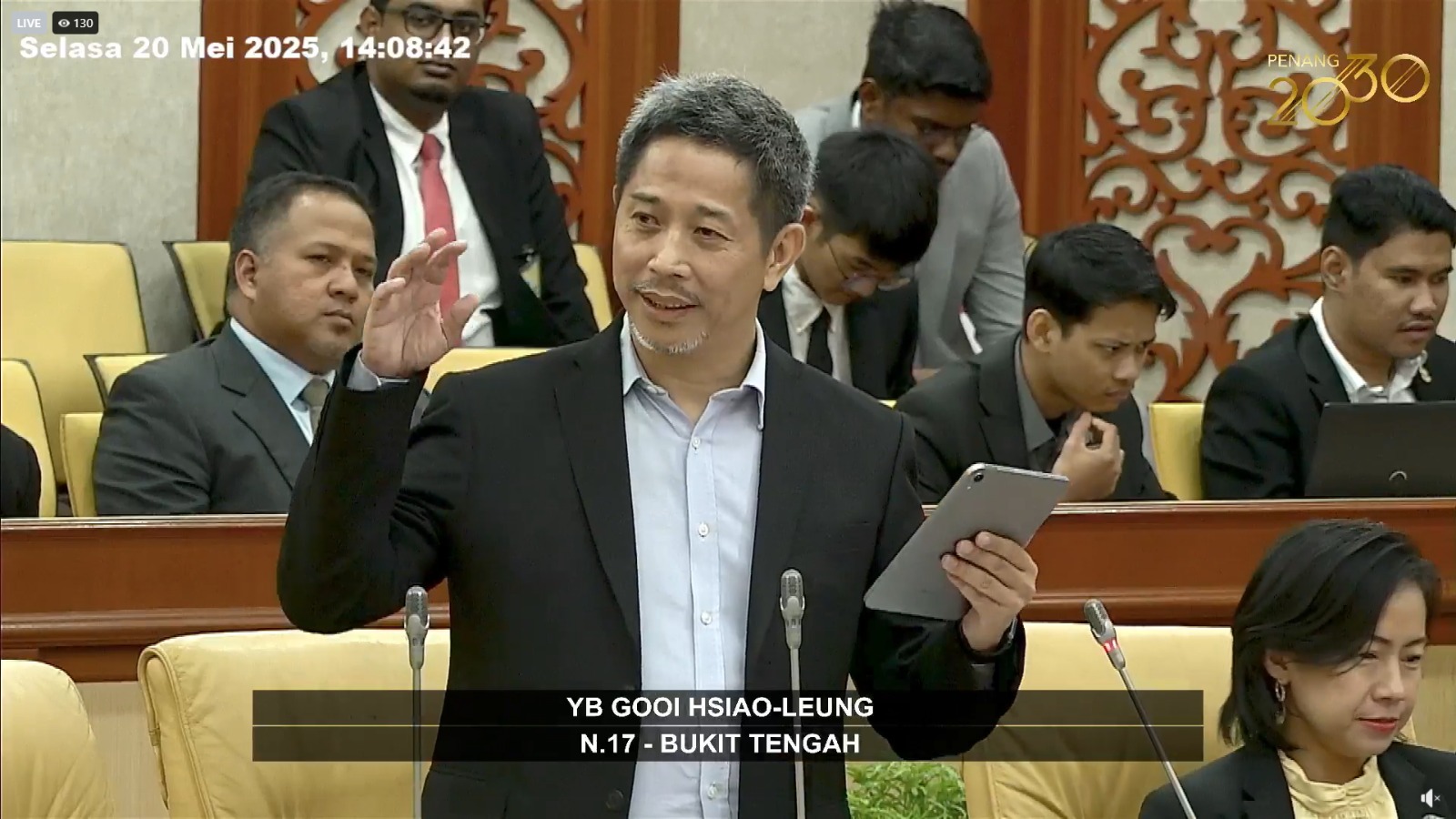

GEORGE TOWN – Amendments to the Federal Constitution and the creation of an inter-state working group, comprising like-minded states, could help pave the way for a minimum tax revenue-sharing formula between the federal and state governments, Bukit Tengah assemblyman Gooi Hsiao Leung has said.
Gooi, a lawyer by training, has long argued that Penang should be fairly compensated for its outsized contributions to the national economy through a transparent revenue-sharing model that reflects the state’s economic output.
He urged Putrajaya to guarantee a minimum share of revenue from the sales and services tax (SST) to the states, calculated according to each state’s contribution to the national gross domestic product (GDP). He said this would help redress the limited fiscal autonomy states currently face.
Speaking to Scoop, Gooi said a rules-based, equitable framework could be institutionalised through constitutional amendments — specifically to the Ninth and Tenth Schedules.
The Ninth Schedule outlines the legislative powers of the federal and state governments, as well as concurrent areas of lawmaking. The Tenth Schedule, meanwhile, governs the distribution of financial resources, including capitation and special grants to states.
“These amendments should include provisions for a minimum guaranteed fiscal transfer, a new formula for revenue sharing, and the establishment of a national fiscal commission to periodically review state allocations,” he said.
“It is a major reform, yes — but achievable with the right political will.”
On the idea of an inter-state committee, the former Alor Setar MP noted that many states shared Penang’s frustration over fiscal imbalances and the centralisation of financial control.
He proposed that states form working groups or forums to coordinate their positions and respond collectively to federal-state issues.
“Greater engagement between states can promote the spirit of federalism, improve governance and strengthen national unity,” he said.
Gooi’s remarks follow a recent Scoop article in which academic Tricia Yeoh and tax lawyer S. Saravana Kumar proposed fiscal decentralisation to address Penang’s longstanding concerns of being shortchanged by Putrajaya.
Yeoh also suggested that the federal government revisit other tax-sharing mechanisms, including the tourism tax revenue-sharing model introduced during the first Pakatan Harapan administration.
However, she cautioned that Putrajaya may be reluctant to share SST revenue due to its significance to federal coffers.
Gooi acknowledged that tourism tax revenue-sharing was already in place but said it remained inadequate, especially considering Penang’s role as a top tourist destination.
He pointed out that nationwide tourism tax revenue amounted to just RM186 million in 2023, in stark contrast to the billions generated annually through SST.
“Tourism tax revenue-sharing can be part of the solution, but it cannot replace the need for broader and fairer revenue-sharing reforms,” he said. “What we need is a clear, formula-based system that reflects each state’s economic contribution.”
‘SST expansion on 1 July’
With the federal government set to broaden the scope of SST from July 1, Gooi questioned how much tax would be collected from each state — and how much would be returned to support local development.
He urged the government to publish a detailed, state-level breakdown of SST revenue to enable more transparent and informed fiscal discussions between federal and state stakeholders.
“If the SST expansion is truly aimed at improving the quality of public services, as announced by the federal government, then why not empower Penang and other states to deliver them more effectively through direct revenue-sharing?” he said. – June 15, 2025