

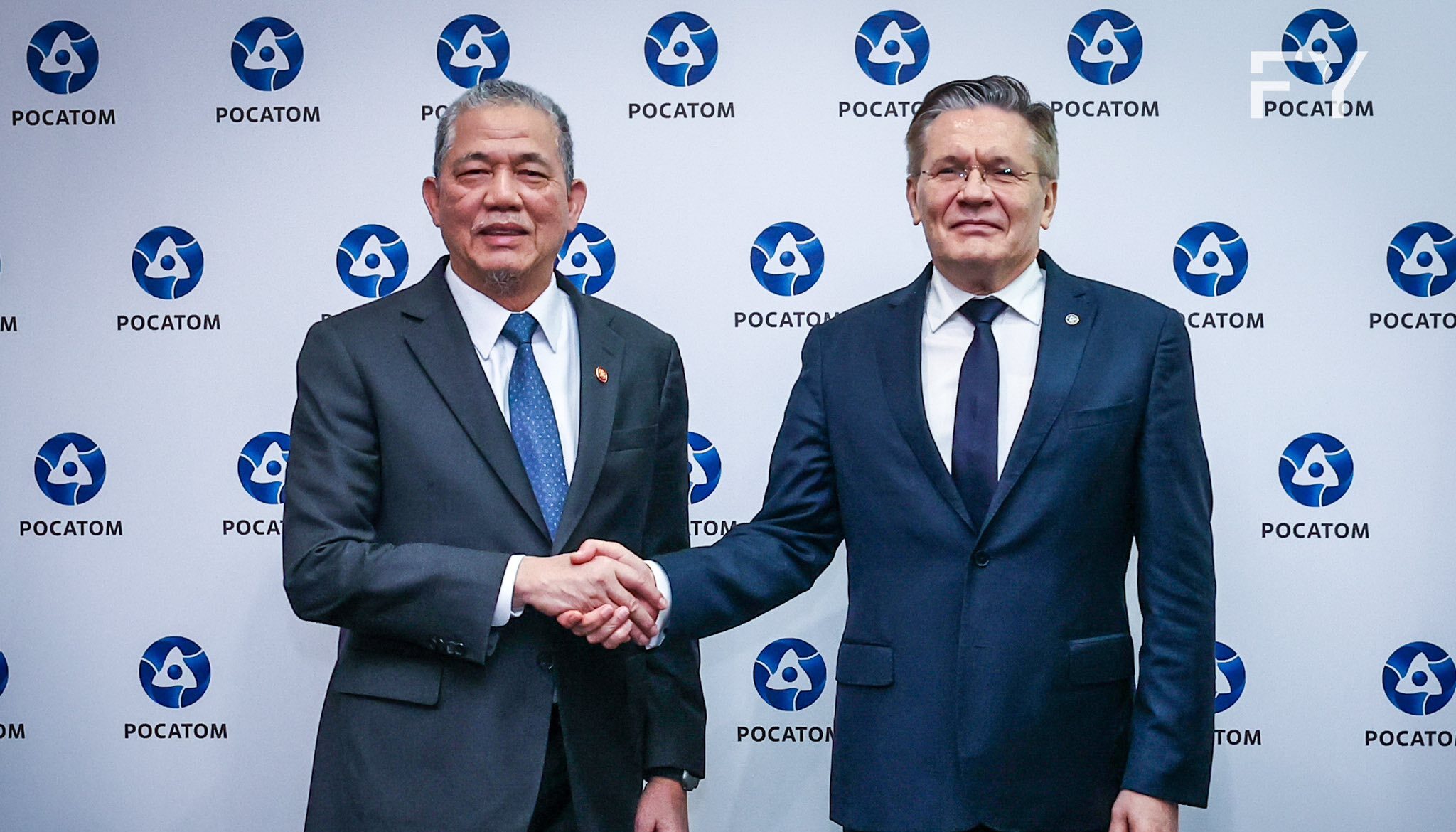
MOSCOW — Russia has agreed to continue supporting Malaysia’s efforts to build capacity in nuclear energy development, covering institutional, technical, legal, commercial, and human capital aspects, Deputy Prime Minister Datuk Seri Fadillah Yusof said.
Fadillah, who is also the Minister for Energy Transition and Water Transformation, said Russia’s vast experience in the peaceful use of nuclear energy should be considered as Malaysia works to enhance its future energy security under the National Energy Transition Roadmap.
“One of the key objectives of this visit was to strengthen energy cooperation between Malaysia and Russia,” he said at a press conference in Moscow late last night, marking the end of his four-day working visit to the country.
He said that in addition to ongoing collaboration in coal imports, discussions with his Russian counterpart, Deputy Prime Minister Alexey Overchuk, had explored potential cooperation in nuclear energy development.
On Friday, Fadillah met with Alexey Likhachev, director-general of Russian state nuclear corporation Rosatom, where talks focused on technology transfer, legal frameworks, operational matters, and training.
“This meeting has opened the door for direct engagement between Malaysia’s technical agencies and Rosatom to identify suitable areas of cooperation. These include the modernisation of our power grid, which could also benefit broader regional efforts such as the ASEAN Power Grid,” he said.
He noted that the Malaysian Cabinet had, in principle, approved the consideration of nuclear energy as part of the country’s future energy mix.
“This is necessary to address our limitations in baseload energy supply. We are working to reduce dependence on coal and gas, but alternatives remain limited. Water resources, for example, constrain further hydroelectric expansion,” he said, adding that nuclear power was increasingly seen worldwide as a viable option.
However, Fadillah stressed that any move towards nuclear energy must be based on a comprehensive study and public engagement.
“Public support is crucial. The process must involve various ministries, agencies, and NGOs to clearly communicate the issues. Only after an international agreement is signed and accepted by the public can this initiative proceed. This is the first step in that direction,” he said.
In addition to energy, Fadillah said Malaysia and Russia would work to deepen bilateral economic cooperation across several key sectors, including halal products, agriculture, food security, and digital industries.
Despite Russia’s large economy, bilateral trade between the two countries remained modest in 2024, with total trade reaching RM11.46 billion (US$2.48 billion), placing Russia ninth among Malaysia’s trading partners in Europe.
Malaysia’s major exports to Russia include electrical and electronic products, machinery and equipment, and processed food.
Fadillah said he had invited Russian companies to invest in Malaysia, particularly in strategic sectors such as aerospace, agrotechnology, energy, ICT, the digital economy, Islamic finance, and the halal industry.
He also proposed enhancing cooperation in agriculture through joint research and development in fertilisers, pesticides, agro-engineering, and food technologies.
On education, he conveyed Malaysia’s appreciation for Russian scholarships and suggested expanding them to cover emerging fields such as artificial intelligence, big data, and information science.
Touching on tourism, he said Malaysia welcomed a proposal for direct flights between the two countries, which is expected to be finalised soon.
However, he acknowledged that financial transaction issues had been a concern for Russia and assured that Malaysia, through agencies including Bank Negara Malaysia, would work to facilitate smoother cross-border payments.
“I will present the outcomes of this visit to the Cabinet. In shaa Allah, I believe Malaysia–Russia cooperation will continue to flourish and bring tangible benefits to both our nations,” he said.
Fadillah’s visit to Russia follows Prime Minister Datuk Seri Anwar Ibrahim’s official trip to the country in May, which aimed to explore new areas of cooperation and strengthen existing ties. Fadillah also visited Uzbekistan from 21 to 24 June prior to arriving in Moscow. — June 28, 2025