

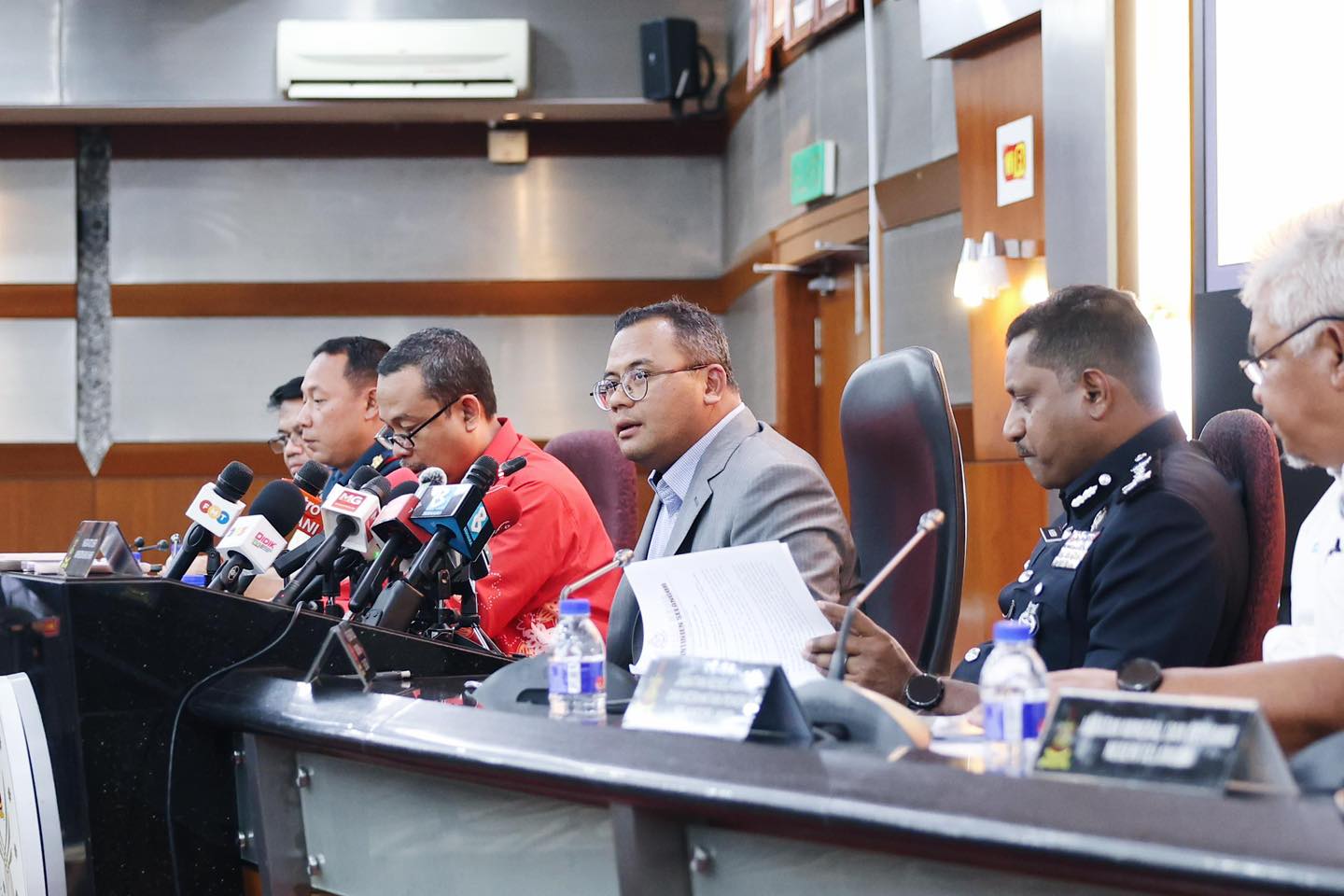
SHAH ALAM – Investigations into the gas pipeline explosion at Putra Heights on April 1 have concluded that the incident was not caused by sabotage or negligence, but rather by long-term ground subsidence, Selangor Menteri Besar Datuk Seri Amirudin Shari said today.
Citing findings from the multi-agency technical team, Amirudin said the gas pipeline experienced a ground settlement of 24.3 centimetres over the past 25 years since it was commissioned in 2000.
“The Royal Malaysia Police found no evidence of sabotage or negligence contributing to the incident,” he said at a press conference at the Selangor state secretariat.
Also present was Selangor police chief Datuk Hussein Omar Khan.
The investigation was led by the Department of Occupational Safety and Health (DOSH), alongside the Department of Minerals and Geoscience (JMG), Public Works Department (JKR), Fire and Rescue Department (JBPM), and police.
Amirudin said the inquiry focused on pipeline integrity, external factors, and the site’s geological conditions. The findings revealed the ground movement had displaced the gas pipeline by 15.9cm.
“This was confirmed through pipe sampling which showed signs of stress and fatigue within the pipeline’s structure.
“JMG also determined that the area had high water saturation and natural underground water reservoirs, which softened the surrounding soil,” he added.
Although the pipeline adhered to the required technical standards, investigators found that environmental factors had compromised its integrity.
“These included unstable soil conditions, long-term groundwater accumulation, damaged monsoon drains and culverts due to shifting soil, and added pressure from climate conditions and increasing population density.
“The team concluded that subsurface environmental factors were the root cause of the pipeline failure, which led to metal friction and ultimately sparked the explosion at 8.08am on April 1,” Amirudin said.
In response, the state government will set up a special committee under the State Disaster Management Unit to work with experts including Petronas.
“This report will serve as a foundation for future risk assessments in similar areas.
“The committee will also propose legal reforms, planning approval procedures, and development policies that consider climate risks and all gas pipeline Right-of-Way zones.
“This is critical to strengthening safety measures in Putra Heights and similar areas to prevent such horrific incidents from happening again,” he said.
Earlier, the Department of Occupational Safety and Health confirmed that the lower portion of the pipeline had lacked support due to moist and soft soil, leading to structural failure and gas leakage. The leaked gas then ignited, causing the explosion.
Petroleum Safety Department director Husdin Che Amat said metallurgical analysis pointed to tensile overload as the main cause, with gradual wear and fatigue causing the pipe to rupture.
“In conclusion, the failure occurred because the soil could not adequately support the pipeline’s weight and pressure, which triggered the leakage and explosion,” he explained.
Selangor police chief Hussein also confirmed that the blast was not criminal in nature and said investigations had been carried out under Sections 435, 285, and 286 of the Penal Code, focusing on potential negligence and contractor activity in the area.
The explosion triggered a massive fire, with flames reaching over 30 metres high and temperatures soaring to 1,000 degrees Celsius. It left a 9.8-metre-deep crater at the site and took nearly eight hours to fully extinguish.
The blast damaged 219 homes, with 81 suffering structural damage of more than 40 per cent. Over 500 residents were evacuated, and some whose homes were destroyed have yet to return as rebuilding is expected to take up to two years. – June 30, 2025