

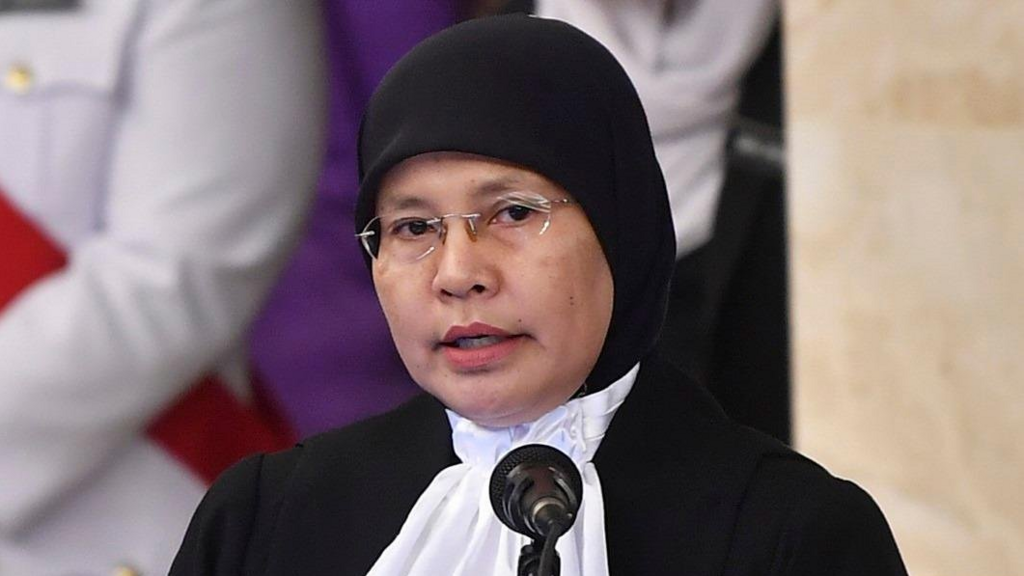
KUALA LUMPUR – Outgoing Chief Justice Tun Tengku Maimun Tuan Mat is scheduled to preside today over the appeal of seven men convicted of murdering Deputy Public Prosecutor Datuk Anthony Kevin Morais, marking the final sitting of her term as Malaysia’s top judge.
The hearing brings to a close a nearly six-year tenure that has seen the judiciary take centre stage in a number of politically and constitutionally significant decisions. Tengku Maimun, appointed in 2019, was the first woman to hold the position. She retires upon reaching the mandatory age of 66.
Her departure has drawn debate over the judicial appointment and extension process, with some observers noting alleged inconsistencies in how term extensions are applied to Federal Court judges.
Debate over extensions
Tengku Maimun’s tenure received both support and criticism, as she faced public and political scrutiny—especially over rulings on religious or sensitive issues.
In a previous interview, she noted that her husband had been singled out in attempts to discredit her, including efforts to push for her recusal in certain cases.
Critics said she went too far in religious cases, while supporters believed she followed the Constitution.
She often defended her decisions as grounded in law, saying: “I would not bend or bow to any person, no matter how high and mighty.”
Under Article 125(1) of the Federal Constitution, Federal Court judges may receive a six-month extension beyond retirement age, subject to the King’s consent. While four judges nearing retirement are reportedly receiving such extensions, Tengku Maimun and Court of Appeal President Tan Sri Abang Iskandar Abang Hashim have not.
The contrast has raised concerns among legal and political observers. The Bar Council, and MPs Rafizi Ramli and Ramkarpal Singh are among those calling for Tengku Maimun’s term to be extended, citing the need for continuity and public confidence in the courts.
Others have questioned the rationale for extending the terms of several judges while allowing the top two judicial posts to lapse without explanation.
Significant rulings
During her time on the bench, Tengku Maimun was involved in a number of notable decisions:
SRC International appeal (2022)
She led the panel that upheld former prime minister Najib Razak’s conviction, issuing a judgment that criticised delay tactics and reaffirmed accountability in public office.
Kelantan Shariah Criminal Code case (2024)
The Federal Court invalidated 18 provisions of the state’s Shariah law for exceeding federal legislative authority.
SIS Forum v Selangor Fatwa Committee (2025)
The court held that fatwas cannot be imposed on companies, delineating the limits of religious authority under civil law.

Unilateral child conversion case (2024)
In a case involving the conversion of minors, the court ruled that consent from both parents is required, a decision widely discussed in interfaith and legal circles.
Karpal Singh sedition dissent (2019)
Tengku Maimun dissented in the sedition case against the late MP, arguing for stronger protections on political speech.
Legal approach
In speeches and judgments, Tengku Maimun often stressed that all institutions, including religious bodies, must follow the Constitution, and believed that upholding precedent was key to legal consistency.
In her 2025 Opening of the Legal Year address, she urged the judiciary to avoid arbitrariness by adhering to precedent, arguing this was key to maintaining the courts’ legitimacy.
She also stressed the importance of freedom of expression in the context of judicial independence. While recognising the public’s right to question the judiciary, she warned against personal attacks that could undermine public trust.
Though not directly involved in the high-profile M. Indira Gandhi ruling, she often cited the case as a reference point in her opinions. The ruling affirmed civil court authority in matters of constitutional rights, particularly involving religion.
Her last case—the Morais appeal—holds symbolic resonance, revisiting a high-profile murder of the public prosecutor linked to high-profile corruption cases. – July 1, 2025