

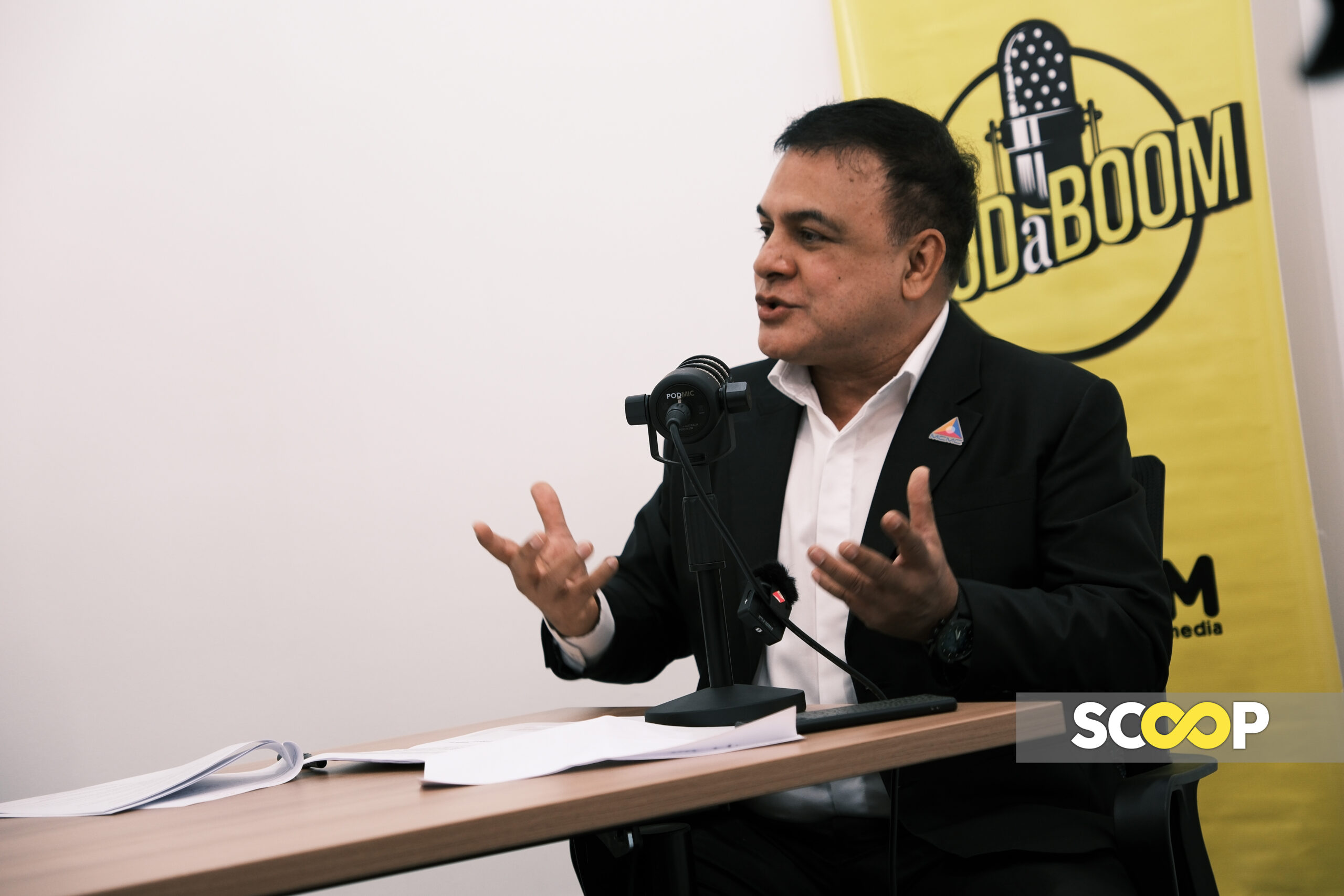

KUALA LUMPUR – Smartphones may be convenient, but they were never meant to serve as digital wallets – and when it comes to online payments, credit cards offer a crucial layer of protection that debit cards simply do not, said Malaysian Communications and Multimedia Commission (MCMC) Commissioner Derek Fernandez.
Speaking on the Scoop Insight podcast recently, Derek, who is the MCMC’s Online Harms and Information Security Committee Chairman – urged the public to take online safety into their own hands, beginning with a smarter approach to digital payments. His key advice: avoid using debit cards for online transactions.
“Try to use a credit card instead of a debit card (for online purchase transactions),” he said. “I know, people don’t like me to say this, but the reason is this: Credit card companies are what they mean and called – they extend credit. In other words, technically they lend you the money… and because they are advancing their money, their level of security is much higher.”
Derek – who spoke on the podcast hosted by Big Boom Media and Podaboom Head of Podcasting, Shazmin Shamsuddin, and Scoop News Editor, A. Azim Idris – explained that in the event of fraud, credit card users are far less likely to face immediate financial damage.
“If they lose that money, and you say ‘I did not do it. It’s not me’, a dispute would have to arise. However, in a debit card situation, it’s gone,” he said.
“You will get in a situation where it hurts you. You will see your accounts empty, whereas with the credit card, you won’t see an empty account – you will see a bill to say ‘pay back the balance’.”
He added that credit card companies have heavily invested in behavioural analytics and fraud detection technologies to minimise risk, but warned, “Technology is growing, but please bear in mind there is no 100% here.”
Derek also cautioned against over-reliance on smartphones for financial activity, emphasising the vulnerabilities of mobile devices.
“Sadly, most people do not know that smartphones were never really designed to serve as a wallet. And no matter what people tell you, it’s not a wallet,” he said.
“It was designed as a communication tool… to be able to get you to buy things. So when you design a building with 74 doors, don’t expect to be able to keep gold there very safely. Every time you open an app, you open a door.”
He urged consumers to set up separate bank accounts to reduce the impact of any potential breach.
“Go to the bank and open an account, and disallow any electronic transfers out of the account. You fence that account,” he said. “You then have another account with a certain limit and you keep your digital payments in that account.”
“In the worst case scenario, malware had gone into your smartphone and they drain your account… maybe your exposure is RM3,000 or RM5,000.”

‘Internet Selamat’ (Internet Safety) campaign
Derek’s advice comes as the MCMC ramps up its Internet Selamat campaign – a nationwide initiative launched in January this year to tackle the growing threat of online harms, including scams, fraud, cyberbullying and child grooming.
“The government has realised that the problem is quite serious – and it’s not only in Malaysia. It’s in every country in the world,” he said. “We’ve had to remove some 60,000 suspected scam and fraudulent activities last year. And to date, this year, there are 35,000 of such attempts.”
He said the campaign takes a multi-layered approach, with public awareness forming the first and most crucial line of defence.
“The first and most important layer involves every one of you out there… whether it amounts to cheating you off your money, cyberbullying you, getting you to harm yourself, or getting you to consume drugs – all of it begins with the ability to get into your mind and letting the criminals do what they want you to do.”
The campaign has so far trained over 33,000 students in 256 learning institutions, including schools in Bintulu, Langkawi and Pulau Pinang. More engagements are scheduled in the coming months at both school and university levels.
“We are hoping to get 10,000 schools involved,” Derek said.
“We’re dealing with universities… we’ve gone to schools like Sekolah Kebangsaan Kuala Nyala in Bintulu, Sekolah Kebangsaan Ulu Melaka in Langkawi, Sekolah Menengah Pendidikan Limbong in Pulau Pinang and so on.”
He said the campaign pays particular attention to the youth, as they are most vulnerable to cyberbullying and child sexual abuse, while older Malaysians tend to fall victim to love scams.
“We need to start at the school age so that they go through school and they learn this as part of their curriculum on online safety,” he said.
Derek noted that understanding how people interpret and respond to online information is a key part of the fight against online threats.
“Everybody responds differently,” he said. “I may say something right now and five or six of you will interpret it differently from what I intended – so everybody has a way of processing information, and everybody responding to that information is different.”
The Internet Selamat campaign, he stressed, is just the beginning.
“This is a national campaign and we will continue to reach as many targeted groups as possible.” – July 15, 2025