

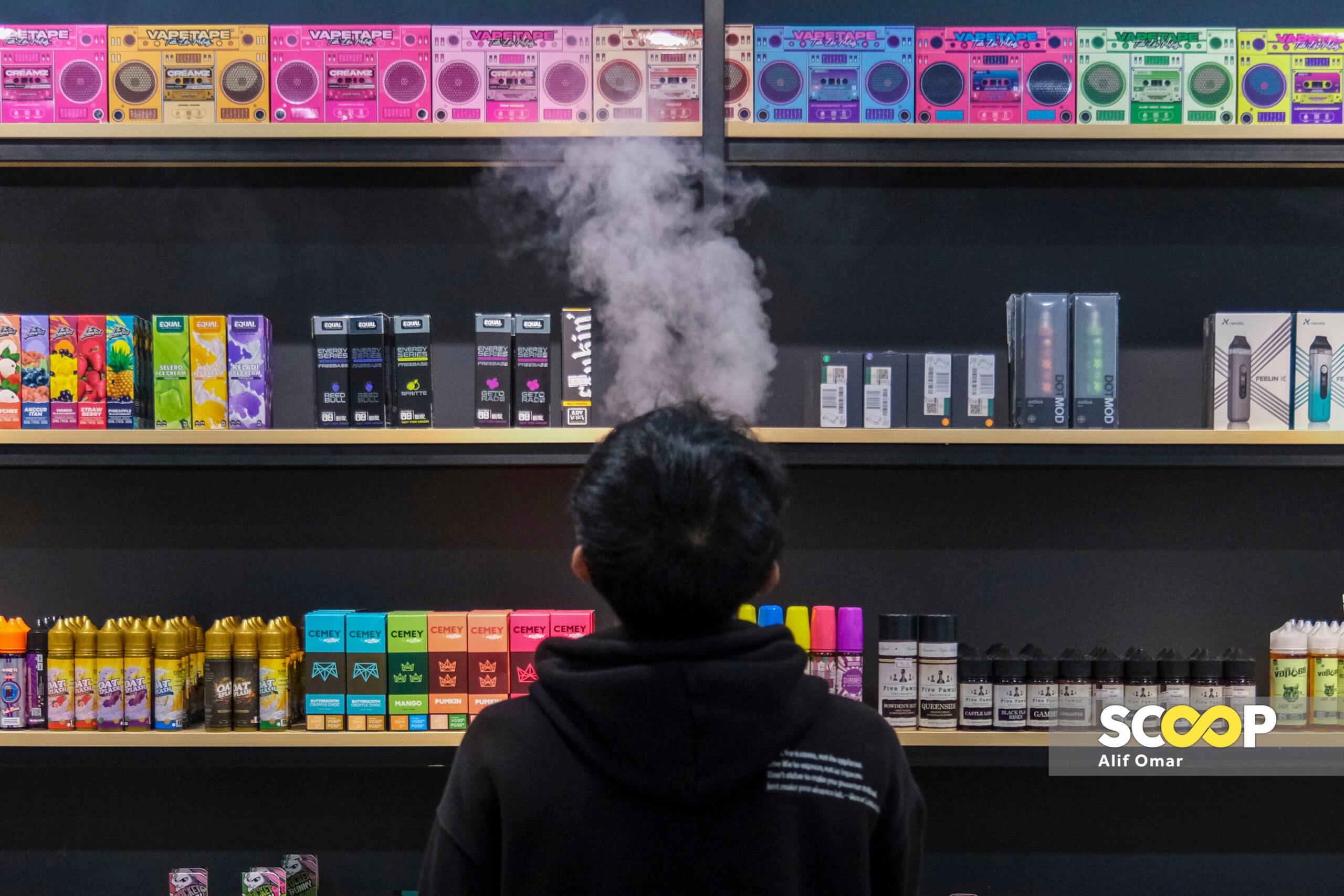

KUALA LUMPUR – A blanket ban on vape products would open the floodgates to an even bigger black market, flooding the country with untested and dangerous products while sidelining law-abiding businesses, according to industry and health experts.
Industry players warn that a ban would not only hurt legitimate vendors but also worsen public health outcomes by pushing consumers towards unsafe, unregulated products.
Health experts echo these concerns, saying prohibition could backfire – spurring addiction, weakening enforcement efforts and ultimately fuelling a thriving illicit market that’s harder to police.
Speaking to Scoop, Malaysian Organisation of Vape Entity (MOVE) president Samsul Kamal Ariffin said history shows that prohibition does little to curb demand and instead hands the market to illegal operators.
“Banning vapes will only lead to an increase in the black market for vape products, which are not tested for safety. A total ban will cause the black market for these products to grow, and untested and unsafe products will become easily accessible, further worsening public health conditions,” he said when contacted.
Samsul added that regulated vaping remains a valuable harm-reduction tool for smokers.
“International studies, including those by Public Health England, show that vaping is about 95% less harmful than smoking.
“The real issue lies with a small group of irresponsible individuals who mix foreign substances such as THC into vape liquids. Regulation in manufacturing, sales and usage must be implemented as soon as possible.”
Universiti Kebangsaan Malaysia community health specialist Dr Sharifa Ezat Wan Puteh said black markets thrive where enforcement is weak, and bans typically make the problem worse.
“Most bans don’t work when enforcement and policing are compromised. Many countries have tried, but black markets always survive due to high demand and limited enforcement budgets. In the end, legitimate vendors who follow the rules are the ones who suffer,” she said.
“If vaping is banned, many users are likely to revert to smoking, particularly black-market tobacco, which is cheap, easily accessible and delivers a stronger throat hit. Black markets will flourish, and abuse will continue unless demand drops significantly and enforcement is robust.”
She called for a framework of strict regulation to protect users and limit illegal sales.
“Effective strategies used abroad include specialised vape stores, vendor registration, profiling of all products sold, and mandatory toxicology checks for vape liquids.
“Other measures involve limiting flavours and colourings, banning sales near schools or communal areas, making liquid nicotine prescription-only, and prohibiting disposable vapes.”
Dr Prem Kumar Shanmugam, founder and CEO of Solace Asia, said prohibition historically strengthens illicit markets.
“Banning has never been a real solution. History shows that prohibition only makes people more curious, and some end up hooked. Addiction is a chronic, relapsing brain disorder – you can’t simply stop it, but with the right approach, people can manage it and get better,” he said.
“Banning vapes without proper awareness or enforcement risks fuelling an even larger black market, just as higher cigarette taxes never stopped smokers but instead drove them to illicit products.”
Prem urged the government to focus on education, regulation and sustainable recovery rather than scare tactics.
“We need to inform the younger generation about the real dangers of adulterated vape products, introduce proper vendor controls, and strengthen enforcement to keep illegal products off the streets.”
The experts’ remarks follow renewed calls by the Sultan of Pahang, Al-Sultan Abdullah Ri’ayatuddin Al-Mustafa Billah Shah, for an immediate nationwide ban on vape sales, citing their harmful effects and the risk of vaping becoming a gateway to drug abuse among youths.
Several states, including Johor, Terengganu, Kelantan and Penang, have already introduced their own restrictions, but a federal-level policy has yet to be implemented.
According to the Global Adult Tobacco Survey (GATS) Malaysia 2023 by the Institute for Public Health under the Ministry of Health, the majority of vape users are aged between 15 and 24 years.
It was reported that a 16-year-old girl died of acute heart failure linked to E-cigarette or Vaping Product Use-Associated Lung Injury (Evali), and a two-year-old child suffered long-term neurological complications after ingesting vape liquid.
As of mid-June 2025, the Ministry of Health had reported 17 cases of Evali nationwide.
It was also reported that the cost of treating vape-related illnesses could reach RM369 million annually by 2030, nearly offsetting the projected vape tax revenue of RM500 million. – July 25, 2025