

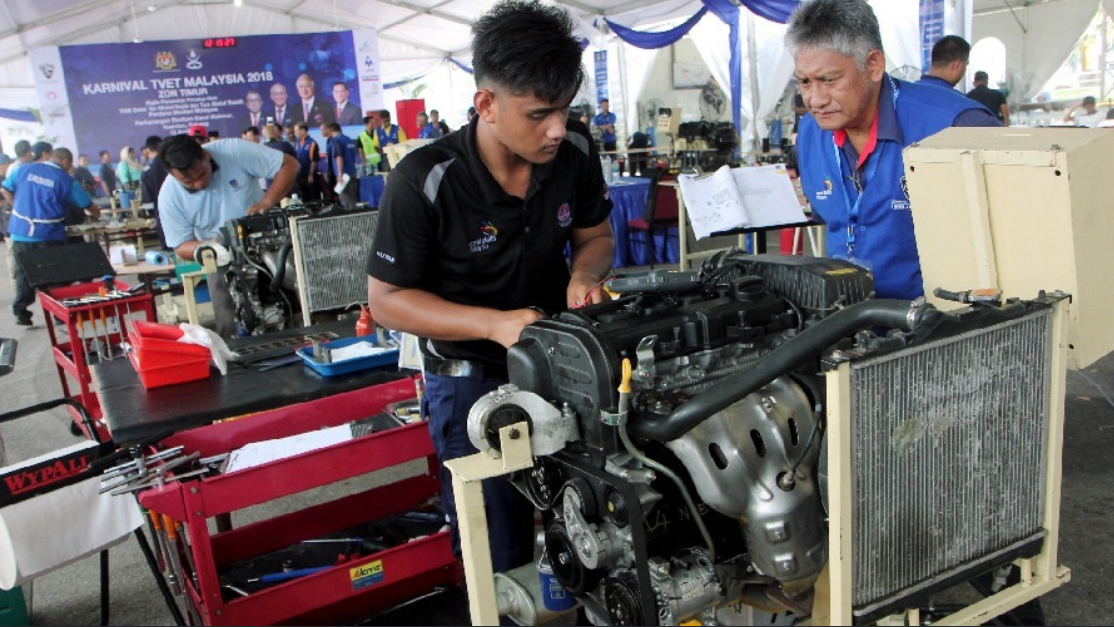
THE Government’s emphasis for technical and vocational training in order to improve workers’ productivity and also graduate employability is a step in the right direction. It would have been better if the initiatives towards that end was carried out much earlier.
This is in line with the need for industrial restructuring and skill development in line with the objectives of our long term industrial plan. It also falls in place with the evolution of our work force nomenclature from labour to human resources and to human capital and now to talent management.
While the word labour may send the connotation of mere factor of production, human capital implies the embodiment of creativity and innovations, in addition to acquisition of high level skill. Being a talented person gives the impression of high performance and one who is sought over by many firms including global establishments.
Given our pursuit for high tech industries in order to create more value-added firms and high skilled jobs in the country, in support of other objectives such as income acceleration among our work force, the Government’s development efforts to enhance skill and talent as well as productivity deserve much support by the society.
In the recent past we have created jobs in the manufacturing sector, especially in the electrical and electronics industries, thus contributing to significant reductions in unemployment levels. However, the jobs so created are mainly in the nature of unskilled and semi skilled jobs to suit industries related to assembling operations then.
Now the nature of electronics industries are mainly semi conductors to cater for high end electronics which may soon demand more design based electronics engineers to be located in Malaysia, from industries from China, Taiwan, USA, and Europe.
The recent interest in relocating industries is aided by some geopolitical developments and supply chain changes that lead to large industrial approvals by our industrial promoting agency, MIDA.
Creating a culture of high performance and a readily acceptance of high technology has to start from early schools where innovations and designing interests are encouraged and promoted. In a way this is slowly being done now especially in the area of robotics where primary schools students are exposed to this interest.
The initiative like this should be widely encouraged in all schools especially in the rural areas and other remote areas. The idea is to ensure that children’s interest in science and technology is strongly encouraged and such interest is not strange to the society as a whole.
In addition to the need for all efforts geared to create skilled and talented Malaysians to support industrial restructuring and income acceleration, it is also critical to our endeavour to achieve our higher income levels or return to labour which in total barely achieve 35% of GDP compared with over 42% for Singapore and South Korea and over 55% for Europe.
These concerns are captured in the academic expression of the contribution of the third factor productivity or TFP which is the contribution of all elements, other than labour and capital. In includes quality of manpower, better organization and management, and role of innovations and creativity (R&D) and others.
Some earlier studies have shown that the contributions of TFP to developed countries such as Germany and Japan are above 60%, while Malaysia’s is about 35%, to the increase in GDP.
In other words Malaysia has to always inject more capital and labour to enhance productivity, while in Japan and Germany, the inertia of the existing factors alone can raise productivity with some reorganization and innovations.
This is where the Malaysia Madani call by the Government hits on the head of all development initiatives, to make all stones unturned in the efforts to raise productivity and quality including improving governance and reducing corruption.
We have tried to improve our TFP by efforts such as the TVET programme, the initiatives of NPC to enhance our performance at establishment level, reduction of unnecessary public sector bureaucratic procedures some of which may be already archaic (as was done by PEMUDAH at the behest of Tan Sri Sidek Hasan, former Chief Secretary), and better communication.
Having said all these, and critical as they are, the other consideration that remains to be penned is the mindset of private sector employers towards all these efforts to achieve a high income nation status.
Innovations and technological deepening accompanied with a higher wage for skilled and trained workers, must be carried out as we move towards greater digital economy and use of Artificial Intelligence (AI).
Let us achieve the policy of high wages through the progressive wage system so that the element and embodiment of human capital in and among our workers is recognized and sufficiently compensated to allow them to live a better quality of life whilst phasing out our dependence on foreign workers.
Tan Sri Dr. Sulaiman Mahbob is an Adjunct Professor at the International Institute of Public Policy and Management (INPUMA), Universiti Malaya