

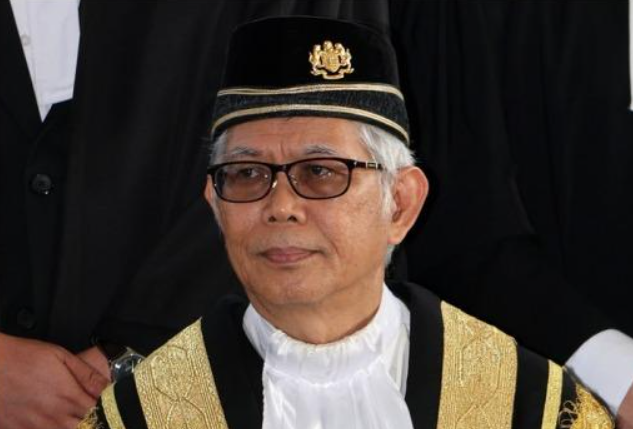
KUALA LUMPUR – Former chief judge of Sabah and Sarawak Tan Sri Abdul Rahman Sebli has revealed facing internal pressure during his time as a Federal Court judge – something he said nearly compromised his judicial independence.
Speaking at a farewell event in Kuching last Wednesday with fellow judges, court officers and invited guests, Abdul Rahman – who retired last Thursday – recounted an incident involving a high-profile case in 2021 where he was part of a seven-member panel.
“I was asked to ‘toe the line’. My draft judgment was harshly criticised, even called ‘hypocritical’. But I stood by my position,” he was quoted as saying by Malaysia Gazette.
He had circulated a draft judgment to the six other panel members, which he said was standard practice in the Federal Court. Shortly after, he received an email from a senior judge who strongly objected to his views, using language he described as sarcastic and condescending.
“At the time I was a Federal Court judge; not chief judge. In terms of hierarchy, I was junior to those applying the pressure. My draft was even labelled ‘hypocritical’,” he said.
Abdul Rahman maintained his position that the constitutional issue raised in the case should have been decided in favour of the Federal Government rather than the litigant.
The pressure, he said, did not end there. He claimed to have overheard one senior judge whispering to another panel member that they needed to “crack the whip” on dissenters.
“I can only imagine the pain if someone were truly whipped until the cane broke,” he said wryly, describing the extraordinary internal pressure he faced from within the judiciary.
Before sharing this dramatic episode, Abdul Rahman reflected on his 17-year judicial career, noting that he had presided over cases that challenged both logic and moral judgment.
“Some drew wide attention, others passed quietly. But every case reminded me that everyone who appears in court – rich or poor – deserves to be treated fairly, with dignity and respect.
“Compassion is not a weakness but an inner strength that defines a good judge.
“The best judges listen with sincerity and decide with courage. We must be firm without being harsh, courteous without appearing weak,” he said.
Although he managed to persuade three other panel members and formed a 4-3 majority, that decision was later overturned by a new panel of three judges – two of whom had been in the original minority. Ironically, the new judgment was written by the very judge who had previously dissented.
In a further twist, Abdul Rahman said plans were set in motion to issue show-cause letters to him and the two other judges who had supported the original ruling. He believed only divine intervention had thwarted an attempt to convene a tribunal against them.
“Had it gone ahead, I might have suffered the same fate as former Court of Appeal judge Datuk Hamid Sultan,” he said, referring to disciplinary proceedings against the outspoken former judge.
He described attempts to pressure judges into aligning with more senior colleagues as not only unethical but a direct assault on the principle of judicial independence – a form of unacceptable interference.
“We often talk about executive interference. But it is even more dangerous when the pressure comes from within the judiciary. That is a form of harassment that cannot be tolerated.
“The courts cannot be truly free if the ‘sword of Damocles’ is constantly hanging over judges’ heads,” he said.
At the event, Abdul Rahman expressed gratitude to court personnel and the legal community in Sabah and Sarawak for their support throughout his tenure.
He also praised newly appointed Chief Justice Datuk Wan Ahmad Farid Wan Salleh for upholding the principle of integrity by recusing himself from a case over concerns of public perception – a decision Abdul Rahman described as a model of judicial leadership.
“To all judges and judicial commissioners, I urge you – uphold the Constitution. Follow your conscience. God will be with you if you have the courage to do what is right,” he said.
He ended his remarks with an Iban pantun that moved many in the room:
“Pedih berserara’ nyiru ke ati, Kitak magang tetap dikenang.” (The pain of parting cuts deep, but you will always be remembered.)
Although retired, Abdul Rahman’s legacy of principled conviction and moral courage is likely to remain a defining chapter in Malaysia’s judicial history. – July 26, 2025