
KUALA LUMPUR – Thailand will release 18 detained Cambodian soldiers as part of the KL Peace Accord, a landmark deal signed today to end decades of tension and restore stability along the two countries’ shared border.
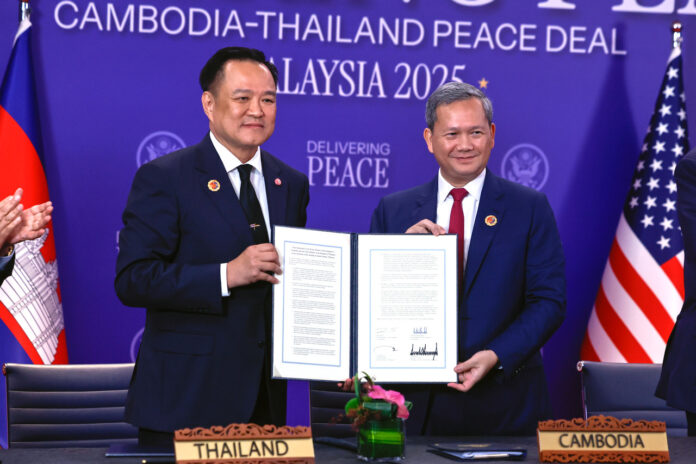
Thai Prime Minister Anutin Charnvirakul said the move follows the signing of the peace agreement with Cambodian Prime Minister Hun Manet, witnessed by Malaysian Prime Minister Datuk Seri Anwar Ibrahim in his capacity as Asean Chair, and United States President Donald Trump, at the Kuala Lumpur Convention Centre.
“Today marks a new chapter for Thailand and Cambodia. We take a concrete step towards peace,” Anutin said during the ceremony held on the sidelines of the 47th Asean Summit and Related Summits.
Under the KL Peace Accord, both countries agreed to withdraw heavy weapons from border areas, release detained soldiers, and begin implementing measures to rebuild trust among affected border communities.
Anutin said the accord reflected both sides’ commitment to peace, sovereignty, and mutual respect.
“We have come a long way since agreeing to the ceasefire here in Malaysia on July 28. The discussions since then have led to this important outcome — the signing of our joint declaration today,” he said.
The Thai leader thanked Hun Manet for his cooperation and extended appreciation to Anwar for “upholding Asean unity” and to Trump for “his personal dedication to peace between Thailand and Cambodia.”
“But more importantly,” he added, “this begins the process of mending our ties. Our border communities have been divided by conflict, and innocent civilians have suffered immense losses. This declaration places a firm responsibility on our two parties to act.”
Anutin also announced the signing of two additional economic documents — a joint statement on a framework for a US–Thailand reciprocal trade agreement and a memorandum of understanding on cooperation in critical minerals — to strengthen long-term supply chain resilience.
Hun Manet, meanwhile, hailed the KL Peace Accord as a “historic milestone” in bilateral relations, pledging Cambodia’s full commitment to its implementation.
“On behalf of the Cambodian people, I wish to express my deepest gratitude to United States President Donald Trump for his decisive leadership and steadfast commitment to supporting lasting peace between Cambodia and Thailand,” Manet said.
He also thanked Anwar for his “unwavering support and facilitation” throughout the peace process.
Manet confirmed that senior military commanders from both nations have begun discussions on a phased withdrawal of heavy weaponry, calling it a demonstration of their shared resolve to uphold the agreement.
He also urged the “prompt release” of Cambodia’s 18 detained soldiers on humanitarian grounds, as stipulated in the accord.
In a symbolic gesture, Manet announced his nomination of Trump for the Nobel Peace Prize for his efforts to promote peace between Cambodia and Thailand, as well as globally.
The KL Peace Accord builds on the ceasefire achieved after a flare-up on July 24 that led to a brief military confrontation.
Four days later, Anwar hosted emergency talks in Putrajaya with Manet and then Thai acting prime minister Phumtham Wechayachai, successfully diffusing tensions and paving the way for today’s breakthrough.
The ceasefire, widely regarded as a major Asean diplomatic achievement, helped prevent further escalation and protected thousands of civilians living along the 817-kilometre border.
Malaysia, as Asean Chair under the 2025 theme “Inclusivity and Sustainability,” is hosting the 47th Asean Summit from October 26 to 28 at the Kuala Lumpur Convention Centre, bringing together regional and global leaders to discuss peace, stability, and cooperation across the Asia-Pacific. — October 26, 2025