

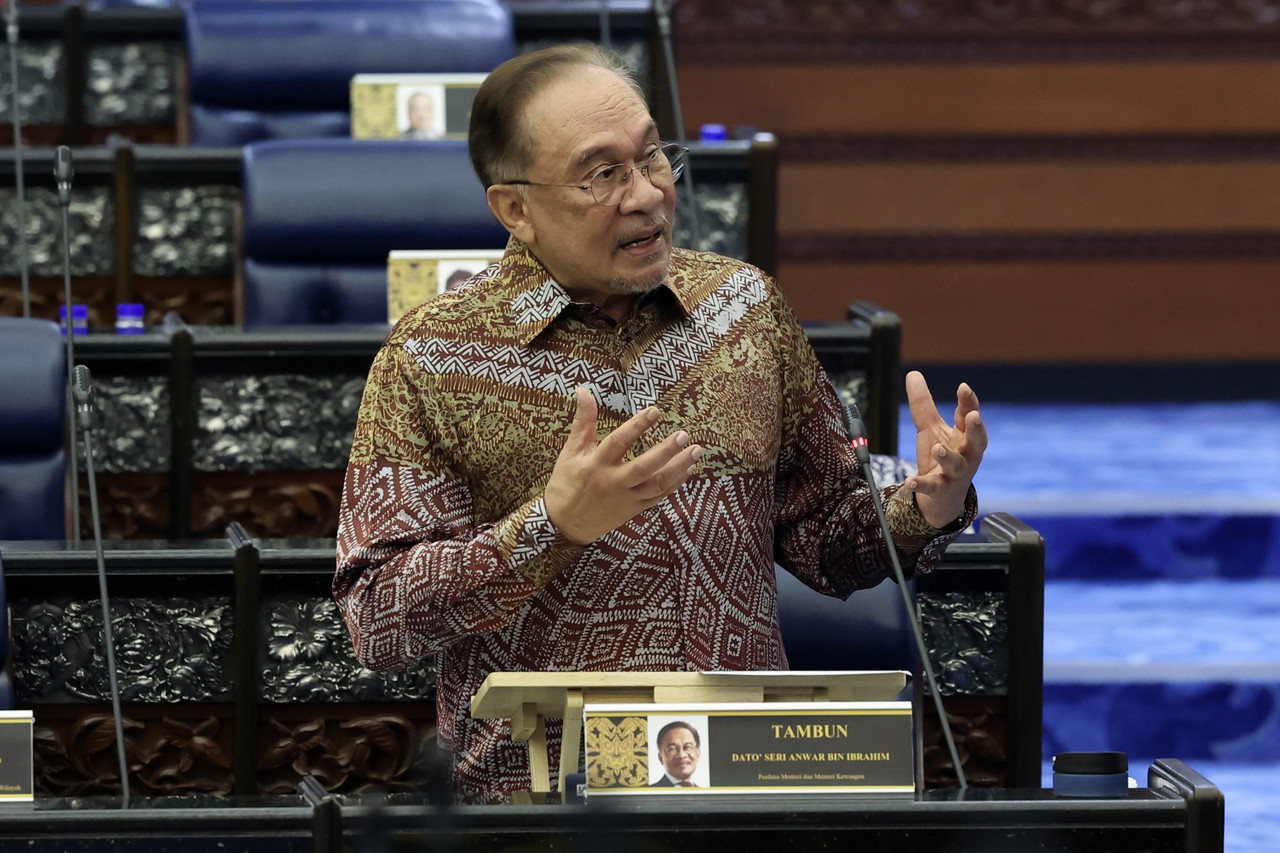

KUALA LUMPUR – The country’s services account recorded a surplus of RM0.7 billion in the third quarter of 2025, marking the first surplus in 14 years, thanks to strong fiscal discipline and sound economic management.
Prime Minister Datuk Seri Anwar Ibrahim attributed this achievement to the Madani economic strategy, the New Industrial Master Plan (NIMP), the energy transition agenda, the National Semiconductor Strategy (NSS), and high-impact sectors like data centres.
The Prime Minister also highlighted the role of fiscal policies in strengthening the ringgit, which had appreciated by 8.2 per cent against the US dollar as of November 14.
“This improvement is the result of policies put in place from the outset, including targeted subsidies. We have stopped using funds for subsidies that did not directly benefit the people,” Anwar explained.
He pointed to the targeted subsidy for RON95 petrol as a key measure driving the ringgit’s rise.
Responding to a question from Jimmy Puah Wee Tse (PH-Tebrau) on the factors behind the ringgit’s appreciation and its impact on the economy, Anwar, who also serves as Finance Minister, noted the importance of encouraging government-linked investment companies (GLICs) and government-linked companies (GLCs) to play a larger role in national development.
“Countries like South Korea and several in Europe, including the United Kingdom, have adopted similar strategies. This proves that our approach is sound and not contradictory, despite some economists raising concerns,” Anwar said.
He added that growing confidence in the country’s currency had also helped boost the services sector.
Anwar further explained that the rapid development of data centres had contributed significantly to the economy, despite requiring substantial imports at the outset. Once fully operational, these centres generate high export services, providing a major boost to the services sector’s overall performance.
“The export services from the development of data centres have been exceptional,” he remarked.
However, Anwar acknowledged that the ringgit’s appreciation had not yet fully translated into price reductions, especially in sectors such as livestock, which depend on imported animal feed.
“Costs should be declining due to low inflation, but price reductions have not been as noticeable,” he said.
To address the rising cost of living, Anwar outlined two key government initiatives. The first was stricter enforcement by the Domestic Trade and Consumer Affairs Ministry to ensure businesses importing goods, including medicines and hospital supplies, lower their prices in line with falling import costs.
“With lower import costs, price reductions are inevitable,” he said.
The second measure involved expanding the Jualan Rahmah programme and strengthening the retail network to ensure the public directly benefits from price stability through lower-priced goods. – November 18, 2025