

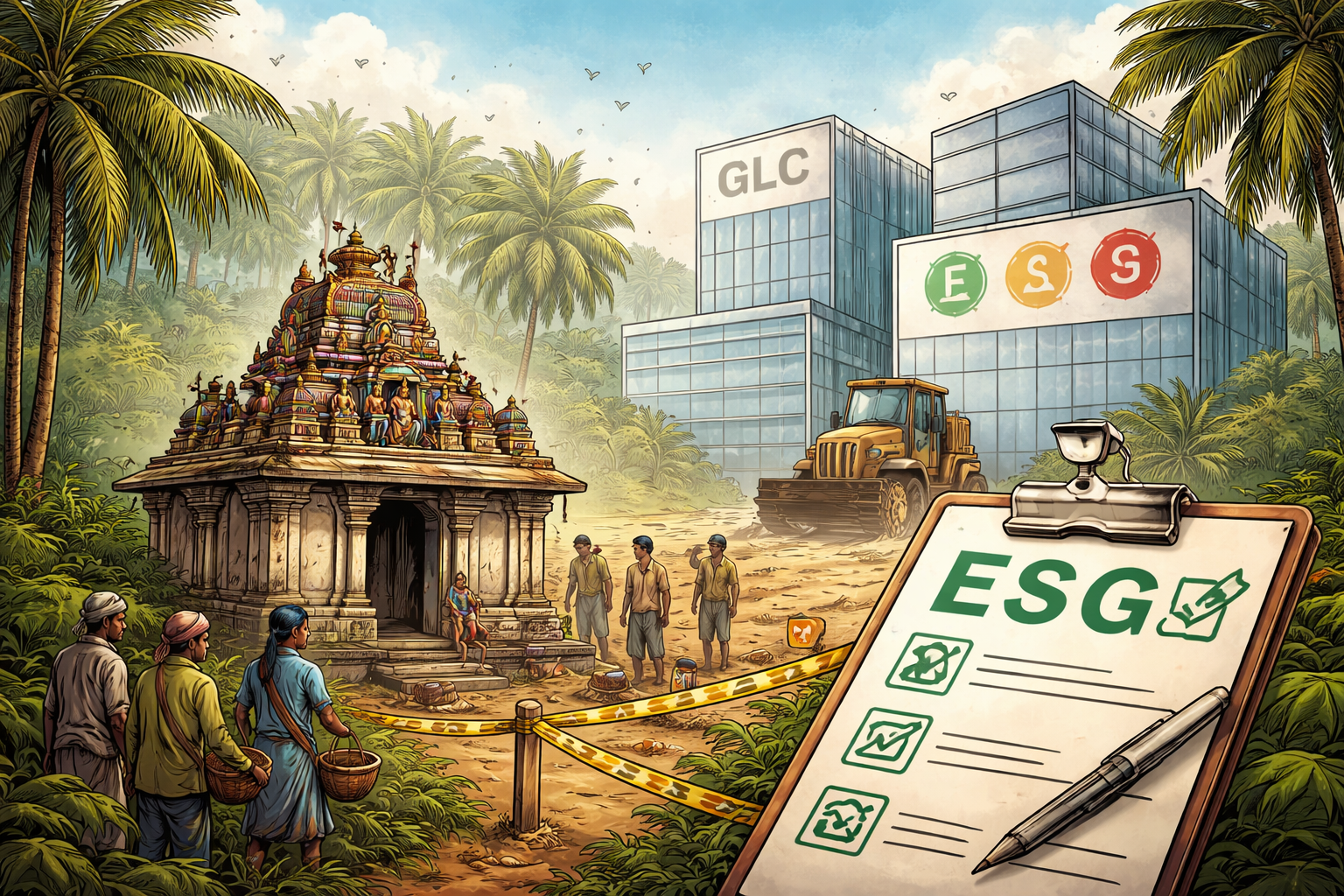
FOR more than a century, Hindu temples stood at the heart of rubber and palm oil estates, built by indentured and later “free” Indian labourers who were never given secure land, only quotas and “targets”. These shrines were not “illegal structures”, they were the only institutions that acknowledged estate workers’ humanity when the company only saw them as headcount and productivity. Today, many of those estates are owned or controlled by government-linked companies (GLCs) and state investment arms, yet the temples that anchored whole communities are treated as encroachment, obstruction or, at best, negotiable assets in land banks and redevelopment plans.
According to Hindu rights groups, about 23,000 Hindu temples and shrines nationwide have been denied legal status since independence, and roughly 10,000 have been demolished, desecrated or forcibly relocated under various authorities and “development” pretexts. While these figures cover all of Malaysia, not only GLC estates, they reveal the scale of institutional neglect and silent violence against Hindu places of worship that GLCs are very much part of.
When the landlord is the state
Malaysia’s plantation map is no longer a map of British company flags but of GLC logos – FELDA and FGV, FELCRA, RISDA, Sime Darby Plantation, the Malaysian Rubber Board and a host of state economic development corporations. Together, they sit on hundreds of estates and plantation schemes carved across more than half a century of “development”, managing hundreds of thousands of hectares formerly worked by Indian rubber tappers and palm cutters.
Federal land and plantation agencies alone tell a powerful story. FELCRA had developed around 268,000 hectares of oil palm, rubber and rice schemes by the mid‑1990s, organised into scores of schemes and clusters. FELDA and FGV oversee large land schemes across the peninsula, while RISDA supervises extensive rubber smallholder settlements and schemes that grew out of estate labour histories.
Sime Darby Plantation, built on the consolidation of Kumpulan Guthrie, Golden Hope and other colonial estates, lists dozens of estates in Malaysia, with state investment arms like Permodalan Nasional Berhad (PNB) as major shareholders. Even the Malaysian Rubber Board’s plantation arm manages its own estates, while state development corporations hold significant plantation land banks.
On paper, these are “national assets”, proudly showcased in annual reports and ESG dashboards. On the ground, they are the same estates where generations of Indian workers lived in cramped lines, buried their dead in corner plots and built temples stone by stone, only now the landlord is not a distant colonial company from 10,500km’s, but a state-linked giant with ministers on speed dial.
GLCs as owner, employer and gatekeeper of faith
GLCs and state agencies play a triple role in the temple crisis. They are landowners and planners, when estates are consolidated, sold or repurposed for townships, industrial parks or commercial projects, the default “solution” for old estate temples is too often demolition or relocation to marginal, inaccessible plots, sometimes with token compensation. They were the employers and power brokers, estate workers and former workers, mostly Indian and Hindu, rarely sit at the table where decisions about “rationalising” land use, “clearing squatters” or “optimising assets” are made, despite generations of contribution to those very assets. Their temples become bargaining chips in negotiations they never truly control.
And they are state-linked actors, as extensions of government policy, GLCs cannot hide behind the excuse of “private rights”. When a GLC estate moves against a temple without due process, meaningful consultation or humane relocation, it is effectively the state itself signalling that Hindu heritage is expendable. High‑profile cases of century‑old temples facing relocation or demolition, including those in prime urban areas that were once estates, show a persistent pattern, sudden notices, disputed “illegality”, demolition or partial demolition under the cover of public holidays or odd hours, and communities left to beg for scraps of recognition after the bulldozers roll
How many GLC estate temples are we talking about?
Here, the silence is loudest. Neither GLC annual reports nor public ESG disclosures provide systematic counts of houses of worship on their estates, and there is no consolidated federal register of temples on FELDA, FELCRA or RISDA land. There is also no standard requirement for plantation GLCs to disclose the number and status of Hindu temples, shrines and other non-Muslim houses of worship on their land.
We are forced to triangulate from broader data. Rights groups estimate about 23,000 Hindu temples and shrines nationwide have been denied legal status since independence, with about 10,000 demolished, desecrated or forcibly relocated. Commentary and official figures suggest more than 800 registered Hindu temples and between 2,500 and 3,000 unregistered ones across the country, with 687 unauthorised temples identified in Selangor alone – 388 on government land and 299 on private land.
Overlay this with the fact that much of the Indian Hindu population historically lived and worked on estates, and that many of today’s townships were once plantations, and a stark picture emerges, a significant share of these temples and shrines originated as estate temples on land now controlled by GLCs and state agencies. It is reasonable and conservative to say that hundreds, and likely several thousand, temples and shrines across Malaysia were or are located on GLC-linked estate land, even if no official will put that number in writing. The refusal to even count them is the first act of erasure. The bulldozer is only the last.
ESG: not a coffee‑table book
Malaysia’s policymakers and major plantation companies proudly point to improved ESG reporting and sustainability scores, especially on deforestation, emissions, labour rights and community relations. But if ESG is anything more than marketing, it must bite where it is most uncomfortable: at the intersection of land, power, religion and minority rights on the estates.
For GLC plantation and estate management, a credible ESG approach to temple issues must centre three core pillars:
Environmental (E)
Recognise estate temples and their surrounding compounds as cultural‑ecological assets, not waste ground to be “cleaned up”, and treat heritage trees, shrines, ponds and cremation sites linked to these temples as part of the estate’s cultural landscape in land‑use planning and impact assessments.
Social (S)
Affirm, in policy, the right of Hindu workers and former workers to practice their religion where their communities have historically lived, in line with labour rights and community relations principles already recognised by Malaysian authorities. Institute
no demolition without consent, no temple or shrine is to be demolished or relocated without transparent consultation, freely given community agreement, and provision of an equal or better site plus full relocation costs. Recognise estate temples as centres of social welfare, culture and mental health, not merely “prayer rooms” and integrate their needs into any resettlement or redevelopment scheme.
Governance (G)
Require every GLC estate to maintain a public Temple and Places of Worship Register, listing all Hindu, Christian and other non‑Muslim sites on their land, with status, history and commitments, and to table this annually at the board and to regulators. Embed temple‑related metrics into board‑level ESG KPIs, number of temples secured with land titles or long‑term leases, number of disputes resolved amicably, and complaints recorded and closed. Ensure meaningful minority representation at the highest level, including independent voices with credibility in Indian and Hindu community affairs to scrutinise any action involving houses of worship.
ESG is not a beautiful booklet to be waved at investors and ministers after spending 100 to 200K, for each year, it is a covenant with the very communities without whom there would be no estates, no yields and no profits.
From performative CSR to justice for estate workers
Moving from rhetoric to justice demands hard structural changes, not more Deepavali hampers on Instagram or sad story of Tiktok.
Immediate moratorium and audit
Impose a moratorium on any demolition or relocation of temples and shrines on GLC and state‑linked estates until a full national mapping and legal audit is completed. Commission an independent, multi‑faith taskforce, with genuine Hindu representation, to map all estate temples, document their history and recommend regularisation and protection mechanisms.
Legal regularisation and secure tenure
Convert long‑standing estate temples into legally recognised houses of worship with proper land titles or renewable long‑term leases, rather than leaving them in limbo as “illegal structures”. Amend GLC and state land policies to explicitly protect existing houses of worship, treating them as social infrastructure on par with suraus, schools and clinics in planning processes.
Fair compensation, not token gestures
Where relocation is absolutely unavoidable, compel GLCs to provide comparable land in accessible locations, full funding for reconstruction, and compensation for cultural and historical loss, negotiated transparently with temple committees and residents. Embed these obligations in legally enforceable agreements, not ad hoc letters or political promises easily discarded once the land is cleared.
Worker voice and accountability
Establish estate‑level Joint Religious and Community Committees comprising worker representatives, temple committee members and estate management, with the power to veto or renegotiate proposals affecting places of worship. Create an independent commission, reporting to Parliament rather than any single ministry, to hear complaints about temple demolitions, police conduct and abuse of planning powers, with authority to halt actions pending review.
Investor and public pressure
Institutional investors, including pension and Islamic funds with strong ethical mandates, must explicitly include treatment of minority houses of worship and estate communities in their ESG screening of GLCs and plantation stocks. Civil society and the media should demand that every ESG or sustainability report carry hard data on temple and community rights instead of sanitised anecdotes about festive CSR events.
The Indian estate worker’s contribution to Malaysia is written into export statistics, GDP tables and GLC balance sheets – but her faith, her temple and her dead are still treated as negotiable clutter. The measure of a GLC is not how thick its ESG report is, but whether the people who tapped its rubber and harvested its palm can still ring the temple bell on the land where their ancestors first knelt.
Please, take a moment to truly see them, they are not mere toys to be played with, but lives that deserve our respect and gratitude for all they have given through the estates. Their hands built more than livelihoods; they helped shape the very roots of this land. – March 25, 2026
***Ravindran Raman Kutty is an award-winning PR practitioner