

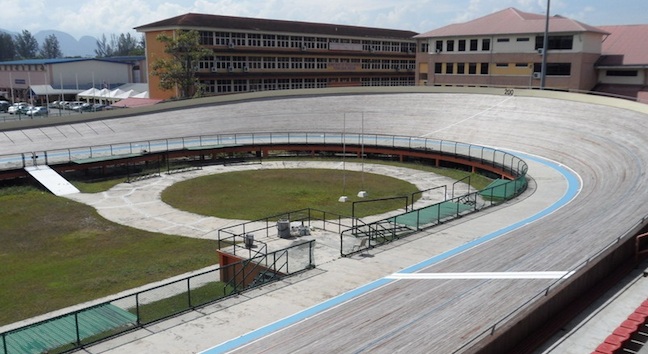

KUALA LUMPUR – The Malaysian National Cycling Federation (MNCF) has backed national cycling programme technical director John Beasley’s proposal to replace the wooden surface at Velodrom Rakyat in Ipoh with a weather-resistant aluminium track, as part of efforts to revive Malaysia’s first-ever velodrome.
Beasley reportedly proposed installing a new aluminium surface over the existing track structure, describing it as a “perfect surface” for Ipoh and a long-term solution that could eliminate the need for a roof while addressing issues related to rotting timber and weather exposure.
Speaking to Scoop, MNCF president Datuk Amarjit Singh Gill said the federation is open to exploring the idea, noting that the choice of track material depends largely on whether the facility is intended for development or elite competition.
“For me, it is very simple. If we want to install a wooden track, then there must be a roof over it. If we go with concrete or aluminium, then a roof is not necessary,” he said.
Amarjit said the Ipoh facility should primarily serve as a development hub to ease pressure on the National Velodrome in Nilai, which is currently operating at full capacity.
“The Velodrom Rakyat is more suited for development purposes. If we had a wooden track with a roof, we could host more international events. But we need to be realistic — we need more development-based velodromes for state-level training,” he said.
He added that riders from northern states currently have limited access to proper training facilities due to the velodrome’s condition.
“We have around 40 track riders in Penang and about 30 in Perak, but no proper place to train. We already have this structure in Ipoh, and it needs to be restored,” he said.
Amarjit also highlighted the strain on the Nilai velodrome, which accommodates the national team, development squads and occasional foreign training camps.
“Right now, the velodrome in Nilai is fully packed with the national team, Podium Programme and others. There is hardly any availability, and we also host foreign teams from time to time,” he said.
He noted that the aluminium track concept, which has been used in a velodrome in the United States, could be explored further, although it is still under feasibility review by the Union Cycliste Internationale (UCI).
“This aluminium track is still very new. It has been used in a velodrome in the United States, and it is something worth exploring. However, the UCI is still assessing its feasibility,” he said.
Amarjit said the estimated cost of around USD2 million (RM7.95 million) should be considered in the context of long-term infrastructure sustainability.
“Everything is expensive nowadays, including aluminium. But the priority is to ensure we get the facility back in proper condition,” he said.
He reiterated that the matter has been raised with both federal and state authorities, stressing that sports associations should not be expected to bear the cost of major infrastructure upgrades.
“There has been a lot of back and forth between the state government, city council and federal government. But when it comes to sports facilities, the federal government can step in and make a decision,” he said.
“We have written to both the federal and state governments. It is not fair to expect sports associations to fund such upgrades. The funding must come from either the federal or state level.” – April 15, 2026