

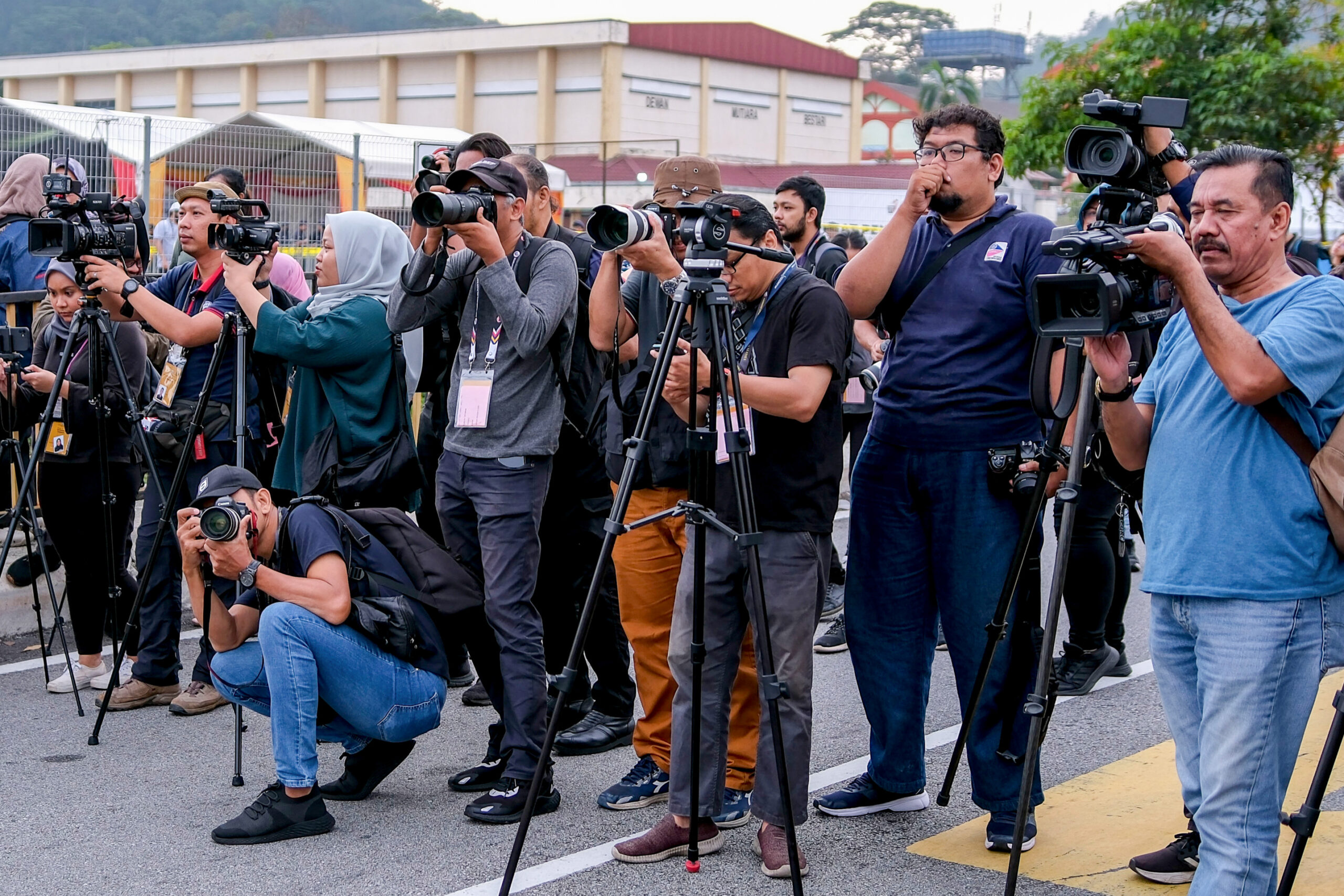
THE annual ritual has played out once again: Malaysia slides seven spots to 95 in the Reporters Without Borders (RSF) Press Freedom Index, and the usual chorus follows — hand-wringing, political point-scoring, and the inevitable declaration that the sky is falling on Malaysian journalism.
But before we accept this ranking as divine, it is worth asking a far more uncomfortable question: who exactly is judging, and by what standards?
Paris-based RSF presents itself as a global arbiter of press freedom, yet its methodology remains problematic.
This was evident in the 2024 index when Israel, which had murdered 140 journalists of multiple nationalities in Gaza was ranked 101st (falling only four spots); while Malaysia plummeted 34 places from 73rd to 107th!
A sit down with RSF Asia-Pacific bureau director, Cédric Alviani with Communications Minister Datuk Fahmi Fadzil and other senior editors at the National Journalists Day in Kuching around this time two years ago, was an eye opener as to the questionable methodology of the press freedom index and even the leadership of RSF.
The rankings rely heavily on survey questionnaires distributed to unnamed individuals and organisations which include “human rights defenders”.
There is no transparency about who these respondents are, what biases they may carry, or how representative they are of the media ecosystems they supposedly evaluate (although one can make an educated guess).
In any other field, such anonymity would be treated with deep suspicion but the RSF gets a free pass because, you know, it’s the RSF. They have a halo over their heads and poop gold nuggets.
And by they I mean the seven-member “panel of experts” that came up with a presumably fool-proof formula in 2022. All of whom are Westerners.
Heck the only South Asian, Prem Samy is French but is not on this year’s panel.
Malaysia’s decline to 95 out of 180 countries is not to be taken lying down
These rankings can effect global perspectives and influence foreign investment, trade and tourism numbers.
Again the oft-repeated reasoning – oppressive archaic laws, legal action on journalists etc. Even with the setting up of the Malaysian Media Council (MMM) which acts as a self regulatory buffer and arbiter between the industry and the Government, it was not good enough.
My problem with organisations like RSF is that it paints journalists from developing countries as compliant and compromised- in other words, corrupt and chicken s**t.
And some of those who echo these findings feel compelled to do so, because well, whose going to give out generous grants if everything is peachy, right?
What the RSF does not consider is the engagement and even table thumping that occurs constantly, the pressure on politicians and successive governments to amend and scrap repressive laws.
Prime Minister Datuk Seri Anwar Ibrahim is facing daily media criticism like no others before him – even Datuk Seri Najib Razak whose administration saw the suspension of newspapers and the jailing of editors and journalists.
Yet we are perceived to be controlled.
This problem is compounded by the organisation’s leadership, which appears curiously detached from the very industry it seeks to assess.
Take aforementioned Alviani — academically credentialed, yes, with a Masters in Journalism but with no lived experience in a newsroom.
His professional background includes running a film festival, a far cry from the daily grind of reporting, editing, and navigating the legal and political pressures that define journalism.
Similarly, RSF’s deputy director-general, Thibaut Bruttin, has never spent a day as a working journalist.
Leadership without newsroom experience is not inherently disqualifying, but it does beg the question: how deeply can one understand the nuances of press freedom without ever having faced a deadline, a defamation threat, or an editor’s call at midnight?
Even communication becomes an issue. When key figures like Bruttin, prefer to operate primarily in French, their messaging risks being lost — or worse, misunderstood — by the broader global audience they claim to engage.
Press freedom, after all, is not a niche conversation for a linguistic elite; it is a universal concern that demands clarity and accessibility.
Beyond personalities and process lies a deeper, more structural flaw: RSF’s reliance on Western liberal benchmarks as a universal yardstick. This is where the index begins to feel less like an objective measurement and more like a projection of values.
The tone deafness to local cultures, conventions and sensitivities is one problem with the likes of RSF.
The fact that France – RSF’s homebase maintained a respectable 25th position over 180 countries calls for scrutiny.
Police violence against journalists covering protests, media ownership that promotes biases and the under-representation of minorities in the very Press RSF is defending makes one wonder why the wide berth between France and Malaysia.
I don’t remember any Malaysian journalists getting clobbered in the past year during demonstrations.
Malaysia’s no fly zone – 3R – race, religion, royalty is something that is frowned upon by the RSF.
Yes, the same people who regard mocking the Holy Prophet (pbuh) on the front page of a satirical newspaper, as journalism.
Press freedom does not exist in a vacuum. It operates within cultural, legal, and societal contexts that differ widely across regions.
Malaysia, like many multi-ethnic and multi-religious societies, navigates a delicate balance between free expression and social harmony.
Laws and editorial decisions are often shaped by the need to manage sensitivities that may be invisible or irrelevant to observers in Paris or Brussels.
To judge such a landscape solely through Western lenses is not just simplistic; it is intellectually lazy and in fact xenophobic with a dollop of supremacy.
Again, this is not to suggest that Malaysia’s media environment is beyond criticism. Far from it. There are legitimate concerns about ownership structures, political influence, and self-censorship.
The use and abuse of social media and the onset of AI is giving regulators an unprecedented headache.
Cybertroopers, agent provocauters and living room commentators who are paid to defame, now identify as journalists and organisations like RSF give them that legitimacy by championing them when these individuals are sued or questioned by the authorities.
So these issues deserve to be examined with nuance, grounded in local realities rather than filtered through preconceived notions of what press freedom “should” look like.
Organisations like RSF play an important role. They shine a light on abuses, advocate for journalists at risk, and keep governments on their toes.
But credibility is their currency — and it is one they risk devaluing when their work appears marred by questionable methodology, thin on-the-ground understanding, and a tendency towards broad-brush judgments.
And that does little to advance the cause of press freedom — in Malaysia or anywhere else. – May 5, 2026
Terence Fernandez is Group Editor in Chief of Big Boom Media that publishes Scoop