

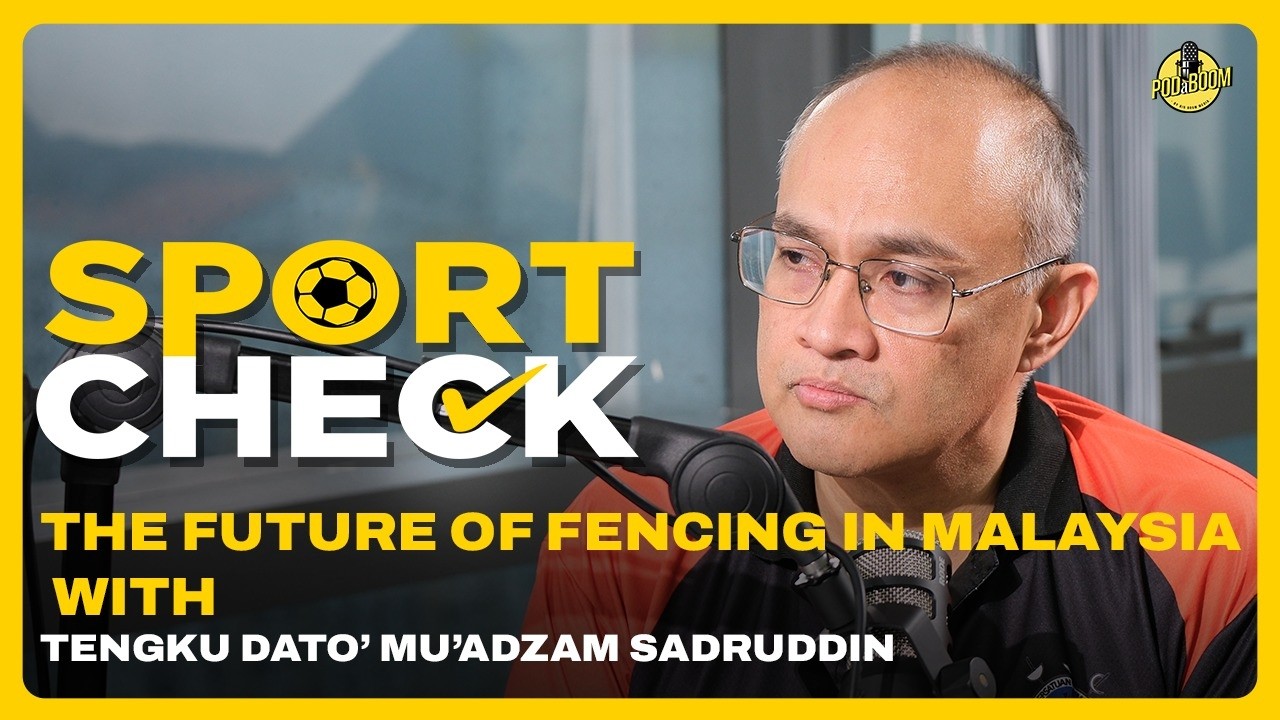

KUALA LUMPUR — The Negeri Sembilan Fencing Association (NSFA) is working to change public perception that the sport is dangerous, insisting that the discipline required makes it among the safest competitive sports when proper safety procedures and equipment are used.
Speaking on Scoop’s Sport Check podcast, NSFA president Datuk Tengku Mu’adzam Sadruddin said misconceptions surrounding fencing often stem from a lack of understanding about the sport, particularly among parents unfamiliar with its rules and protective systems.
“I had the same concerns when my own boys first started fencing,” he admitted.
“But fencing is actually a very safe sport.”
Tengku Mu’adzam explained that unlike the sharp swords often portrayed in movies, fencing weapons used in competition are blunt and designed with safety mechanisms.
“The weapon tips are not sharp. They are blunt and use a spring mechanism, which is how the scoring system works,” he said.
He added that modern fencing equipment is built with strict safety standards, including highly durable protective gear designed to withstand heavy impact.
“The jackets are usually made with Kevlar and are essentially bulletproof, while the masks are designed to withstand a very high amount of force,” he said.
According to Tengku Mu’adzam, safety discipline is also heavily emphasised from the very beginning of training.
“Any good coach will stress safety from day one. One of the first rules taught is that whenever you hold a weapon, you must wear your mask,” he said.
He noted that serious injuries in fencing are relatively uncommon compared to many mainstream sports, with most injuries involving issues such as twisted ankles or anterior cruciate ligament (ACL)-related injuries rather than direct impact from weapons.
“Generally, the most serious injuries I’ve seen in fencing are things like ACL injuries or twisted ankles. In that sense, it is actually very safe,” he said.
Beyond safety, Tengku Mu’adzam also highlighted the intellectual and disciplinary benefits of fencing, describing it as a sport often referred to as “physical chess”.
“Fencing requires strategy and mental sharpness because athletes need to think several moves ahead, just like in chess,” he said.
He added that many successful fencers also tend to perform well academically due to the discipline and focus developed through the sport.
“What we notice is that many good fencers are highly disciplined. Coaches always emphasise punctuality, preparation and mental focus before competitions,” he said.
Tengku Mu’adzam also pointed out that fencing can open educational opportunities for athletes, with many universities offering sports scholarships to state and national-level competitors.
“If you are a state-level fencer, many universities may offer around a 50 per cent scholarship. If you represent the country, it could even be a full scholarship,” he said.
He revealed that one Negeri Sembilan fencer previously secured a full scholarship from Nilai University after representing both the state and Malaysia at the Asean University Games.
Despite fencing still being viewed as a niche sport in Malaysia, Tengku Mu’adzam believes greater grassroots exposure and public education can help grow participation nationwide.
“Our hope is that more people will understand that fencing is not just safe, but also a sport that builds discipline, confidence and critical thinking,” he said. – May 27, 2026