

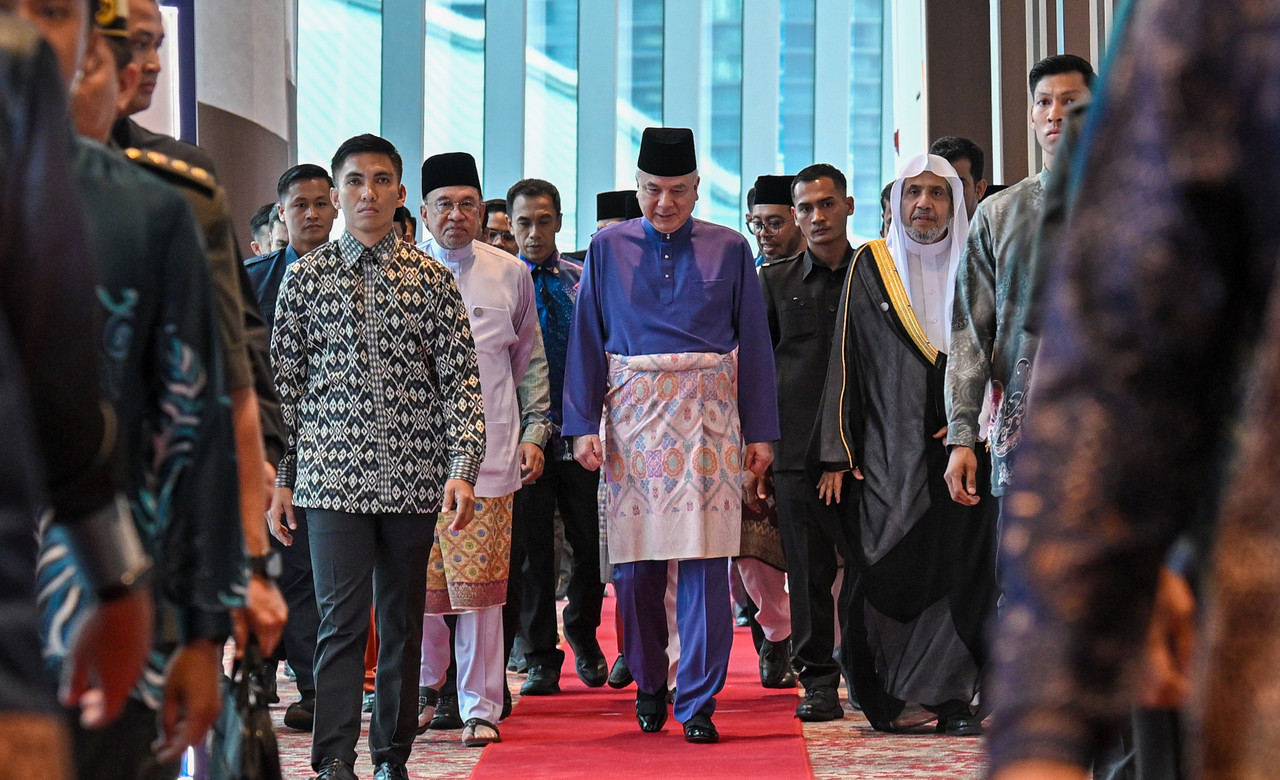
KUALA LUMPUR – The Sultan of Perak, Sultan Nazrin Shah, has called on religious leaders to confront the spread of artificial intelligence (AI)-driven disinformation among young people, warning that algorithms now “preach” more persuasively than traditional authorities of faith.
Speaking at the 3rd International Summit of Religious Leaders today, he noted that the struggle for youth engagement is increasingly unfolding on platforms “we do not own” and in a “language we have been too slow to learn”, Bernama reported.
He observed that many young people, already anxious about climate change, conflict, and economic uncertainty, are also seeking meaning, belonging, and trust.
“Nearly 1.8 billion youth make up the largest generation in history, with Muslims forming the youngest major faith community,” Sultan Nazrin said. “Institutions must stop speaking of youth only as the future and instead recognise they are already ‘organising, innovating and reshaping public discourse.’
“We have spent a great deal of time talking about young people, and far too little time listening to them and sharing power with them. The phrase the young peacebuilders themselves now use is exact, and it should sting us: they ask to be treated as co-creators, not consultants.”
He added that faith leaders are uniquely positioned to bridge this gap. Empowering young people and engaging them as partners is critical, particularly as violent extremists compete for the same young hearts.
“He comes clothed in scripture, quoting the very verses we quote. He invokes the same hunger for meaning, the same clarity of purpose, the same ache for dignity, and with great skill bends it away from mercy and towards grievance,” Sultan Nazrin said. “He offers the sense of belonging that comes from having an imagined enemy. If all we offer in return is a sermon young people find remote, in a language they have stopped speaking, delivered inside a building they have stopped entering, then we have come armed with a manuscript to a contest being fought on iPhones.”
Highlighting the role of faith in the digital era, he referred to Pope Leo XIV’s recent encyclical, Magnifica Humanitas, on safeguarding the human person in the age of AI. “The screen can deliver information, but only a human being can deliver meaning,” he said.
According to the 2026 Edelman Trust Barometer, Sultan Nazrin noted, only seven in 10 people globally are hesitant to trust someone with different values or beliefs, while only one in three believe the next generation will be better off. “This is where religious leadership has a vital role to play. At its best, religion teaches us to look beyond the self. It reminds us that human beings are not merely consumers, competitors or avatars in a digital crowd, but persons of dignity and moral worth.”
He stressed that engaging youth requires religious leadership to be both rooted and responsive. “Responsive because each generation encounters new realities and asks new questions. The task is not to dilute faith for our youth, nor to abandon inherited wisdom, but to bring that wisdom into living conversation with the conditions of the present world,” he added.
Also attending the summit were Prime Minister Datuk Seri Anwar Ibrahim, Muslim World League secretary-general Datuk Seri Sheikh Dr Mohammad Abdul Kareem Al-Issa, and Minister in the Prime Minister’s Department (Religious Affairs) Datuk Dr Zulkifli Hasan.
The event, jointly organised by the Department of Islamic Development Malaysia (JAKIM) and the MWL, brought together about 1,500 scholars, policymakers, and religious leaders from 31 countries under the theme “Religious Leaders and Youth Empowerment: Advancing Coexistence and Social Harmony.” – June 12, 2026