

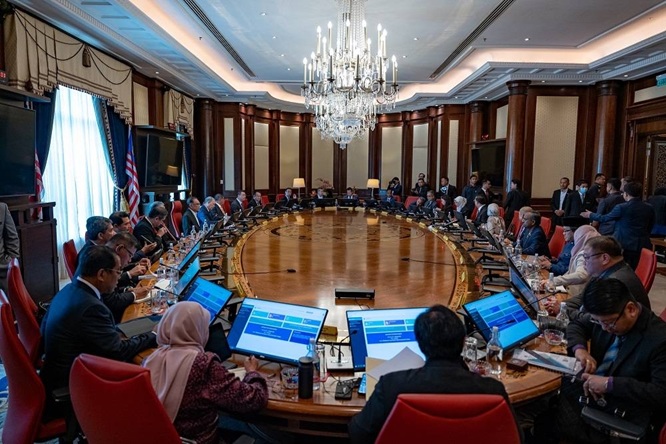
ON the night of June 4, a friend in political circles forwarded me a message regarding the timing of a Cabinet meeting and arrangements for a group photograph of all Cabinet ministers before the meeting. The moment I read the message, I sensed that the possibility of an early general election had increased.
Traditionally, an official Cabinet photograph is taken before Parliament is dissolved. Likewise, when a new government is formed, another “family portrait” of the Cabinet is usually taken at its first meeting. Over the years, this has become a ritual to mark the transition of power.
However, Communications Minister and Unity Government spokesperson Datuk Fahmi Fadzil clarified after the June 5 Cabinet meeting that the group photo was merely an administrative arrangement and had nothing to do with the dissolution of Parliament.
Yet based on years of reporting on and observing political developments, I remain somewhat sceptical of Fahmi’s explanation.
Earlier, the Johor State Assembly secretary had issued a notice that the assembly would convene for a one-day sitting on June 22. At the time, many assumed the assembly would only be dissolved after that meeting. Instead, before the sitting could even take place, Johor Menteri Besar Datuk Onn Hafiz Ghazi unexpectedly announced the dissolution of the state assembly on June 1.
This once again confirms a fundamental rule of politics: every political move is backed by careful planning and calculation. Prime Minister Datuk Seri Anwar Ibrahim undoubtedly has a specific moment in mind that he considers “the timing is right” to call for elections.
In fact, by the end of last year, I had already felt strongly that a General Election might be called earlier than expected. However, following the United States and Israel’s attack on Iran on February 28, which triggered a fresh wave of global economic uncertainty, many people, including myself, believed the likelihood of an election this year had diminished significantly.
Now, however, Johor has become the first state to dissolve its assembly, effectively setting the stage for elections in Negeri Sembilan, Melaka and perhaps even Sarawak. At the same time, political parties from both sides of the divide continue to pressure Anwar to dissolve Parliament sooner rather than later. Some have argued that if Parliament is only dissolved next year, worsening economic conditions could impose a much heavier political cost on Pakatan Harapan (PH).
Politics is always a game in which circumstances evolve faster than plans. Whether a general election takes place this year remains entirely in Anwar’s hands. Personally, Anwar would prefer to serve full term. Nevertheless, he must be prepared for the possibility of an election at any time.
To me, the Cabinet group photo has already sent a subtle signal. What remains uncertain is whether the political winds will shift strongly enough to trigger an election.
If Anwar is considering an election this year, he will undoubtedly weigh several critical variables, including the pace and severity of economic deterioration, the direction of internal divisions within Perikatan Nasional (PN), PH’s potential alliance partners, Barisan Nasional’s performance in state elections such as Johor, Negeri Sembilan and Melaka, as well as developments surrounding former Prime Minister Datuk Seri Najib Razak—News Opinions Features whether he is allowed to serve his sentence under house arrest, receives a royal pardon, or remains in prison.
All these factors are interconnected and will influence the broader political landscape and PH’s electoral prospects.
What was once considered the coalition with the strongest chance of winning the next general election—particularly PAS within Perikatan Nasional (PN) —is now facing internal turmoil centred on Datuk Seri Hamzah Zainudin. PAS appears prepared to part ways with Parti Pribumi Bersatu Malaysia (Bersatu) over the issue. Yet Bersatu president Tan Sri Muhyiddin Yassin has made it clear that he has no intention of leaving PN. As PAS adopts an increasingly hardline position, PN’s component parties may eventually be forced to decide where their loyalties lie.
Such infighting violates one of politics’ cardinal rules: never engage in internal conflict before a major battle.
A senior Bersatu leader, speaking on condition of anonymity, told me bluntly that PAS is attempting to hijack PN.
“PAS wants to break away from us because it has found a new partner. It is preparing to join forces with Umno and Hamzah’s Reset movement to form a grand unity alliance,” he said.
The leader also cautioned PN component parties such as Gerakan and the Malaysian Indian People’s Party (MIPP) to think carefully before choosing between Bersatu and PAS. They should understand PAS’ real objectives and consider whether its politicalNews Opinions Features direction can truly gain acceptance among Chinese and Indian voters.
Gerakan president Datuk Dominic Lau attended Hamzah’s Reset gathering in Kelantan on Saturday. Also present were PN chairman Datuk Seri Dr Ahmad Samsuri Mokhtar, PAS president Tan Sri Abdul Hadi Awang and Kelantan Menteri Besar Datuk Mohd Nassuruddin Daud.
At the event, Hamzah announced the formation of a new party called Parti Wawasan Negara (National Vision Party). The party promotes a framework known as the “New National Consensus”, emphasising political reform, moderation, and the defence of the Federal Constitution, the Rukun Negara and the spirit of the Malaysia Agreement 1963 (MA63).
Lau’s public support for Hamzah suggests where Gerakan’s four votes may eventually go. It is understood that PN will soon hold a meeting and vote, in accordance with its constitution, on whether Bersatu should be expelled from the coalition. PAS controls eight votes, Bersatu six, while Gerakan and MIPP each hold four. Barring surprises, the outcome appears increasingly predictable.
As for why PAS and Hadi Awang are so determined to back Hamzah—even at the cost of alienating Muhyiddin—sources close to Hamzah say the answer lies in PAS’ broader political plan and calculations.
“Do you remember the last Johor state election?” one source asked. “UMNO originally preferred Datuk Hasni Mohammad asmenteri besar, but the Sultan eventually chose Onn Hafiz.”
For that reason, PAS and its allies believe they must prepare at least three potential prime ministerial candidates should they one day form the federal government.
At present, PAS’ official candidate is Terengganu Menteri Besar and PN chairman Samsuri. Behind the scenes, however, Hamzah remains an alternative candidate. As everyone knows, the final decision on the appointment of a prime minister rests with the Yang di-Pertuan Agong. If Samsuri is deemed unsuitable, Hamzah could emerge as an alternative nominee.
At the same time, PAS continues to extend olive branches to UMNO. UMNO president Datuk Seri Ahmad Zahid Hamidi has publicly admitted that he remains cautious about PAS and does not wish to be “bitten by the same snake twice.”
He has repeatedly insisted that Muafakat Nasional will not be revived.
Nevertheless, there are reports that PAS and UMNO have quietly reached a form of electoral understanding, with the upcoming Johor election expected to serve as a testing ground. Hamzah’s Reset movement is also said to be part of the broader arrangement.
In December last year, I wrote an article titled “Will Zahid bid Anwar farewell?” in which I first revealed what I called the “Sawadeekap Move”. The political manoeuvre, now commonly referred to as the “Bangkok Move”, allegedly involved secretNews Opinions Features meetings attended by PAS secretary-general Datuk Seri Takiyuddin Hassan, Hamzah and Zahid.
If such a grand coalition succeeds in forming the next federal government after the 16th General Election, the list of potential prime ministers would likely include Samsuri, Hamzah and Zahid.
History, however, offers a cautionary lesson. Almost every political party or coalition that has partnered PAS has eventually watched it walk away.
From Barisan Nasional (1973–1977), the Malaysian Consultative Council (1986), Angkatan Perpaduan Ummah (1989–1996), Barisan Alternatif (1998–2004), Pakatan Rakyat (2008–2015), Gagasan Sejahtera (2016–2018), Muafakat Nasional (2019–2020), and now Perikatan Nasional (2020–2026), PAS’ alliances have rarely lasted more than seven years and sometimes as little as one year.
In that sense, nearly every political coalition that partnered with PAS has eventually ended in disappointment.
In 2015, PAS abruptly announced its split from DAP. What began with both sides singing from the same hymn sheet ended in silence, and Pakatan Rakyat collapsed shortly thereafter.
Although PAS temporarily lost urban support after breaking with DAP, it later expanded its reach through participation in PN and the federal government. It successfully moved beyond itsNews Opinions Features traditional East Coast strongholds and gained a foothold in Kedah, Perlis and several urban areas.
Yet only a few years after aligning with Bersatu, PAS is once again severing ties—this time with Muhyiddin—just as another general election approaches. The party’s latest idea, dubbed “PN Plus”, aims to broaden its alliance network and advance its longheld goal of Malay political unity.
Meanwhile, Parti Bersama Malaysia (Bersama), whose growing popularity is seen as a potential threat to PH’s vote base, is actively recruiting members nationwide. It is understood that Datuk Seri Rafizi Ramli has already attracted more than 100,000 members, around 40% of whom are politically unaffiliated young Malaysians from various ethnic backgrounds.
Although the party has become a new vehicle for voters disillusioned with PH, PN and BN, it remains unclear how much support it can attract among non-Malay voters, especially in urban and semi-urban constituencies. At this stage, it also appears unlikely to compete effectively against PAS, Bersatu or Umno for Malay votes.
The reality is that in Malaysia’s deeply polarised and highly politicised ethnic landscape, non-Malay parties such as DAP, MCA and Gerakan have limited options. They must usually align themselves with one of the three major Malay political blocs— PAS, Bersatu or UMNO—if they hope to participate in government and advocate for their communities from within the system. Otherwise, they risk remaining in opposition and gradually becoming irrelevant.
This is a political reality that cannot be ignored.
The Chinese community, in particular, should avoid emotional voting and should think carefully before choosing not to vote or casting spoiled ballots, as such decisions often work against its own interests.
As for Parti Keadilan Rakyat (PKR), despite being led by Malays, its multiracial positioning has long caused it to be viewed as insufficiently “Malay” by some segments of the electorate. In a political structure dominated by Malay-centred politics, it has struggled to establish itself as a fourth major political bloc. Consequently, Anwar has repeatedly sought to court Malay voters, yet has never been fully accepted by them, leaving him squeezed from multiple directions.
The same challenge awaits Bersama. Without substantial Malay support, it risks following the same path as PKR.
Perhaps the only way to break Malaysia’s current ethnic political framework would be for Sarawak’s ruling party to expand into Peninsular Malaysia and for a Sarawakian leader such as Tan Sri Abang Johari Openg to have a realistic chance of becoming Prime Minister.
Ultimately, until Parliament is dissolved, that Cabinet group photograph remains frozen in time—like a snapshot of Anwar standing at the starting line with a starter’s pistol in hand, waiting for the signal to begin the race.
The longer the election is delayed, the more political calculations will evolve with changing circumstances. The one constant, however, is that the influence of the “green wave” within Malay society shows no sign of fading. – June 14, 2026
Datuk Kuik Cheng Kang is the Group Editor-in-Chief of Media Chinese International (Malaysia).