

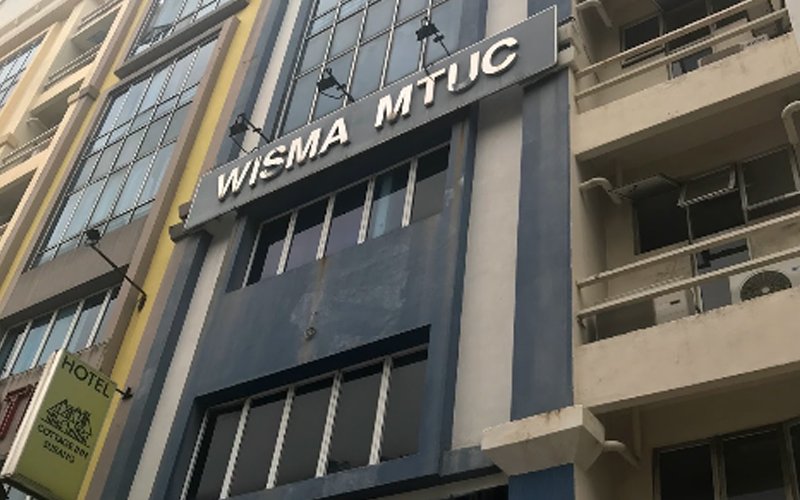
ONE of the region’s oldest labour organisations, the Malayan Trades Union Congress (MTUC), was provisionally dissolved by the Registrar of Societies in May this year, yet the development has drawn relatively muted responses from political circles and fellow unions.
Apart from sporadic concern, there has been little coordinated action to reinstate the umbrella body, which represents an estimated 500,000 members.
Earlier this month, Human Resources Minister R. Ramanan dismissed speculation that the government intended to replace MTUC, instead urging the congress to resolve its internal disputes.
The temporary dissolution was ordered by the Registrar after the union allegedly failed to submit key documents, including audited statements and details of foreign funding sources.
Veteran unionist K. Veeriah said that many of the union executive council members remain in the dark over what is unfolding next with minimum communication available.
“This is a dark period for MTUC. It is also the first time that we have been temporary deregistered and we have failed to uphold workers rights now,” Veeriah told Scoop.
He urged Ramanan to step – in , saying the Madani – form of leadership should not allow the flagship of union workers to be disbanded at a period where there are concerns over retrenchments in the country.
There are also allegations that workers were been abused, including journalists by errant employers, said Veeriah when contacted.
“The good minister has the clout to intervene and bring back MTUC pending the resolution of its issues with the Registrar. There is no need to see a prolonged dissolution.”
His views were echoed by former MTUC secretary Datuk M. Ramachandran, who says that the Registrar should allow the union to function because there are many issues, which workers in the country needs addressing.
He stressed that labour concerns extend beyond job losses and unpaid wages, covering insurance coverage, Social Security Organisation (Perkeso) matters, healthcare access and alleged workplace discrimination. Ramachandran currently serves as a special officer to Deputy Chief Minister II Jagdeep Singh Deo.
Ramanan urged MTUC to double their membership drive as only six percent of the country’s workforce is unionized and he also underscored a need for MTUC to be given time to resolve their outstanding issues.
But time is not on their side, Veeriah argued, warning that prolonged uncertainty would leave workers’ grievances unresolved.
Lawyer S. Raveentharan described the situation as unacceptable, arguing that the country’s largest labour body should not be rendered inactive at a time of rising living costs.
“We need to get our act in order – both the unions and the government.”
Restoring MTUC to the influence it enjoyed during the era of trade union leaders such as P. P. Narayanan, V. David, Datuk Zainal Rampak and G. Rajasekaran, all of whomm have passed away, would require much more than rebuilding its public image, said Raveentharan.
He added that it would require institutional reform, renewed relevance to today’s workforce, and stronger governance.
Raveentharan also noted that MTUC has historically highlighted its role as the national voice for workers, while recent governance issues have posed serious challenges.
Its current key priorities include:
*Restoring credibility
*Resolve all outstanding governance and compliance issues.
*Publish audited accounts promptly every year.
*Adopt transparent elections and independent oversight.
*Release annual reports detailing finances, campaigns, membership and achievements.
Following the Registrar temporary dissolution order over compliance issues, restoring public confidence is an essential first step.
*Reconnect with ordinary workers
During its strongest years, MTUC was closely connected with workers in plantations, ports, manufacturing and public services.
Today’s workforce is different, they include:
*Gig workers
*E-hailing drivers
*Delivery riders
*Freelancers
*Technology employees
*SME workers
MTUC should establish dedicated divisions for these sectors rather than focusing primarily on traditional unions by developing a younger generation of leaders as many Malaysians under 35 know very little about trade unions.
MTUC could also:
*Recruit university graduates
*Create youth councils
*Train workplace organisers
*Build leadership academies
*Mentor future union leaders
*Become Malaysia’s leading labour policy think tank
Instead of only reacting to government announcements, MTUC could publish regular research on:
*Wages
*Productivity
*Automation
*AI and employment
*Retirement security
*Migrant labour
*Cost of living
High-quality evidence would strengthen its influence with policymakers and employers.
*Improve media engagement
In its heyday, MTUC leaders were frequently quoted by national media.
Today it should:
*Maintain active digital platforms
*Publish weekly commentaries
*Issue rapid responses to labour issues
*Provide accessible experts for interviews
*Release data visualisations and reports
This would help position MTUC as the first organisation journalists contact on employment issues.
Strengthen international partnerships
MTUC previously held a strong international profile. It should deepen cooperation with:
*The International Labour Organization
*The International Trade Union Confederation
*ASEAN labour organisations
*Regional research institutes
The biggest challenge today? The labour market has changed dramatically, and union density is lower than in previous decades.
Manufacturing employs a smaller share of the workforce, service industries dominate employment. Platform and gig work has expanded rapidly, and younger workers are generally less likely to join unions.
For MTUC to regain its former stature, it cannot simply recreate the model that worked in the 1970s or 1980s.
It would need to become a modern labour organisation—one that combines transparent governance, digital engagement, policy expertise and effective representation for both
traditional employees and workers in emerging sectors. – June 4, 2026.
John Chin is a contributor for Scoop