

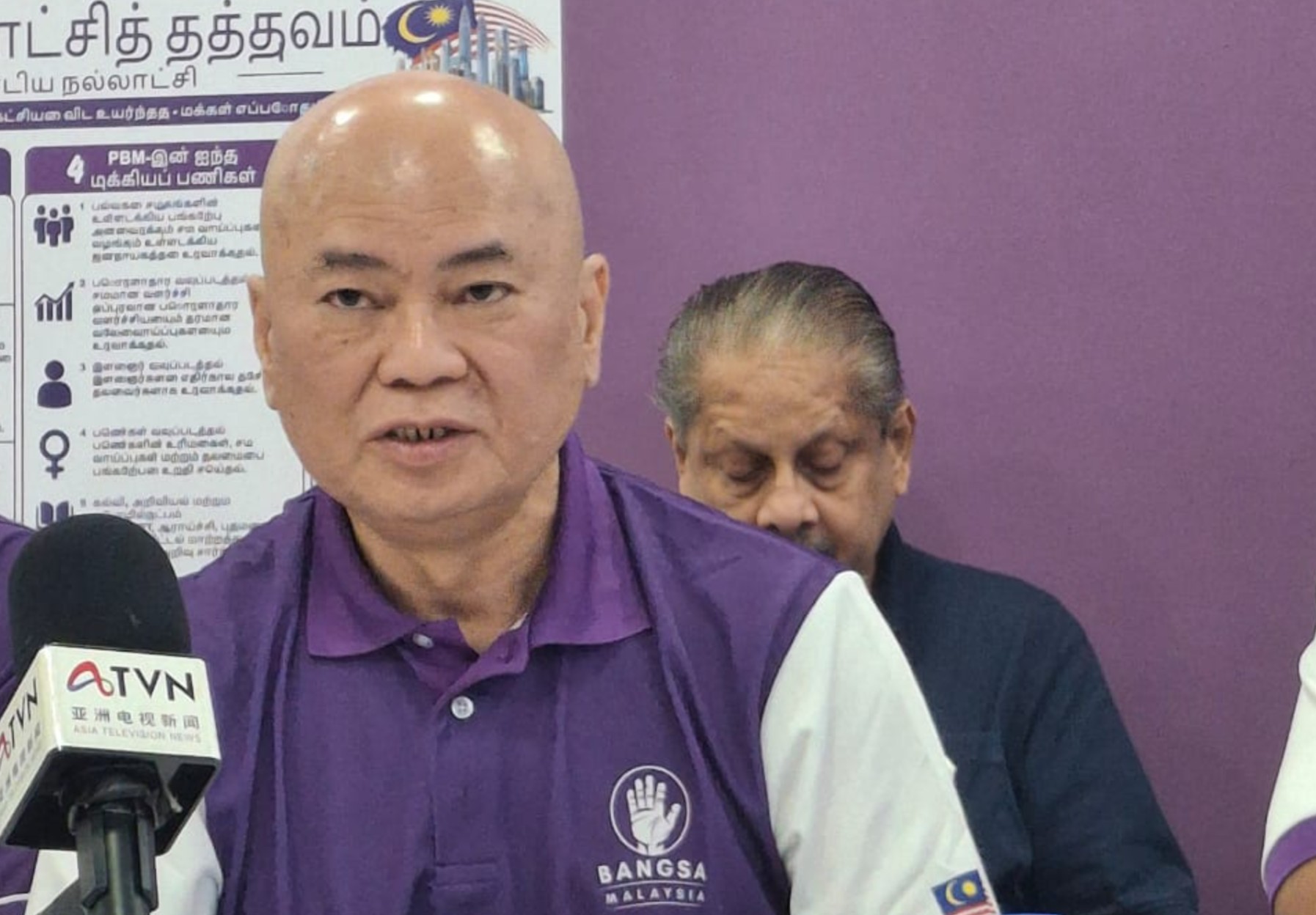
KUALA LUMPUR — The cooperation between Barisan Nasional (BN) and Perikatan Nasional (PN) is merely a temporary arrangement and will eventually collapse, said former DAP leader Ronnie Liu.
Liu, who recently joined Parti Bangsa Malaysia (PBM), described the partnership as a “marriage of convenience”, arguing that both coalitions would eventually find themselves competing against each other for the same Malay voter base ahead of the 16th General Election (GE16).
“Marriage convenience, I think that is very temporary. Very soon we will see cracks between PN and BN. Very soon,” he said at a press conference in Kuchai Lama today.
He said the cooperation between BN and PN in Negeri Sembilan was more likely a strategic move rather than a long-term political partnership.
“What happened in Negeri Sembilan is just tactical. Not permanent. They will divorce.”
“They will go separate ways. And in coming GE, because they are all fighting for the same gold bank, there’s no way they can work together,” he added.
Liu predicted that BN and PN would eventually contest GE16 separately, rather than maintaining their current cooperation.
Asked whether a split could happen earlier, such as during the Malacca state election, Liu said the state could become the first test of their relationship.
“It will start from Malacca. If they are not careful,” he said, adding that the political landscape in Malacca was more complex as both BN and PN believed they had strong support there.
Meanwhile, commenting on DAP’s performance in recent state elections, Liu said dissatisfaction with the government had contributed to declining voter turnout among non-Malay communities, including previous supporters of Pakatan Harapan (PH).
He said frequent changes in government since 2018 had caused frustration among voters over unfulfilled promises and policies they felt were not part of the original agenda.
“I think in general, people are not happy with the government. Not happy with the promises.”
“Not happy with a lot of promises in the manifesto. It was not delivered. And then a lot of things that nobody asked for, but suddenly it falls on us.”
“A lot of bad policies. So people in general are quite pissed off, actually,” he explained.
Liu estimated that more than 40% of non-Malay voters had stayed away from the ballot box in recent state elections, contributing to weaker voter turnout.
“Judging from the turning out of the voters, starting from Sabah to Johor, then Negeri, I think more than 40% of the non-Malays didn’t show up to cast their votes,” he added.
He said voters who continued participating in elections were becoming increasingly divided between established parties such as DAP and MCA, while new political platforms could also attract support.
“So if there’s no new platform, new parties, I foresee that the situation continues,” he said.
Liu said PBM hoped to position itself as an alternative platform that could appeal to Malaysians across different backgrounds, particularly younger voters.
“So our new platform will be for everybody, all Malaysians, all walks of life. Of course we will pay special attention to young people. We want to pass on our experience to young people, young politicians,” he added.
He said voters were dissatisfied with both the current administration and previous governments, creating an opportunity for new political alternatives.
“I sense that people in general are not happy with the current government, but they haven’t forgiven the past governments for the wrong things and things like that. So that’s where the new platform is coming in,” he explained.
Liu said the evolving political landscape meant parties could no longer depend solely on traditional support bases, with GE16 expected to be a more competitive contest.
“Because they are all fighting for the same gold bank, there’s no way they can work together. No way they can work together,” he said.
Liu returned to active politics today after joining PBM, with the party keeping its options open on contesting upcoming state elections and GE16, while also exploring possible cooperation with other political parties. – August 9, 2026