

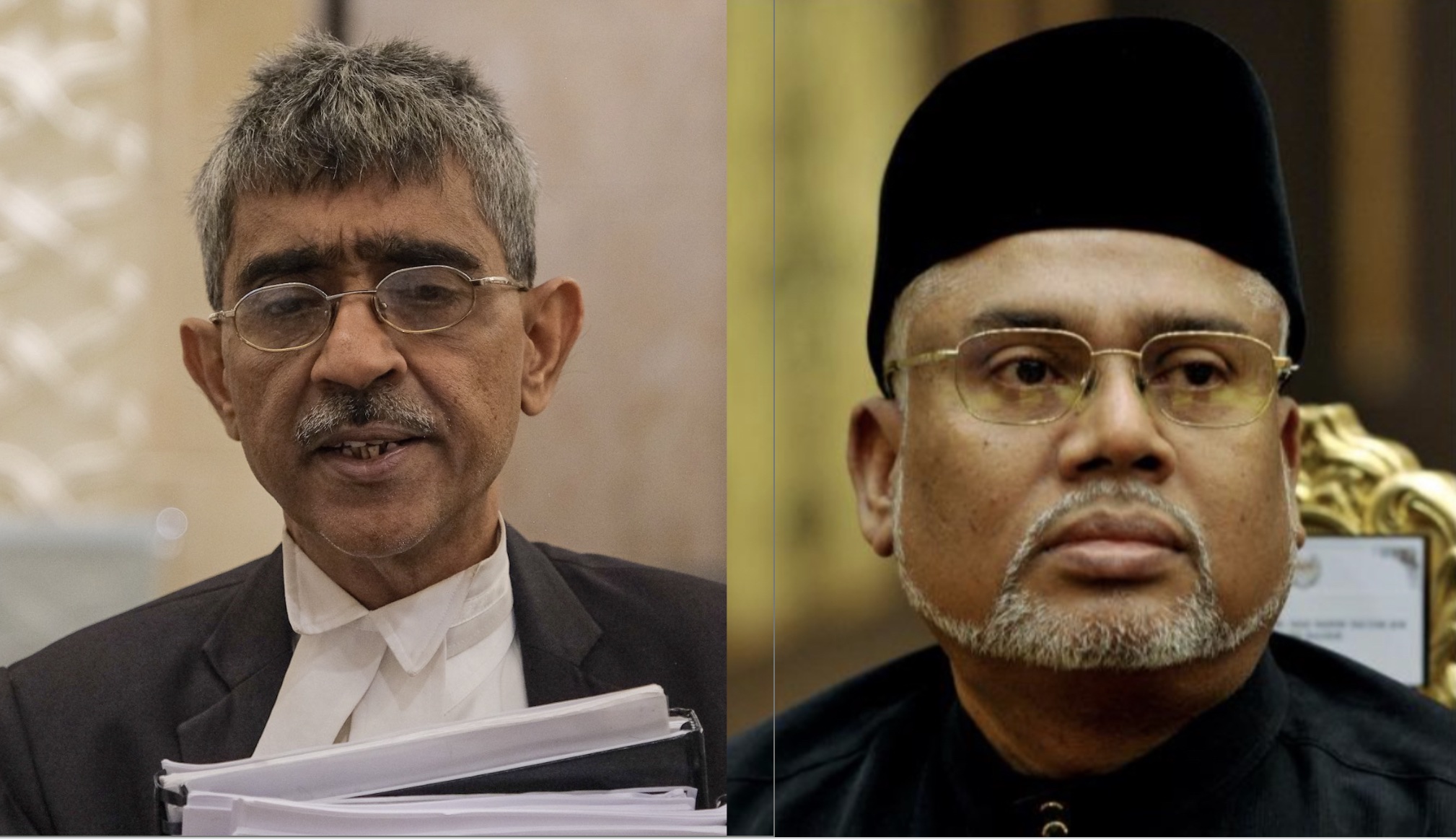
KUALA LUMPUR — The constitutional dispute in Negeri Sembilan can be solved in two ways, with a lawyer calling for the matter to remain within the domain of the royal institution, while a retired judge says the apex court should take up the issue for review of its own accord.
Lawyer Haniff Khatri Abdulla said the dispute involving the position of Yang di-Pertuan Besar Negeri Sembilan Tuanku Muhriz Tuanku Munawir should not be debated publicly as doing so could undermine public confidence in the royal institution.
There are instead existing constitutional and customary mechanisms, including the Dewan Keadilan dan Undang (DKU), although he acknowledged that the status of the body itself was currently disputed.
“When we have a conflict between the royals, it is not for public consumption.”
“When public weighs in on who is right, who is wrong, then the issues on the merit of the dispute will become public domain. And that would bring the royal institute into ridicule and odium,” Hanif Khatri told Scoop.
He added that he had previously proposed for the Conference of Rulers to establish a Royal Tribunal to resolve disputes involving state royal institutions.
He said such a mechanism could also provide a permanent avenue to deal with similar disputes involving other states in the future.
“I urge for the Conference of Rulers to convene a special meeting and create this Royal Tribunal to allow disputes such as this to be brought directly to them in a very private and confidential matter,” he said.
As such, Haniff Khatri rejected calls for the Federal Government to intervene directly in the dispute over the Negeri Sembilan throne.
Putrajaya’s intervention was proposed by 10 former Malaysian Bar presidents yesterday, after Negeri Sembilan Menteri Besar Datuk Ismail Lasim refuted a royal order to dismiss the state executive council (Exco) members.
The Exco on Sept 15 had endorsed a proclamation by the state’s territorial chieftains (Undang Yang Empat) to depose Tuanku Muhriz and replace him with Tuanku Nadzaruddin Tuanku Ja’afar as the new Yang di-Pertuan Besar.
The 10 former Bar presidents questioned if the attempt to remove Tuanku Muhrzi had followed Article 10 of the state constitution which provides for a “complete enquiry by the Undangs” before a Ruler could be removed.
Haniff Khatri, however, said Putrajaya had no say on the issue of state royal powers. He also said the Attorney-General’s view, which backed Tuanku Muhriz as the rightful Yang di-Pertuan Besar, should not be treated as binding on the state.
Federal Court can initiate review
Retired Court of Appeal judge Datuk Dr Hamid Sultan Abu Backer offered a different route, arguing that disputes involving constitutional functionaries should ultimately be brought before the courts.
He said any dispute over a Ruler’s decision should be challenged through the courts, and the courts could do this suo motu. This Latin legal term means “on its own motion or initiative”.
“Misconduct of constitutional functionaries can be immediately reviewed by the Federal Court on its own motion issuing suo motu orders or directions.
“It is a super fast review process and is frequently employed by Indian Supreme Court under specific articles in their constitution which provide for it,” said Hamid Sultan.
He also said that judges, in taking their Oath of Office, swear to protect, preserve and defend the Federal Constitution, and as such, courts have constitutional judicial power “which is more superior than the judicial review principle”.
Hamid Sultan said he had been advocating for the courts to decide using suo motu when constitutional crises arise for the last 20 years.
“It is a pity that the Malaysian legal fraternity has not picked this up…Perhaps it is time for the Attorney General to approach the Federal Court to seek suo motu orders or directions to expeditiously resolve Negeri Sembilan dispute,” he added.
Ismail had earlier signed the state Exco’s endorsement of the removal proclamation against Tuanku Muhriz. This led to the Attorney-General’s Chambers to state that Ismal as Menteri Besar and the state Exco had no unilateral power to terminate or vacate the position of the Yang Dipertuan Besar of Negeri Sembilan.
The state Dewan Keadilan dan Undang (DKU) also affirmed that Tuanku Muhriz remains the legitimate Yang Dipertuan Besar of Negeri Sembilan and Chairman of the DKU.
Ismail, in his refusal to comply with Tuanku Muhriz’ order to dismiss the state Exco, said the Ruler had not acted in accordance with the state constitution.
The Menteri Besar said Article 40(1) of the state constitution required Tuanku Muhriz to act based on the advice of the Menteri Besar and the Exco in matters of executive administration. As such, the Yang di-Pertuan Besar had no constitutional authority to decide on the removal of the Exco, Ismail said. – September 22, 2026