

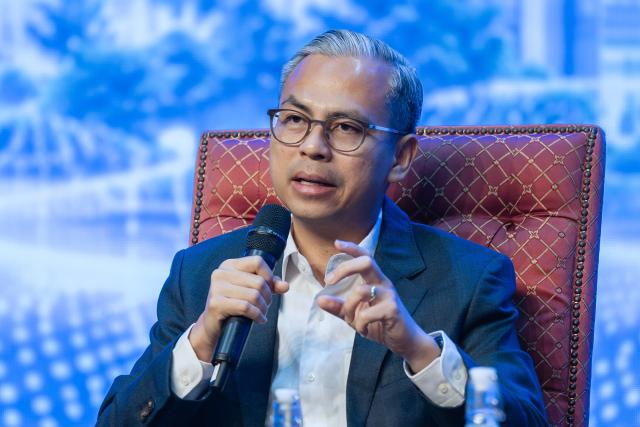
KUALA LUMPUR – Researchers and higher education institutions in the country should forge closer strategic collaborations with local telecommunication companies (telcos) to tap industry funding for research and development (R&D), Minister of Communications Datuk Seri Fahmi Fadzil said.
He said telcos had dedicated R&D funds and were willing to support research efforts, particularly those concerning connectivity and technological solutions.
“Don’t just ask from the Ministry of Communications; ask also from the telcos. They understand that students and researchers, especially first-year students, are current and future users of their services.
“They have to be close to where the future of the country is going to be,” he said.
Fahmi was speaking at a plenary session titled “Charting Malaysia’s Path to 2030: Research, Innovation and Investment for National Development” at the University Research and Innovation Investment Summit 2026 (URIIS 2026) at the World Trade Centre Kuala Lumpur today.
Finance Minister II Datuk Seri Amir Hamzah Azizan was also a panellist at the session. The summit was officiated by Deputy Prime Minister Datuk Seri Dr Ahmad Zahid Hamidi.
Fahmi said university researchers should partner more comprehensively and closely with the industry to create greater value, especially when research is aided by artificial intelligence (AI) technology.
He also encouraged researchers to leverage the 1,099 National Information Dissemination Centres (NADI) nationwide as “living labs” to test their products and innovations directly with rural communities.
He said every state constituency in the country now has at least one NADI centre, with Sarawak having the highest number at 156 centres.
“A long time ago, NADI was just to provide internet connectivity, computers, and photostat machines. Now, we are able to educate the community which most of those living three to five kilometres from a NADI centre, on how to sell stuff on platforms like TikTok Shop and Shopee,” he said.
The minister said these facilities have enabled rural entrepreneurs to thrive, citing an example of a woman in Dengkil, Sepang who earns an official income of about RM45,000 a month selling buns online and offline through the skills and facilities provided through NADI.
Fahmi said affordable, secure, and widely accessible high-speed internet could also help reverse rural-to-urban migration by enabling people to establish businesses in their home villages.
Highlighting the quality of rural infrastructure, the minister noted that internet speeds at NADI centres in FELDA Soeharto at Sungai Besar, Selangor, and Kampung Sim-Sim at Sandakan, Sabah, had reached about 1 gigabit per second (Gbps), surpassing the 800 megabits per second (Mbps) at Parliament.
Beyond providing internet access, he said NADI centres also serve as community referral hubs, parcel pick-up and drop-off points, skill training centres for sewing and phone repairs, as well as assistance points for government aid applications like Sumbangan Tunai Rahmah (STR).
Therefore, Fahmi advised researchers not to remain confined to the “ivory tower”, but to stay grounded in reality and base their research on real-world needs to make Malaysia a better place. – September 22, 2026