

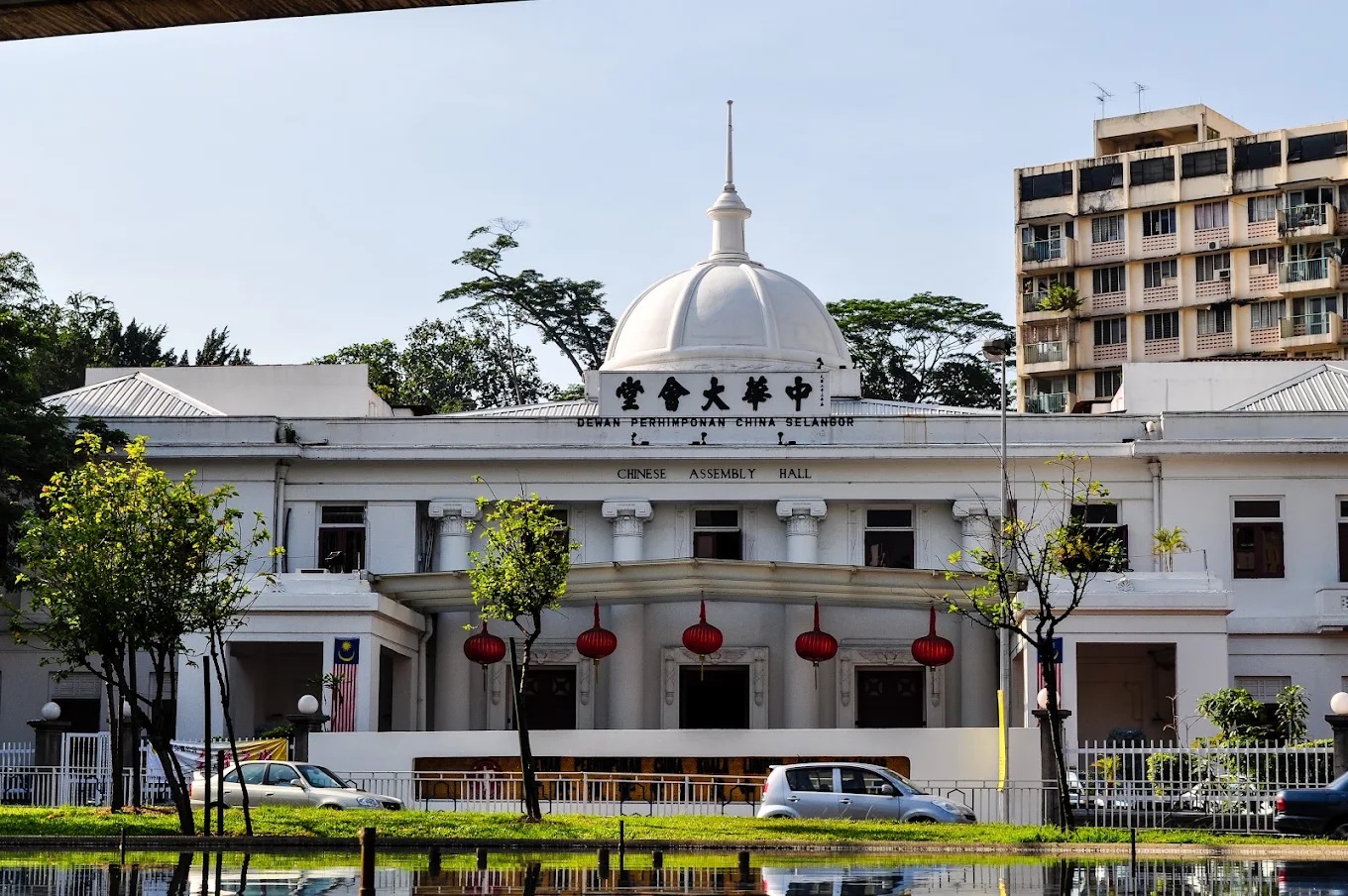
KUALA LUMPUR – The Kuala Lumpur and Selangor Chinese Assembly Hall (KLSCAH) hosted historic discussions between Umno and MCA in 1952 that helped lay the foundations for Parti Perikatan, making its preservation a matter of shared national heritage rather than race, says a DAP leader.
DAP Federal Territory treasurer Ben Fong Kok Seng said it was ironic that the building, which played a role in bringing Malay and Chinese political leaders together, had become the subject of racial controversy following the approval of its 99-year land lease renewal at a nominal premium of RM1,000.
Parti Perikatan, the predecessor of Barisan Nasional (BN), subsequently led Malaya to independence.
Fong also pointed out that KLSCAH was officially opened in 1934 by the then Sultan of Selangor, Sultan Alauddin Sulaiman Shah, the great-grandfather of the state’s reigning Sultan.
“There is therefore considerable irony in the present controversy. A DAP minister has helped secure the long-term preservation of a building associated with the political origins of BN, while some political critics are now attempting to turn the decision into a racial issue.
“Have they forgotten the significance of the very building they are now attacking the government for preserving?” he said in a statement today.
He said although the assembly hall was established by the Chinese community, its historical importance extended beyond ethnic boundaries, particularly given its association with Malay-Chinese cooperation in the country’s formative years.
KLSCAH was declared a National Heritage building in 2007, with the National Heritage Department subsequently allocating RM500,000 for conservation work in 2008.
On the controversy surrounding the reduced land premium, Fong said the decision to renew the lease for RM1,000 should be viewed in the context of the land’s reclassification from commercial to institutional use.
He said the change meant the property could no longer be commercially developed for projects such as condominiums or shopping malls, as it had to be retained for institutional and heritage purposes.
As such, the earlier estimated premium of RM4.67 million should not be considered without taking into account the restrictions now imposed on the land, he added.
Fong also argued that granting nominal land premiums to institutions serving the public interest was not without precedent.
He cited the 2021 decision under the administration of then prime minister Tan Sri Muhyiddin Yassin to grant historic Convent Bukit Nanas in Kuala Lumpur a 60-year lease extension at a premium of RM1,000, subject to restrictions on land use.
The decision followed public calls for the school’s preservation, including from then Bukit Bintang MP Fong Kui Lun of DAP.
“While the circumstances of the two cases are not identical, the principle was accepted under a previous administration. Why should the preservation of a historic institution suddenly become controversial simply because the present decision was made under a DAP minister?” he said.
Fong said the MADANI government should extend similar consideration to other heritage sites and institutions, regardless of the communities they represented.
He stressed that preserving national heritage should not be interpreted as favouring one ethnic group over another.
His statement comes amid criticism from Umno and PAS leaders over the lease renewal, with Federal Territories Minister Hannah Yeoh accusing her detractors of attempting to racialise the issue.
In a Facebook post today, Yeoh said some opposition figures and government backbenchers had accused her of looking after her own community and allowing KLSCAH to avoid paying a higher premium because she was a Chinese minister from DAP.
Yeoh explained that the reduction from the earlier RM4.67 million valuation was linked to KLSCAH’s voluntary decision to change the land classification to institutional use, effectively giving up the potential for major commercial developments.
She also said the 103-year-old building operated at an annual deficit of about RM400,000 due to rising maintenance costs, its ageing structure and the need for safety upgrades.
Despite the reduced premium, Yeoh said KLSCAH remained responsible for paying quit rent to the land office, assessment tax to Kuala Lumpur City Hall (DBKL) and income tax to the Inland Revenue Board.
She also questioned the track record of previous Kuala Lumpur administrations in preserving public assets, pointing to the restoration of the Sultan Abdul Samad Building and Carcosa Seri Negara under Prime Minister Datuk Seri Anwar Ibrahim’s administration.
Yeoh further alleged that public fields and flood retention ponds had previously been sold for commercial development during the time Umno and PAS administered the capital.
Umno Youth chief Datuk Dr Muhamad Akmal Saleh had earlier demanded an explanation for the reduction, arguing that the prime city-centre land still carried a valuation of RM4.67 million.
Meanwhile, PAS Kuala Terengganu MP Ahmad Amzad Hasim called on the government to disclose the conditions and protection clauses attached to the reduced premium.
Academic Prof Emeritus Datuk Dr Teo Kok Seong also described the RM1,000 premium as unreasonable, arguing that the original valuation of RM4.67 million was based on concrete grounds.
Fong urged political leaders to stop exploiting the controversy to inflame racial sentiments, warning that such rhetoric could damage relations between communities.
“Such irresponsible rhetoric only breeds suspicion and resentment between communities, undermining the mutual understanding and trust that generations of Malaysians have worked hard to build.
“As 2026 draws to a close and we prepare to celebrate the 70th anniversary of Merdeka in 2027, we should be reflecting on how far we have come as a nation and how much more we can achieve together, rather than allowing ourselves to be dragged backwards by divisive racial politics.
“Malaysia’s history belongs to all Malaysians. It should not be rewritten or selectively forgotten for political convenience,” he said. – November 17, 2026