

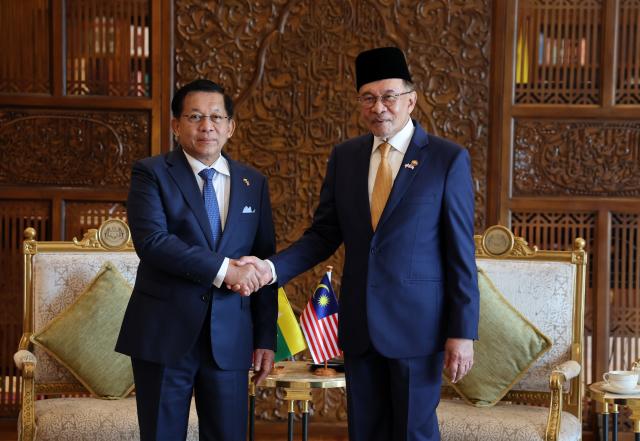
PRIME Minister Anwar Ibrahim has some explaining to do. On October 8, he welcomed Myanmar’s military leader Min Aung Hlaing on a state visit, despite warnings from stakeholders about the implications of according him such diplomatic recognition.
This was no ordinary diplomatic engagement. The-then International Criminal Court (ICC) prosecutor Karim Khan had, in November 2024, applied for an arrest warrant against Min Aung Hlaing over alleged crimes against humanity, specifically the deportation and persecution of the Rohingya. ICC judges have yet to make a public decision on that application.
Anwar’s decision is now even harder to defend. The International Court of Justice (ICJ) has delivered a historic judgment finding Myanmar responsible for genocide against the Rohingya during the military’s 2017 “clearance operations” in Rakhine state.
For the first time, the world’s highest court has found a state responsible for genocide in a judgment on the merits. This is a monumental victory for the Rohingya, particularly survivors who have spent almost a decade seeking recognition, accountability and justice. It is also a vindication of The Gambia, which took the extraordinary step of bringing Myanmar before the ICJ in 2019.
The Court found that Myanmar’s military killed thousands of Rohingya civilians, committed widespread sexual violence, subjected children to extreme violence, attacked people fleeing their homes and destroyed villages. Crucially, it found that these acts were committed with the specific intent to destroy a substantial part of the Rohingya population.
Against this backdrop, Anwar’s assurance to Min Aung Hlaing that Malaysia would find ways to facilitate Myanmar’s return to Asean is deeply disturbing.
What exactly is Malaysia seeking to rehabilitate: a military regime whose conduct has now been recognised as genocide by an international court?
Myanmar has been excluded from high-level Asean meetings because of its failure to implement the Five-Point Consensus following the 2021 military coup. Its return cannot be treated as a diplomatic favour, nor should Asean membership become a convenient route to restoring the junta’s international legitimacy.
Reintegration must be contingent on concrete political and institutional change, an end to violence, meaningful engagement with all stakeholders and compliance with international obligations. Offering legitimacy before accountability is not diplomacy but appeasement.
For Asean, the ICJ judgment must be a turning point. The organisation cannot issue statements welcoming the decision and then carry on with business as usual. It must use its collective diplomatic and political influence to compel Myanmar to comply with the Court’s orders.
This means pressing for effective measures to prevent further genocidal acts, investigating and prosecuting those responsible, preserving evidence and ensuring guarantees of non-repetition.
The rights of displaced Rohingya must also remain central, including their right to return safely, voluntarily and with dignity; reinstatement of citizenship; and the opportunity to rebuild their lives. Asean should establish a credible monitoring mechanism, engage independent human rights experts and regularly assess Myanmar’s compliance.
While this is a very welcome ruling, implementation however, will be another uphill battle. The ICJ has no independent enforcement arm, and Myanmar’s military establishment has repeatedly demonstrated its contempt for international pressure.
A landmark judgment means little if governments allow it to gather dust. The United Kingdom has announced action following the judgment, including the expulsion of Myanmar’s defence attaché and calls for an urgent UN Security Council meeting.
Other governments should consider coordinated, targeted sanctions against military leaders and those financing or enabling the junta, alongside freezing assets where legally justified. The international community must also use the two-year reporting period to demand measurable progress, not simply wait for Myanmar to submit its next report. Asean, in particular, must move beyond expressions of concern and become an active force for compliance.
The ICJ has spoken. Now the world must act. And Malaysia, having chosen to extend a state welcome to Min Aung Hlaing and promised to help bring his regime back into Asean, must decide which side of history it intends to stand on. – November 20, 2026
Charles Santiago is a former three-term Member of Parliament for Klang.