

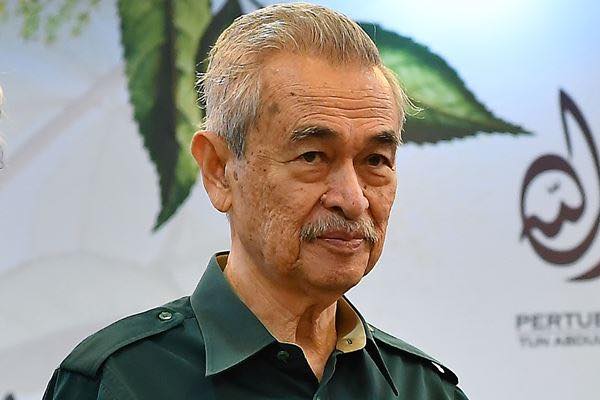
KUALA LUMPUR – Former prime minister Tun Abdullah Ahmad Badawi is in stable condition at the National Heart Institute (IJN) after being admitted for a small spontaneous pneumothorax, or a minor collapsed lung.
Abdullah’s son-in-law, Khairy Jamaluddin, shared this in an Instagram story today, adding that Abdullah is receiving treatment in the coronary care unit (CCU).
“(Abdullah) was admitted to the hospital yesterday because he suffered from a small spontaneous pneumothorax. He is in stable condition and is still in IJN’s CCU for monitoring,” he said.
As such, Khairy also said his father-in-law would not be expecting any visitors, upon instructions from IJN.
“Alhamdulillah, he is in good condition but requires sufficient rest. Representing the whole family, I appreciate all prayers and words of encouragement for him.
“However, IJN has advised against having visitors for the time being.”
In 2022, Khairy said Abdullah suffered from dementia, could neither recognise nor remember family members, and required a wheelchair.
He also said Abdullah had shown signs of cognitive impairments since 2009, after resigning from the prime minister post.
Abdullah, popularly known as Pak Lah, served as prime minister between October 31, 2003 and April 3, 2009. – April 25, 2024