

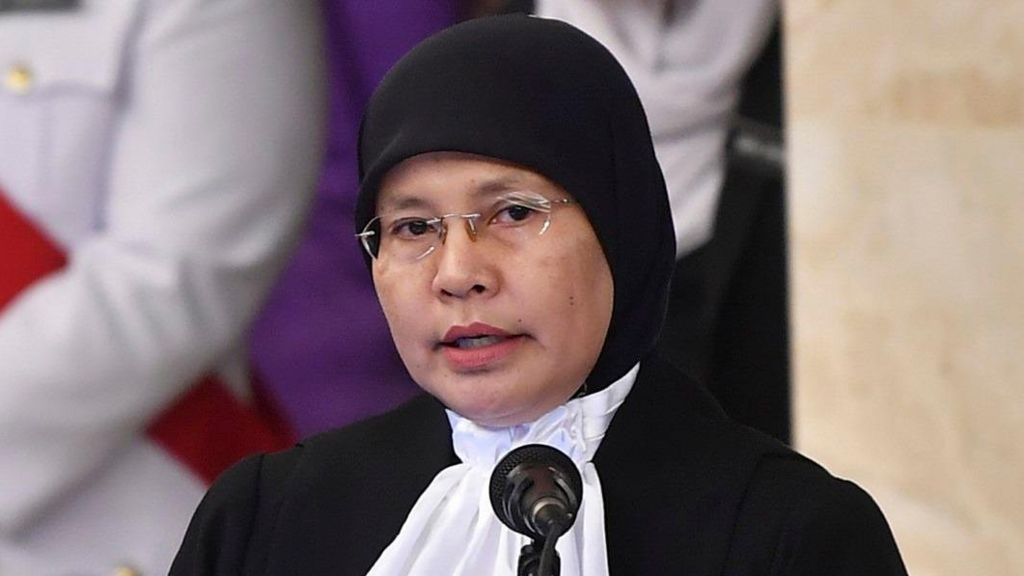
PUTRAJAYA — The appeal by Sisters in Islam (SIS) Forum (Malaysia) does not concern the substantive beliefs, mandates, or doctrines of the Islamic faith, but instead relates to the exercise of legal powers by certain state authorities, the Federal Court said in its judgment.
Chief Justice Tun Tengku Maimun Tuan Mat explained that the challenge pertained solely to the review of the Selangor State Fatwa Committee, the Selangor Islamic Religious Council (MAIS), and the Selangor government’s exercise of specific legal powers—distinct from the substance and content of their decisions.
“Although it involves a particular fatwa (religious edict), the case is not about the substantive beliefs of the Islamic religion, nor does it concern the administration of its substantive aspects,” she said in the 40-page majority judgment, Bernama reported.
The Chief Justice noted that in all civilised democracies with independent judiciaries, it is routine for executive decisions to be subject to judicial review. In most such cases, the issue lies not in the discretion exercised, but in the manner in which the decision was made.
On Thursday, the Federal Court, in a 3–1 majority decision, upheld the validity of the 2014 fatwa issued by the Selangor State Fatwa Committee and gazetted by the state government—but only in so far as it applies to individuals, not to companies.
The court held that a fatwa cannot be imposed on an organisation such as SIS Forum, as a corporate entity is not capable of professing a religion.
This ruling partially allowed the appeal by SIS Forum and its co-founder, Zainah Mahfoozah Anwar, to quash the 2014 fatwa, which had declared the group as deviating from Islamic teachings.
In the written judgment published on the judiciary’s website, Tengku Maimun clarified that the Selangor state government and the religious authorities form part of the executive branch and derive their powers from the Federal Constitution and state laws enacted by the Selangor Legislative Assembly.
“The fact that they deal with matters relating to Islamic faith, dogma, and doctrine is beside the point—and in any event, those matters fall outside the Civil Courts’ jurisdiction,” she said.
Tengku Maimun also reaffirmed that, under Article 121(1A) of the Federal Constitution, the Shariah Courts have exclusive jurisdiction over matters within their purview. However, when Shariah Courts act beyond that jurisdiction, their decisions remain subject to review by the Superior Courts.
She reiterated that SIS Forum’s legal challenge did not contest the contents of the fatwa, but rather its application to the organisation.
That challenge, she said, raised constitutional and administrative law issues—matters squarely within the jurisdiction of the Superior Courts.
The Chief Justice further reminded all judges that decisions of the Federal Court are binding unless overturned by a subsequent ruling of the same court, and failure to comply constitutes an affront to the administration of justice.
She also stressed that a fatwa, once gazetted, carries the force of law and is not merely advisory in nature. It is binding on all Muslims in the state and on the Shariah Courts. — June 21, 2025