

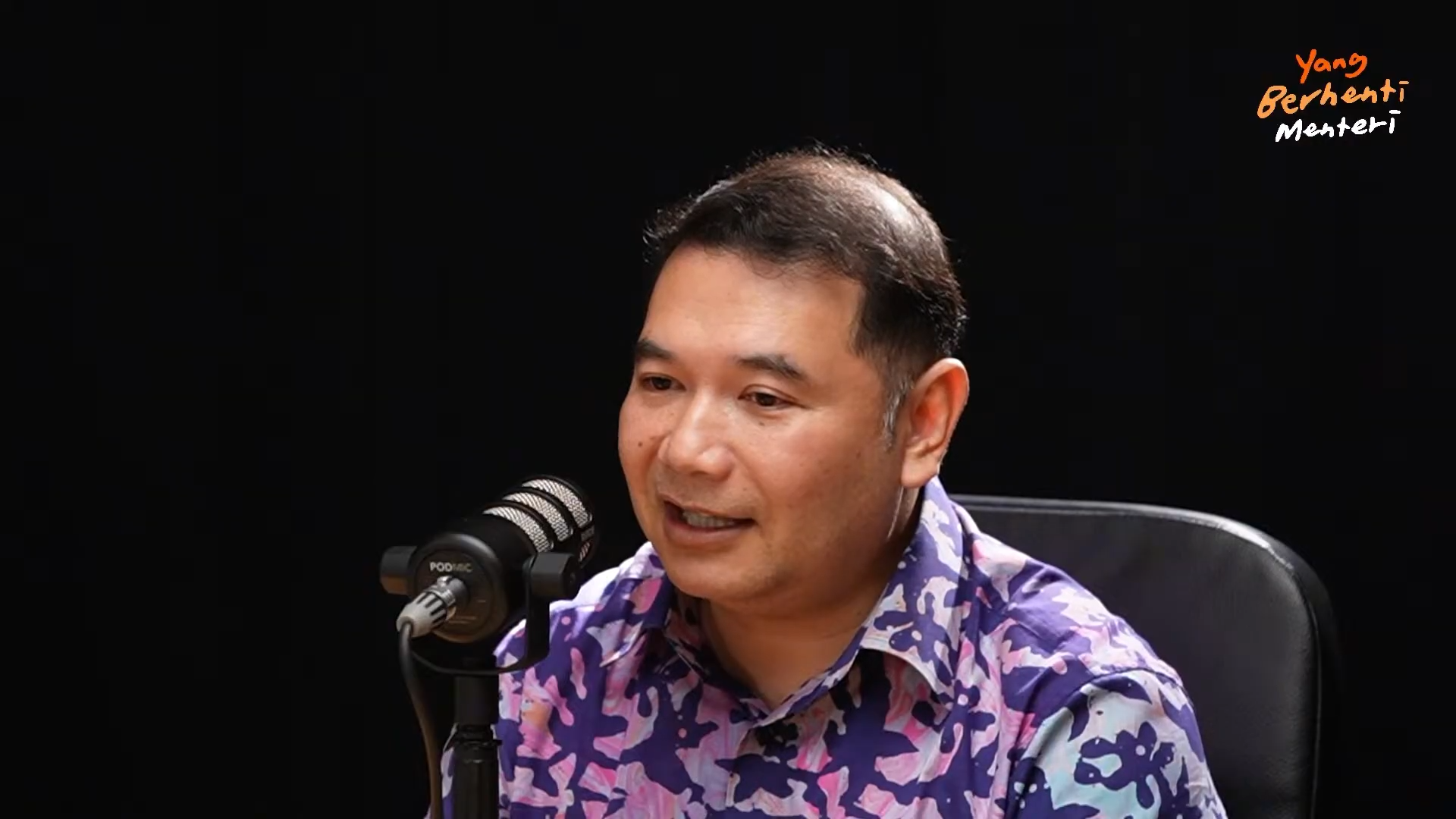

KUALA LUMPUR – Former economy minister Datuk Seri Rafizi Ramli has urged the government not to politicise the 13th Malaysia Plan (13MP) or the Padu central database, warning that short-term manoeuvres to reframe either initiative risk derailing structural reforms already underway.
Speaking on the Yang Berhenti Menteri podcast, Rafizi said 13MP was the result of a two-year process led by the Economy Ministry, involving data analysis, stakeholder engagement and inter-ministerial workshops.
“This is not changing menus in two weeks. We had consensus. If you change things now just to claim it’s someone else’s idea, you risk ending up with something incomplete or cosmetic.
“This isn’t some showpiece. It’s meant to guide the country for five years,” he said.
Rafizi warned that attempts to distance the plan from his tenure would not only waste public sector effort, but also risk losing the public’s attention.
“If people think this is just another political tool, they won’t care. That would be a real loss. Without a reform roadmap the public believes in, the national discourse risks reverting to race and religion – where Perikatan Nasional wants to keep it.”
He added that 13MP was the clearest expression of the unity government’s ability to plan and deliver reforms.
“In my view, the strength of the unity government lies in its ability to govern — unlike PN,” he added.
Rafizi said 13MP was deliberately designed to allow space for feedback and refinements from ministries before its tabling. Following its presentation to Cabinet in February 2025, ministries were instructed to return with any objections or suggestions.
Among the most active was the Education Ministry, which submitted substantial input. Discussions continued through March and April, coordinated by Prime Minister Datuk Seri Anwar Ibrahim, resulting in consensus on key adjustments.
Initially, the tabling was scheduled to be in June. However, Rafizi said that in the midst of the PKR elections, there were suggestions to postpone it to July.
Last month, Finance Minister II Datuk Seri Amir Hamzah Azizan – now also acting economy minister – announced that the government will revise and restructure 13MP to reflect the Madani Economy framework ahead of its tabling in Parliament on July 31.
The move has drawn concern from some policy watchers and business groups who say excessive political input could dilute policy coherence.
The plan, finalised in February this year, was only delayed to incorporate updated economic data – not to rewrite its core direction.
“This is the document that shows what we’re about. Don’t let it be reduced to a political reset.”
Rafizi also pushed back against criticism of Padu, Malaysia’s Central Database Hub, which he said has already started serving its purpose across government.
“Padu was never just about petrol,” he said, amid criticism from the public on it not being used for the petrol subsidy rationalisation move.
“If there were 10 things Padu was meant to do and it’s already doing five or six, that’s progress. It’s being used. Don’t reduce it to just the RON95 issue.”
Launched in January 2024 by Prime Minister Datuk Seri Anwar Ibrahim, Padu consolidates socio-economic and personal data from across government agencies into a single system.
Rafizi said it was intended to improve service delivery and support targeted subsidies – including for education, PTPTN and cash aid – not just petrol.
He said the initiative was also a response to years of fragmented, duplicative digital infrastructure across ministries.
“Each ministry used to build its own system A to Z: spec, database, backend, frontend. And every time, the rakyat had to fill in the same data again and again,” Rafizi said.
“We used to spend RM12 to RM13 billion a year on IT systems like this, developed in silos.”
Despite talk of Padu costing RM85 million, the Pandan MP clarified that the actual cost was around RM20 million plus. Around RM10 million went to IT development, with RM16 million used to hire temporary MyStep officers to assist with registration.
He also highlighted that as of March 2024, the system had registered 21 million individuals from 12 million households – covering roughly 70% of the population.
Rafizi said that although it is not yet actively used by the public, it is already being utilised by ministries and agencies, such as the Digital Ministry’s single sign-on system.
He described Padu as a foundational digital platform to reduce duplication, enable cross-agency coordination and support future reforms.
“Padu is the backbone of any effort to digitise the country,” he said.
“Leave the ministry alone, they’ve done good work. Keep it that way.” – July 5, 2025