

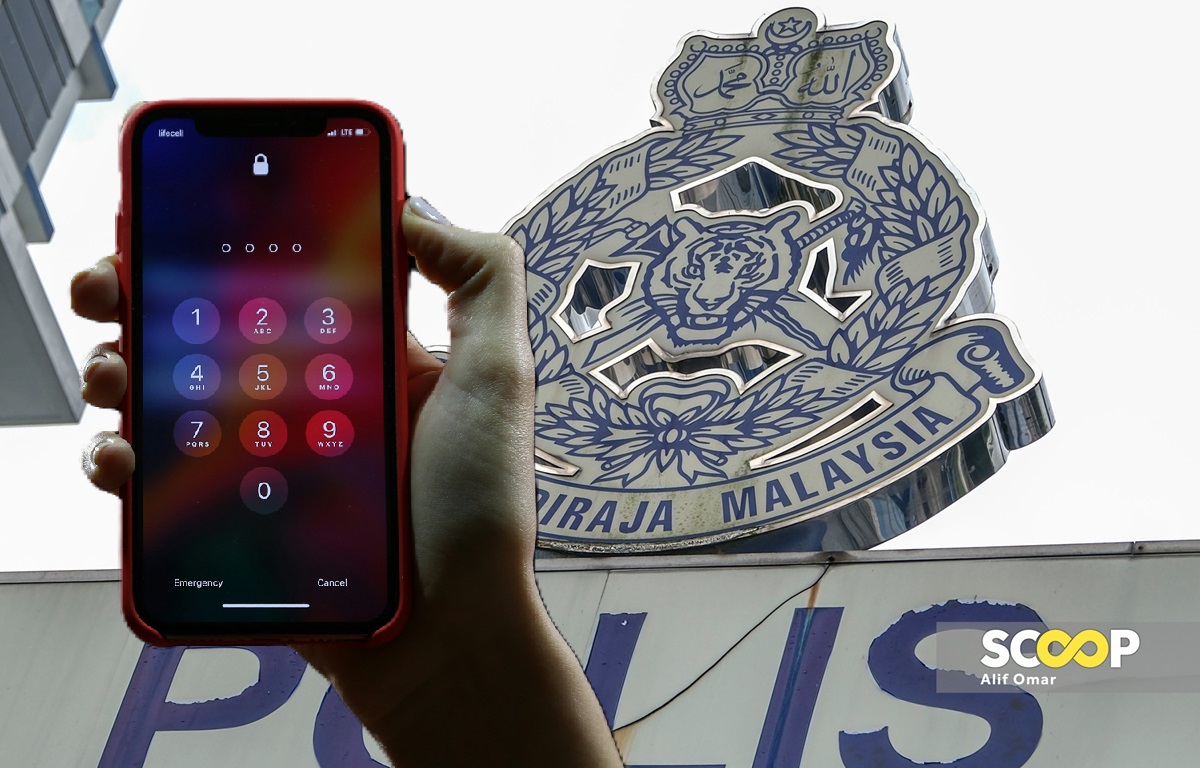

KUALA LUMPUR – On July 20, three men were fined a total of RM11,000 by the Kota Bharu Magistrate’s Court for allegedly possessing obscene images and videos on their mobile phones during a raid at a health screening event in Kemumin, Kelantan, reportedly linked to the LGBT community.
The case has revived an ongoing debate over police powers to inspect individuals’ mobile phones – this time adding a sharper question: can police check your phone even if you are not suspected of committing a crime?
Lawyers Andrew Khoo and Rajesh Nagarajan say the answer is “no”. They argue that officers cannot randomly demand to inspect phones without reasonable grounds.
“(There needs to be a) reasonable suspicion of the commission of an offence, what is referred to as ‘probable cause’ in popular jargon,” said Khoo when contacted by Scoop.
Rajesh added that a phone may only be inspected if the individual is under investigation or the subject of a police report. He stressed that only officers ranked inspector or higher are authorised to conduct such searches – specifically under Section 116B of the Criminal Procedure Code (CPC) and Section 248 of the Communications and Multimedia Act (CMA) 1998.
In the Kelantan case, he said, police had no legal basis to check the men’s phones during an LGBT outreach event, making the search unlawful.
When asked if LGBT-themed apps – including dating platforms – could be considered obscene material, Rajesh clarified that there is no such law.
“However, if police have reasonable grounds to suspect that an app is being used to distribute obscene or indecent media under Section 292 of the Penal Code or offences under the CMA, investigation may follow – but the app itself isn’t illegal simply for being LGBT-themed,” he said.
Legal loopholes and vague definitions
Rajesh noted that due to flaws and ambiguities in current laws, police may still inspect phones even when no offence is suspected – raising concerns about privacy, abuse of power, and lack of oversight.
He pointed to the term “reasonable suspicion” as a key problem, as it remains vaguely defined under the law. Both Section 116B of the CPC and Section 249 of the CMA allow police to access digital devices if they believe an offence has occurred.
“But ‘reasonable suspicion’ is not clearly defined, and in practice, it’s open to subjective interpretation by enforcement officers. This opens the door to broad, discretionary powers, especially at roadblocks where abuse of power may occur,” he said.

Rajesh added that the Federal Constitution currently offers no explicit protection for digital privacy. While courts have read privacy rights into Article 5 (right to life and liberty) and Article 10 (freedom of expression), no statute exists to enforce these rights.
He also highlighted a gap in Section 116B of the CPC, where inspectors and higher-ranking officers can access phones without the need for a warrant or court order, and without standard procedures for recording, reviewing or challenging the access.
“There is no exclusionary rule for illegally obtained devices – even if a search was illegal or unconstitutional, the evidence may still be admissible unless challenged on procedural grounds.
“This reduces accountability for unlawful searches. There’s also no comprehensive data protection or surveillance oversight, as the Personal Data Protection Act (PDPA) only applies to the private sector, not the police or other government agencies.
“There is no independent oversight body or regulator for digital surveillance monitoring state conduct,” he added.
Fix the law, define the limits
Rajesh urged lawmakers to revise existing laws and clarify what constitutes “reasonable suspicion”. He proposed that Parliament introduce a clear, objective test based on verifiable evidence, clear links to a crime, and thresholds such as imminent threats or named suspects.
He also recommended amending Section 116B of the CPC to require a magistrate’s warrant unless there is an emergency. Mandatory post-search documentation should be introduced to notify affected individuals in writing, along with justifications for access.
He called for a new Digital Rights and Privacy Act to protect personal devices, apps, messaging, metadata, and cloud storage – defining surveillance limits and legal remedies for misuse.
“(The government should) amend the PDPA or create a parallel law for public authorities, including the police; amend the Evidence Act to exclude evidence from unconstitutional or illegal phone searches.
“(Also) establish a Digital Rights Commissioner or a parliamentary committee on surveillance and police accountability to audit digital inspections, handle complaints, and review policies and statistics annually,” he said.
Khoo meanwhile stressed that public awareness is key to pushing back against unlawful police actions. He said civilians must know their rights and be prepared to challenge overreach.
He also called on the Independent Police Conduct Commission (IPCC) to prioritise civilian rights instead of shielding officers who conduct unauthorised phone inspections.
“There is also the role of the courts to call out police who step out of line,” he added.
In January, Home Minister Datuk Seri Saifuddin Nasution Ismail stated that police must follow existing rules when inspecting phones.
The minister stressed that enforcement officials must act within legal limits and assured the public that police will not “suddenly” check phones without a proper basis. – July 30, 2025