

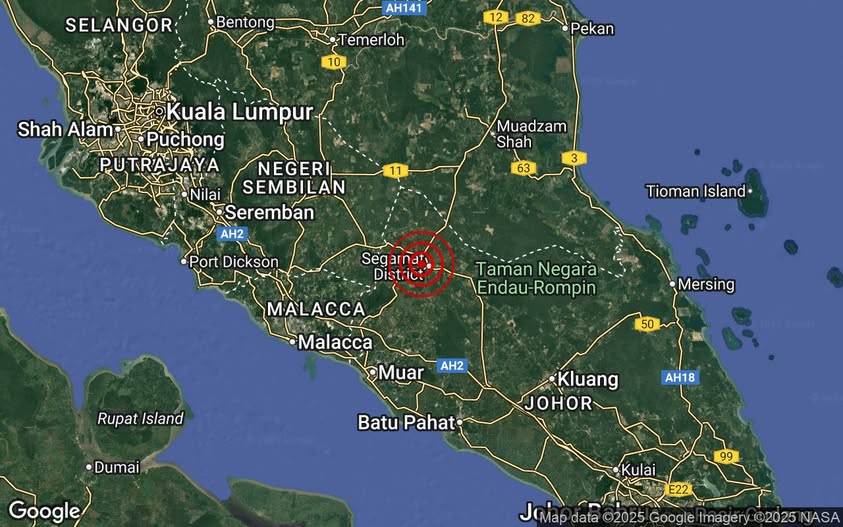
KUALA LUMPUR – The minor earthquake that struck Segamat last week was triggered by renewed movement along the Mersing fault, a geological structure previously thought to be inactive, according to experts.
Dr Mohd Zamri Ramli, a senior lecturer at Universiti Teknologi Malaysia and member of the Engineering Seismology and Earthquake Engineering Research group, said the 4.1 magnitude quake on August 24 — followed by aftershocks of 2.8 and 3.2 — confirmed the fault’s reactivation and highlighted the need for deeper study.
“The occurrence of three tremors in four days in Segamat is not impossible, even though Peninsular Malaysia is considered a low seismic zone,” he said, adding that tectonic pressures from neighbouring Indonesia and the Philippines could trigger dormant faults.
Tremors were also reported in Kluang, Muar and Melaka. According to Zamri, Johor’s hard, ancient crust allows seismic energy to travel further without losing intensity.
“Although the epicentre is in Segamat, surrounding areas can still feel the quake, albeit at a lower intensity,” he explained, Bernama reported.
Malaysia has several known old fault lines, including those in Raub, Genting, Sungai Perak and Terengganu.
The Segamat quake also reignited concerns about building safety. Before 2015, most structures in Malaysia were built under British standards that did not consider seismic loads. Only after the Ranau earthquake in Sabah did the country adopt Eurocode 8, which incorporates earthquake resilience.
Zamri said the Segamat tremor underscored the urgency of updating seismic hazard maps to ensure buildings are designed with accurate parameters.
“The design now takes into account earthquake loads, and the Segamat 2025 experience proves the need to update seismic hazard maps so that reference values such as peak ground acceleration (PGA) are more accurate.
“Otherwise, structures at risk are designed with parameters that are too low,” he warned.
He also urged increased investment in seismic research, stricter adoption of earthquake-resistant design codes, and closer collaboration between MetMalaysia and the Department of Mineral and Geoscience to identify and remap active faults.
For public safety, he advised Malaysians to practise the “Drop, Cover, Hold On” principle during tremors, keep emergency kits ready, and avoid cracked structures.
Local authorities, he added, should ensure critical buildings such as schools, hospitals and mosques meet updated resilience standards. — August 30, 2025