

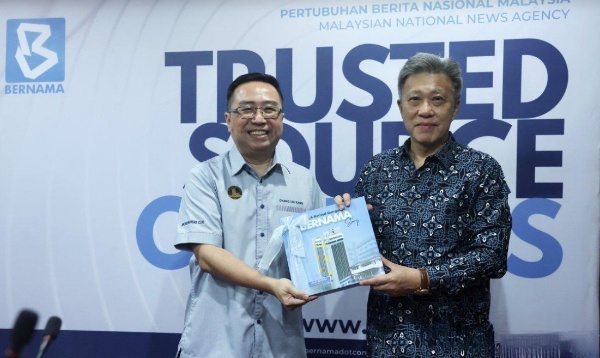

KUALA LUMPUR – Malaysia’s first satellite launch pad will be developed by the private sector, with the government only playing a regulatory role, said Science, Technology and Innovation Minister Chang Lih Kang.
He said the country’s location near the equator offers a significant advantage for the project, allowing more efficient rocket launches by cutting fuel requirements.
“At present, most of the launch facilities are located far from the equator. The nearest one is in French Guiana. A facility near the equator will reduce rocket fuel requirements, which translates into major cost savings.
“This is one of our advantages, although we need to compete with other countries, especially in Asean,” he said after a dialogue session with the Concorde Club at Wisma Bernama today.
Chang added that Malaysia’s strong electrical and electronics (E&E) and semiconductor industries, combined with its relative safety from natural disasters, further strengthen its case as a regional launch hub.
“We have the right recipe for a satellite launching pad. However, I want to emphasise again that this will be a private initiative, while the government will only play a regulatory role,” he said.
While he declined to name the parties involved, Chang confirmed that two foreign companies and a state government have submitted feasibility studies for the project.
On whether Sabah or Pahang was more likely to host the facility, he said the studies were ongoing and several factors would determine the final site.
“It is not only about the suitability of the location, but also other aspects such as wind conditions and weather. For instance, if it is constantly sunny, that would be good. International waters and other countries’ territories also need to be taken into consideration,” he explained.
The Malaysian Space Agency (MYSA) previously said Malaysia was on track to become the first Southeast Asian nation with its own rocket launch pad by 2029.
The project, part of the National Space Policy 2030, could generate more than RM10 billion in gross domestic product if the country establishes itself as a regional leader in the growing space industry.
On a separate matter, Chang, who is also Tanjong Malim MP, said the town is expected to see rapid growth driven by major investments in the automotive sector.
He said the Automotive High-Tech Valley, anchored by Geely, and the KLK TechPark, anchored by BYD, will attract the full supply chain of next-generation automotive technologies and vendors to the area.
“In addition, Proton is relocating its Shah Alam plant to Tanjong Malim, which is expected to bring about 6,000 new employees.
“This will contribute to a significant population increase requiring supporting infrastructure such as housing, public amenities and services, while also benefiting local businesses, including food and beverage outlets. So, I see very good prospects in my constituency,” he said. – September 26, 2025