

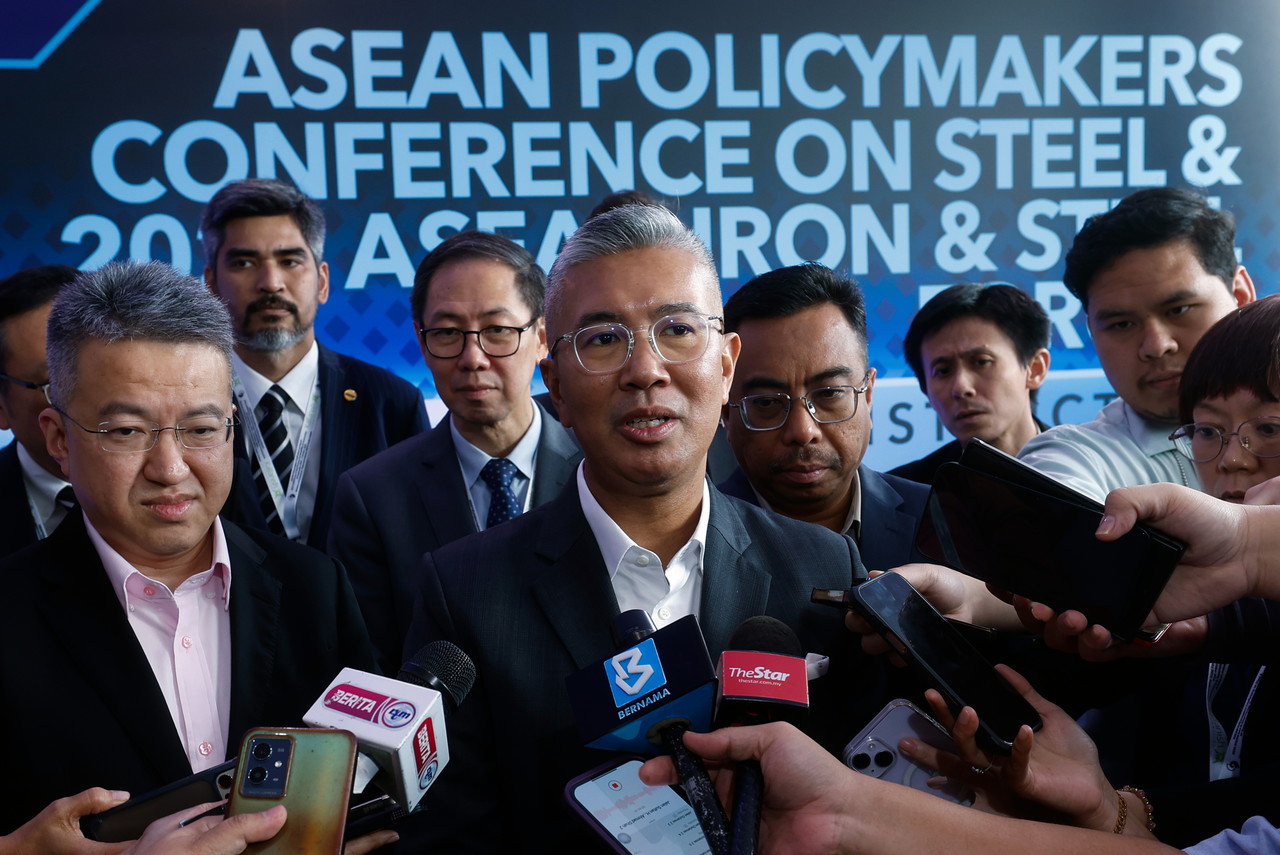

KUALA LUMPUR — Investment, Trade and Industry Minister Datuk Seri Tengku Zafrul Abdul Aziz today launched the Steel Industry Roadmap 2035 (SIR2035), calling it a “sequential pathway” to stabilise, restructure, and transform one of the country’s most carbon-intensive industries.
“Steel remains among Malaysia’s most carbon-intensive industries, exposing us to regulatory market barriers and making decarbonisation a necessity, both environmentally and economically, Tengku Zafrul said at the Asean Policymakers Conference on Steel and the 2025 Asean Iron and Steel Forum.
The roadmap sets out 15 strategies across three stages: stabilisation, resilience, and transformation.
In the next two years, authorities will focus on stabilising the industry by managing overcapacity, tightening licensing frameworks, enforcing action against illegal operators, and securing domestic raw materials. The plan also seeks to lay early groundwork for carbon reduction.
From 2027 onwards, the emphasis shifts to transformation, with investments in low-carbon production, carbon pricing mechanisms, and new technologies. By 2050, Malaysia aims to operate a fully green steel sector in line with its Net Zero commitment.
“This roadmap is in line with the New Industrial Master Plan 2030 and the National Energy Transition Roadmap, ensuring Malaysia’s steel sector remains competitive and resilient,” Tengku Zafrul said.
Malaysia’s steel sector faces a stark mismatch between capacity and demand. By 2030, upstream capacity is projected to reach 40.8 million tonnes, but domestic demand is expected to remain at just 14.7 million tonnes.
“This gap highlights overcapacity – assets underutilised, poor return on investments, and weakening competitiveness,” Tengku Zafrul said.
The minister warned that Asean’s steel market faces mounting external pressure as over 600 million tonnes of excess global steel production seek markets in the region.
Asean demand stood at 74 million tonnes in 2023, close to pre-pandemic highs, and is expected to reach 80 million tonnes by 2025. But supply imbalances persist, with oversupply in long steel products and import dependence in flat steel products.
“This imbalance distorts our markets and creates an excessive burden on Asean’s steel industry,” Tengku Zafrul said, pointing to additional challenges such as anti-dumping tariffs, transhipment practices, and carbon-related trade measures.
Malaysia, he said, is ready to work with Asean to ensure the industry remains viable in the face of global shifts.
“We look forward to turning plans into performance and aspirations into actions, forging a steel industry that is competitive, fair, and future-ready,” he said. — September 29, 2025