

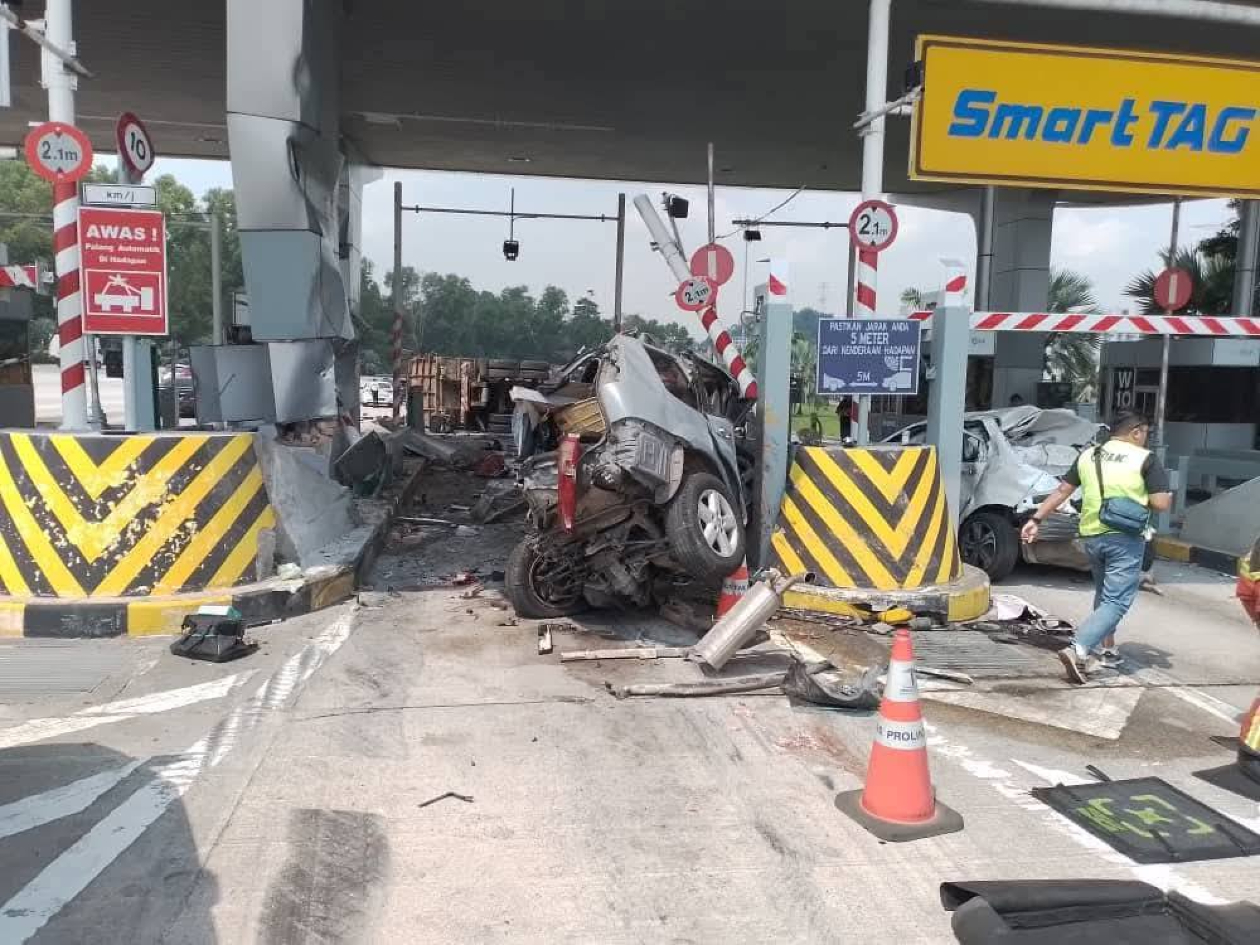

KUALA LUMPUR – The Land Public Transport Agency (APAD) has revoked the operating licence of the lorry company involved in the tragic crash at the Bukit Kajang toll plaza on September 27.
The accident, which occurred on the Kajang SILK Highway, led to the death of a 16-month-old baby boy and left eight others injured when the lorry, loaded with scrap materials, collided with four other vehicles.
In a statement, APAD revealed that an investigation found that LDT Metal Trading, the company responsible for the lorry, failed to install a Global Positioning System (GPS) in the vehicle, violating basic safety requirements for the operation of commercial vehicles.
“Under Section 62 of the Land Public Transport Act 2010, APAD has revoked the operating licence of LDT Metal Trading 201403193195, effective from October 2,” the agency was quoted as saying.
APAD stressed that the cancellation means the company is no longer authorised to operate or use any vehicles under the revoked licence for service purposes.
The agency reaffirmed its firm stance against any violations of regulations or reckless driving involving public transport vehicles. “All licensed operators are reminded to always comply with the terms of their licences to avoid the cancellation of their operating licences,” it said.
Meanwhile, APAD reiterated its commitment to creating a holistic, efficient, safe, and competitive land public transport ecosystem.
Earlier today, the Malaysian Institute of Road Safety Research (Miros) underscored the need for a collective effort in ensuring the safety of heavy vehicles on Malaysian roads. Miros chairman, Professor Dr Wong Shaw Voon, speaking to Scoop, warned that relying solely on Puspakom or any single agency is inadequate to prevent tragic road accidents.
The recent fatal crash at Bukit Kajang toll plaza, where a lorry’s brake failure allegedly caused a four-vehicle pile-up and resulted in the death of a 12-month-old child, exposed significant gaps in the nation’s vehicle inspection and enforcement systems.
The victim, Amir Husayn, was thrown from his family’s car and became trapped underneath it. Authorities suspect mechanical failure may have contributed to the incident.
“It is essential to determine whether the vehicle involved was inspected as required, as this will likely be a key aspect of the police investigation,” Dr Wong said.
He also highlighted the importance of periodic technical inspections (PTI) for heavy vehicles, which are mandated every six months to ensure roadworthiness.
These inspections focus on components such as tyres, windscreens, ignition systems, and the vehicle’s structural integrity.
“Heavy vehicles frequently encounter bumps or carry heavy loads that can affect their structure. We need to ensure they continue to meet safety standards,” Dr Wong explained, stressing that owners must not overlook or underestimate maintenance issues.
“Having a third party conduct inspections is crucial to identify any potential problems. A poorly maintained vehicle can be deadly. If not properly managed, it can lead to fatalities,” he added.
He also called for greater enforcement, urging authorities to monitor and audit inspection companies regularly to ensure they are performing inspections accurately and consistently.
In July, the Transport Ministry appointed four private firms to conduct vehicle inspections alongside Puspakom in an effort to improve efficiency in vehicle ownership transfers and safety checks. This initiative aims to reduce congestion at Puspakom facilities, which have long held a monopoly on inspection services.
The four companies—Carro Technology Sdn Bhd, Carsome Academy Sdn Bhd, Wawasan Bintang Sdn Bhd, and Beriman Gold Sdn Bhd—have been given 12 months to prepare their facilities according to operational guidelines. – October 2, 2025