

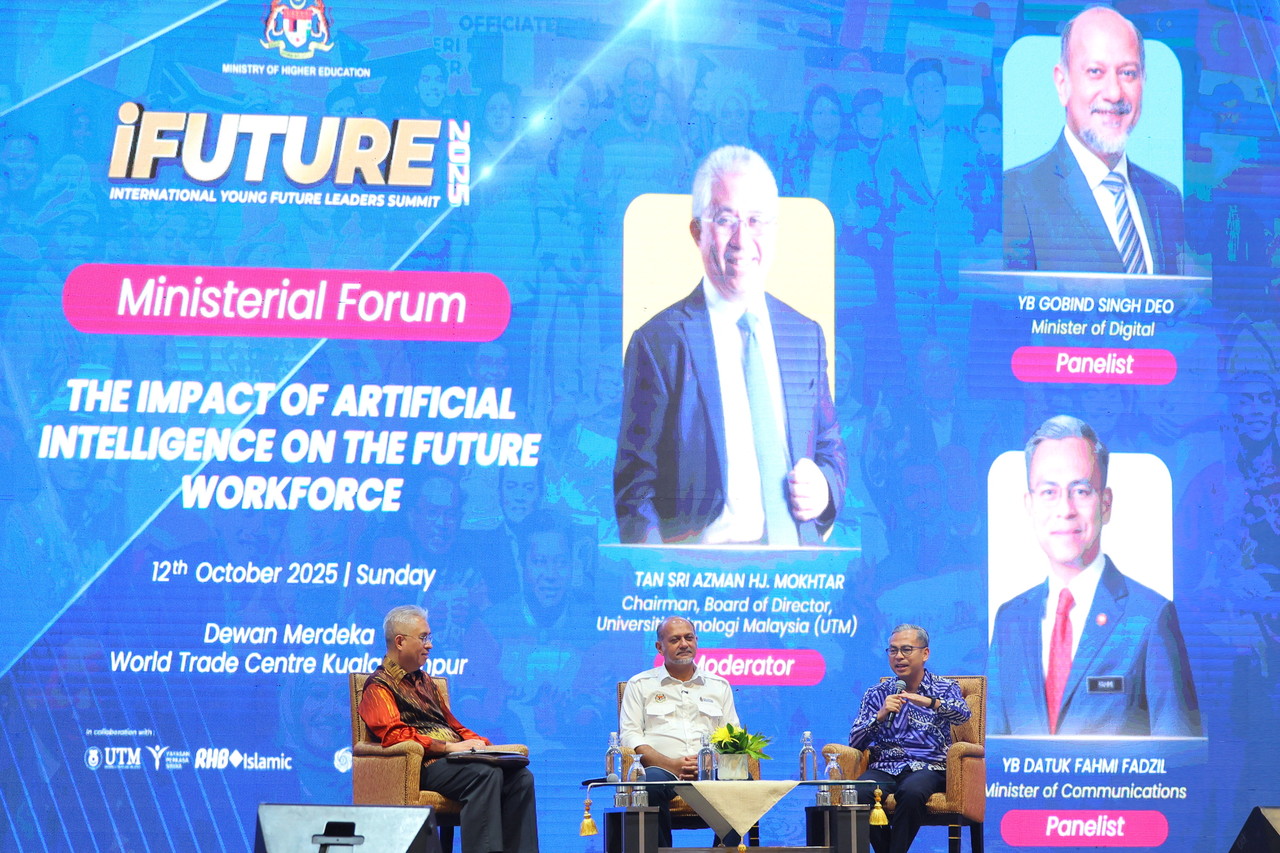

KUALA LUMPUR – Artificial intelligence (AI) should be viewed as a complementary tool to enhance human capability rather than a replacement for workers, Communications Minister Datuk Fahmi Fadzil said today, as he and Digital Minister Gobind Singh Deo called for Malaysia to accelerate readiness in embracing the technology responsibly.
Speaking at the Ministerial Forum: The Impact of Artificial Intelligence on the Future Workforce, held during the International Young Future Leaders Summit (iFuture) 2025, both ministers underscored the need for a whole-of-nation approach to strengthen Malaysia’s digital ecosystem and stay competitive amid rapid technological shifts.
“What’s more important than using these technologies is to possess the right frame of mind. It’s no longer ‘to be or not to be’ — but the question now is, what is the question?” Fahmi said, as quoted by Bernama.
He noted that students tend to be more open to using AI than administrators or lecturers, stressing the need for leadership to set the tone in guiding responsible adoption.
Citing McKinsey & Company’s Super Agency in the Workplace report, he said employees are often more prepared than corporate leaders to embrace digital transformation.
Fahmi pointed to practical examples of AI use in Malaysia, such as Pos Malaysia’s sorting machines, which can process 22,000 letters per minute compared with 1,500 a day by human workers — but still depend on people to interpret unclear handwriting.
“Technology still has its limits,” he said, adding that agencies such as the Auditor-General’s Department are already using AI to summarise reports in days instead of months.
However, Fahmi cautioned that the same technology carries risks. “While AI offers tremendous opportunities, it also opens the door for abuse. Many have contacted me saying their faces were used in deepfake scams,” he said.
Gobind, meanwhile, said Malaysia must build a solid foundation of infrastructure, data and trust to fully harness AI’s potential.
“We need to understand the philosophy behind AI. This gives us the perspective to craft strategies that prepare our country to take advantage of this technology,” he said.
He noted that the Data Sharing Act, which came into force on April 28, will enable ministries and agencies to securely digitise data and create AI-driven solutions.
Malaysia, he added, is attracting major global technology players — including Amazon Web Services, Microsoft, Google, Oracle and NVIDIA — to establish data centres, boosting the nation’s computing capacity for an AI-driven economy.
Gobind stressed that confidence and readiness must evolve alongside innovation.
“The prime minister’s vision of making Malaysia an AI nation by 2030 requires immediate, coordinated action across all sectors if we are to avoid being left behind,” he said. — October 12, 2025