



KUALA LUMPUR – A wooden plank, believed to be a fragment of a shipwreck discovered on Melaka Island, has the potential to unlock new chapters in the region’s maritime history, predating the arrival of Parameswara in the state.
The remarkable find, uncovered through an excavation led by the National Heritage Department (JWN) in collaboration with the Melaka Museum Corporation (Perzim) and Universiti Kebangsaan Malaysia (UKM), is thought to be from a nobleman’s vessel, dating back between 1,200 and 1,300 years, Bernama reported.
This places the ship’s construction long before the official recorded history of Melaka, which begins around 1262 in the 13th century.
JWN Deputy Commissioner, Ruzairy Arbi, stated that the ship’s size, construction materials, and design indicate the advanced maritime skills of Melaka’s people well before the establishment of the Sultanate.
“We have uncovered numerous ship components, including the hull, bow, and floor, buried in the muddy earth. Based on the structure and size, this vessel is estimated to be between 50 and 70 metres long, far larger than previous discoveries, including the Mendam Berahi shipwreck,” he said during a media visit to the excavation site on Melaka Island on Friday.
Also present were JWN Registered Archaeologist Mohd Nasruddin Rahman, Project Leader Muhammad Termizi Hasni, and Perzim General Manager Erne Hamsah.
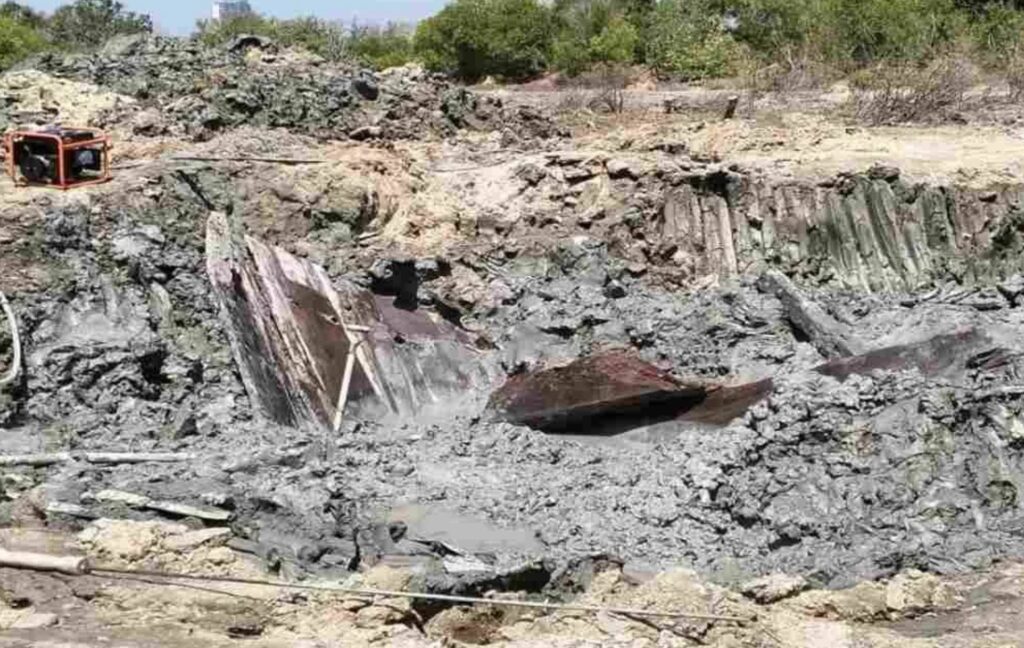
Ruzairy explained that the third-phase excavation in a 12×12 metre area also revealed a large wooden block, whose purpose remains uncertain but is believed to be part of the ship’s main structure.
“We have sent two wood samples to the Beta Analytic laboratory in the United States for testing, and the results show that the ship incorporated local timber species such as saga wood and small amounts of merbau wood. This suggests that the vessel was likely constructed using entirely local materials, rather than imported materials,” he added.
Ruzairy noted that the preliminary analysis revealed that the wooden planks correspond to the shipbuilding techniques used by aristocrats and nobility during Melaka’s golden age, rather than typical merchant vessels.
“This is further supported by the discovery of currency artifacts and porcelain shards at the same site. Based on the size and thickness of the planks, we estimate the ship’s size to be comparable to the Mendam Merahi ship, described in early Southeast Asian historical records,” he said.
He added that the ship’s size suggests it could have belonged to nobility, possibly resembling the luxurious royal sailing ships of today.
Muhammad Termizi, meanwhile, shared that JWN plans to carefully disassemble the ship’s components before sending them for further conservation. The porcelain shards and coins, believed to date from the reign of Sultan Mahmud, will be displayed to the public once excavation and documentation are complete.
“We are carefully exposing the ship’s components, as we aim not only to identify the original positions of each piece, such as the mast, bow, stern, and the ship’s overall structure, but also to understand how the ship was built, who owned it, and its purpose,” he said.
“For instance, no evidence of iron or metal nails has been found. Instead, the construction shows the use of copper nails or wooden pegs—an ancient technique still employed by shipbuilders in Makassar, Sulawesi, today,” he added. – October 31, 2025