

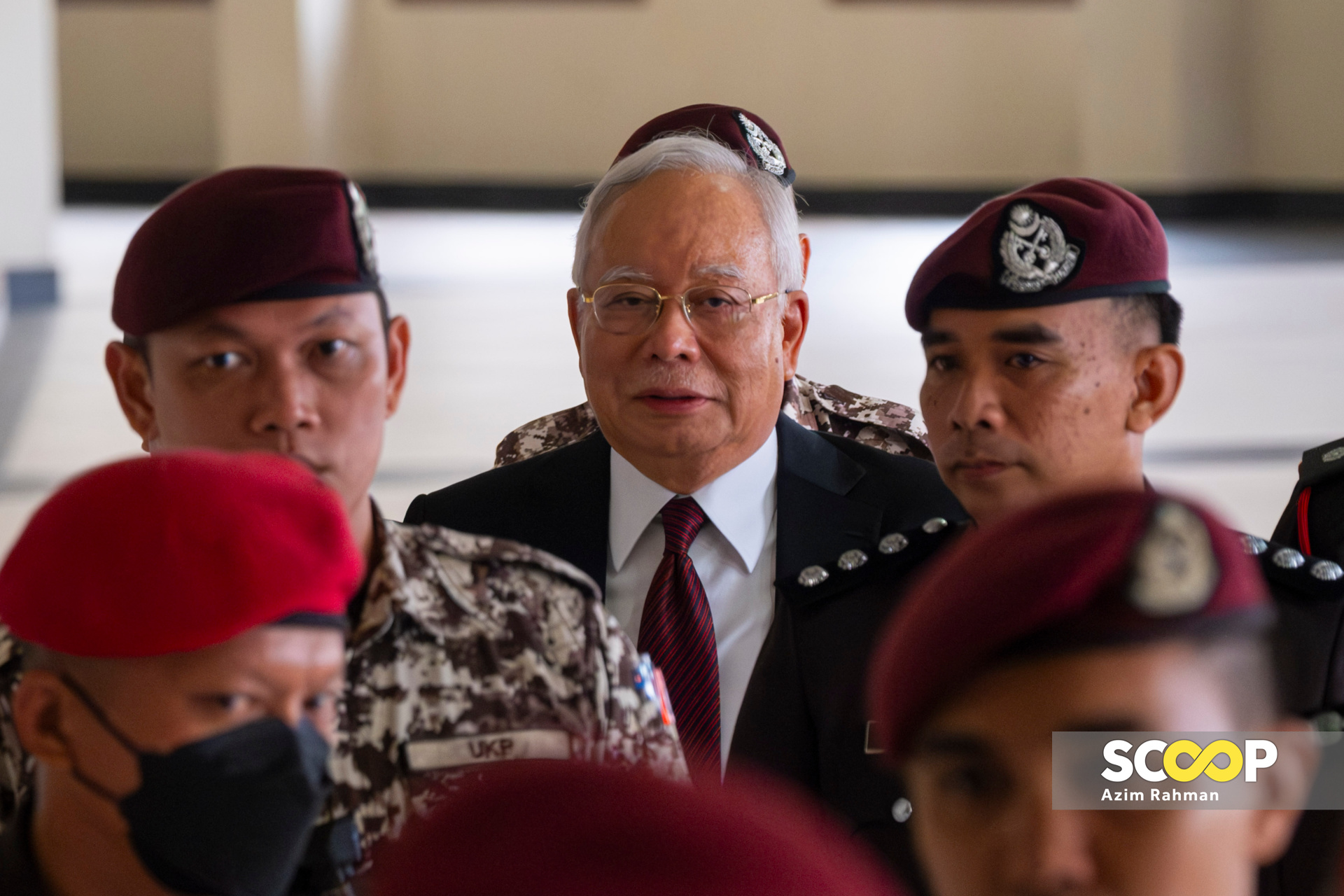

KUALA LUMPUR – Political analysts have warned that Datuk Seri Najib Razak faces slim chances of securing a royal pardon for his 1MDB convictions, with the Yang di-Pertuan Agong reportedly not inclined to grant clemency, leaving the former prime minister’s future largely dependent on legal appeals.
Speaking to Scoop, Lau Zhe Wei of the International Islamic University Malaysia explained Najib’s legal options and the challenges he faces, noting that the former prime minister’s path forward is complicated both legally and politically.
“A pardon is unlikely to be of much use. Even if Najib were to secure a pardon for the SRC case, obtaining one for the 1MDB case would require approval from the current King.
“From my observations, the King does not appear inclined to grant such a pardon at present. Therefore, the only viable options are to pursue an appeal or a judicial review. At this stage, Najib can still appeal, as the high court ruling is only the first instance.
“However, even if he succeeds in his appeal, it is likely that the government would counter-appeal at the Court of Appeal. It is also important to note that the 1MDB case is not the central issue. The key focus remains the SRC case, specifically whether the addendum is deemed relevant or irrelevant.
“A 15-year sentence is a significant period, and it runs consecutively after SRC, which will extend the imprisonment further. Given his age, whether the sentence is 15 years or even 60 years may not be the most pressing concern for Najib personally.”
Lau added that while the case is ongoing, it carries serious political implications.
“The question now is whether Umno will act rationally or emotionally. Even if Umno were to withdraw support from the current Madani government, the government is unlikely to suffer substantial setbacks, and the opposition would gain little,” he said.
House arrest impractical
Dr Oh Ei Sun, Principal Adviser at the Pacific Research Centre of Malaysia, said that Najib must exhaust all legal avenues, including appealing his home detention order and seeking release during his Tanore appeal after serving his current sentence, which could conclude next year with potential remission for good behaviour.
“Anything is possible when it comes to the royal prerogative. These dynamics are likely to influence the pardon process significantly, as there are politicians on the Pardons Board. While many in UMNO would favour Najib’s release, a considerable number in PH oppose it, effectively cancelling each other out. It is therefore extremely difficult to predict the outcome,” he said.
Meanwhile, Dr Azmi Hassan from the Nusantara Academy for Strategic Research said combining the 1MDB and SRC cases makes house arrest impractical.
“From a legal standpoint, the most realistic course of action is to seek a pardon once again, or to request forgiveness from His Majesty the Yang di-Pertuan Agong. Implementing house arrest simultaneously for both cases would be challenging,” he said.
Azmi added that any subsequent pardon must follow proper procedure.
“The granting of a pardon ultimately depends on His Majesty. Any subsequent pardon must be approved if Najib submits a second request. I am confident His Majesty will follow the proper procedure, unlike the first pardon, which did not undergo the proper process.
“Regarding political capital, I do not intend to use this issue to strengthen any party, as it could portray Najib as a political victim. That is why he was found guilty in both cases,” he explained.
Najib, Malaysia’s former prime minister, was recently convicted on all 25 charges linked to the 1MDB scandal, including abuse of power and money laundering involving approximately RM2.3 billion.
The High Court imposed a 15-year prison sentence for the 1MDB charges, which will run consecutively after his existing SRC International sentence. Both cases remain under appeal, leaving his legal options and the possibility of a pardon uncertain. – December 29, 2025