

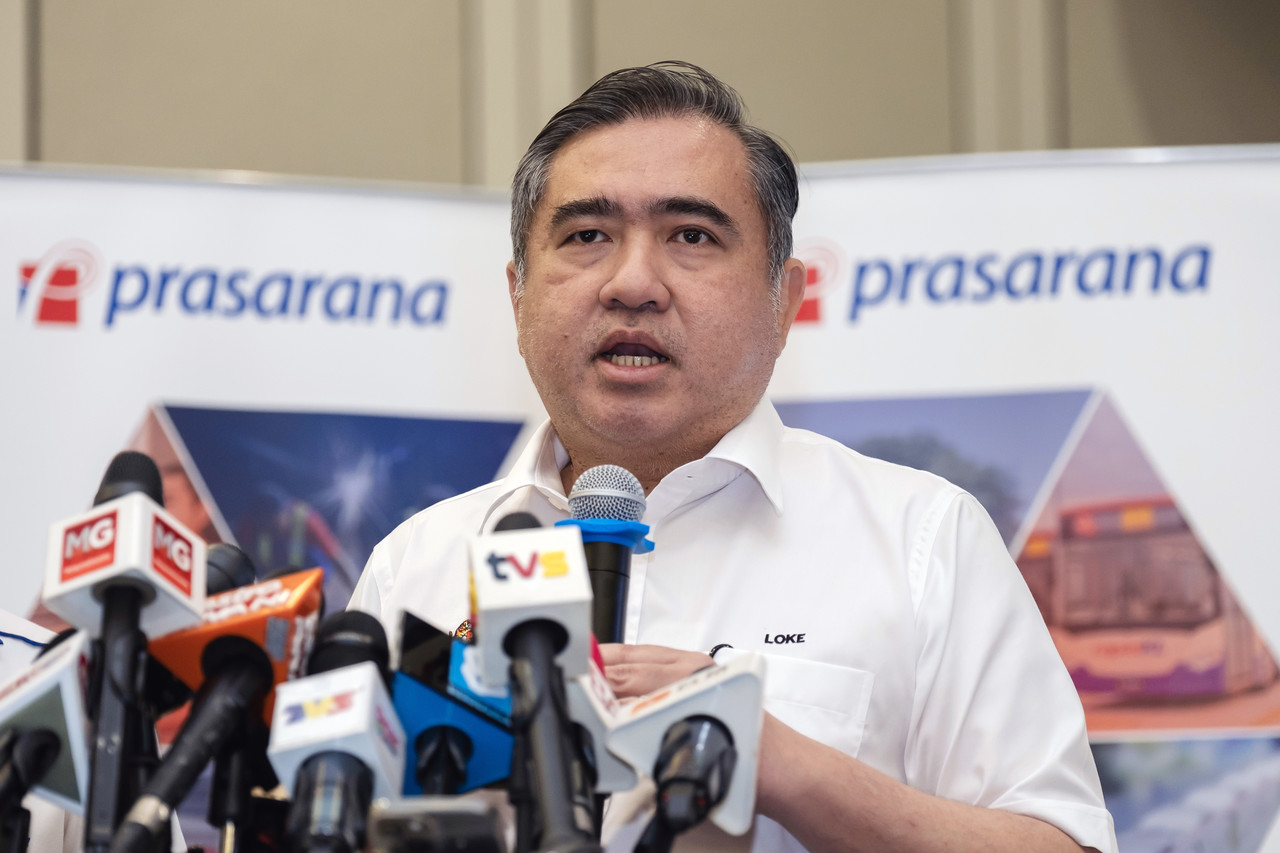
KUALA LUMPUR – The failure-free run (FFR) for the Light Rail Transit 3 (LRT3) train service has yet to begin due to unresolved issues, Transport Minister Anthony Loke confirmed.
A meeting between Prasarana Malaysia Bhd (Prasarana) and the main contractor is scheduled for next week to discuss the way forward and determine when the FFR can take place. Loke added that there is currently no fixed date for the start of the FFR.
“FFR must be conducted on all trains before we can begin trial operations. As of today, only three LRT3 train sets have successfully completed the FFR,” he explained.
While acknowledging the delay, Loke stressed that safety remains the priority. “Although we are disappointed by the delay, safety must come first,” he told reporters during a press conference on Prasarana’s performance in 2025 and its outlook for 2026.
The delay follows an earlier confirmation from Prasarana that the LRT3 line could not begin operations last December due to ongoing system stability and software issues identified during the testing and commissioning phase.
In a separate update, Loke announced that platform screen doors would be installed at 20 stations this year.
In early December, Prasarana postponed the launch of the LRT3 Shah Alam Line, shelving its planned debut after new safety concerns arose during final testing. Prasarana’s President and Group CEO, Amir Hamdan, explained that the postponement followed long-distance tests, which uncovered intermittent software faults that required more extensive trials.
“During intensive testing, we found intermittent software issues that only appeared after extended runs. These included platform-stopping accuracy, train movement response, and automatic door operations,” he said. “By strengthening our testing now, we avoid future disruptions and ensure a smooth, safe passenger experience from day one.”
Amir emphasised that Prasarana would not compromise on safety, reliability, or system stability, in line with stringent standards set by the Land Public Transport Agency (APAD).
“Only when every system performs at optimal levels and all issues are fully resolved can we consider opening the line,” he stated. “All repair and technical enhancement works are now prioritised to ensure the Shah Alam Line is stable and safe before it opens to the public.”
Regarding a new launch date, Amir revealed that Prasarana would provide an update in mid-January.
“If the systems are not yet stable, we cannot commit to a Q1 or Q2 opening. We will announce the latest status in mid-January,” he said.
A Scoop report in December noted that the delay is also linked to the lengthy process required by multinational firm Siemens to deliver and stabilise the signalling software.
Sources confirmed that improvement and validation work on the Siemens signalling system and its integration are still ongoing. To ensure smooth operations, the testing period has been extended so any issues can be identified and rectified before the line opens, guaranteeing that LRT3 operates safely and reliably from the outset.
Amir also clarified that the delay would not result in additional project costs.
“We are taking the time now to get everything right, so that commuters can enjoy a modern, convenient, and dependable service in the long term,” he said. “Better to fix it now, than cause delays later.” – January 7, 2026