
KUALA LUMPUR – Prime Minister Datuk Seri Anwar Ibrahim has confirmed that Bahasa Melayu and History will become compulsory subjects in the Sijil Pelajaran Malaysia (SPM) examination for all schools across the country. This includes international schools, religious schools, and those following the Unified Examination Certificate (UEC) curriculum.
The Prime Minister stated that this initiative is part of the government’s effort to unify the education system under a national framework, addressing long-standing debates and ensuring equal access to higher education pathways, Bernama reported.
“The situation has changed. The vast majority of UEC and international school students already sit for the SPM examination.
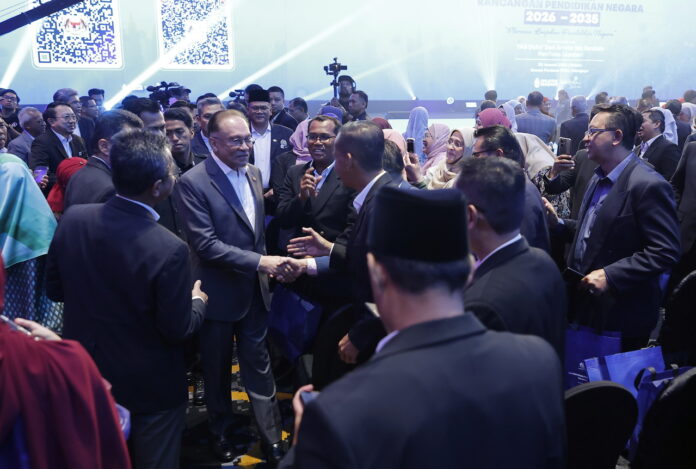
Under this policy, Bahasa Melayu and History will be made compulsory for international schools, religious schools, and all Chinese or UEC-stream schools,” he said during the launch of the National Education Blueprint (RPN) 2026-2035.
He further explained that the aim of this policy is to remove any controversy surrounding the transition to higher education for students from these streams. “With this approach, their pathway to higher education should no longer be controversial,” Anwar added.
The new policy will also apply to community-based religious schools and tahfiz institutions, which together enrol over 400,000 students nationwide.
“They may retain their religious curriculum; we will not interfere with that. But as a condition for receiving government assistance, they must also offer Bahasa Melayu and History,” Anwar confirmed.
During the event, Anwar also referenced the remarks of His Majesty Sultan Ibrahim, King of Malaysia, made at the opening of the Parliament session.
Anwar reaffirmed the government’s commitment to maintaining Bahasa Melayu as the national language, stating that proficiency must go beyond basic skills and be integrated into the curriculum.
“Mastery of Bahasa Melayu must be strengthened through school and university curricula in line with the demands of the times,” he remarked.
Additionally, Anwar emphasised the importance of enhancing English proficiency to meet global standards, recognising the country’s role as a trading nation.
He advocated for improved teaching quality in English, especially as it pertains to areas like digital transformation and artificial intelligence. “English must be given greater priority as a second language,” he said.
The Prime Minister also directed the Education Ministry to ensure the availability of qualified teachers for major languages such as Bahasa Melayu, English, and electives including Mandarin, Tamil, and Arabic, to cater to students’ needs in national schools.
Concluding his address, Anwar expressed hope that this policy would put an end to the language debates that have characterised Malaysia’s education system for decades.
“I grew up in the 1950s and 1960s, when language disputes were intense. With this 2026 policy, God willing, we will put an end to it,” he said. – January 20, 2026