

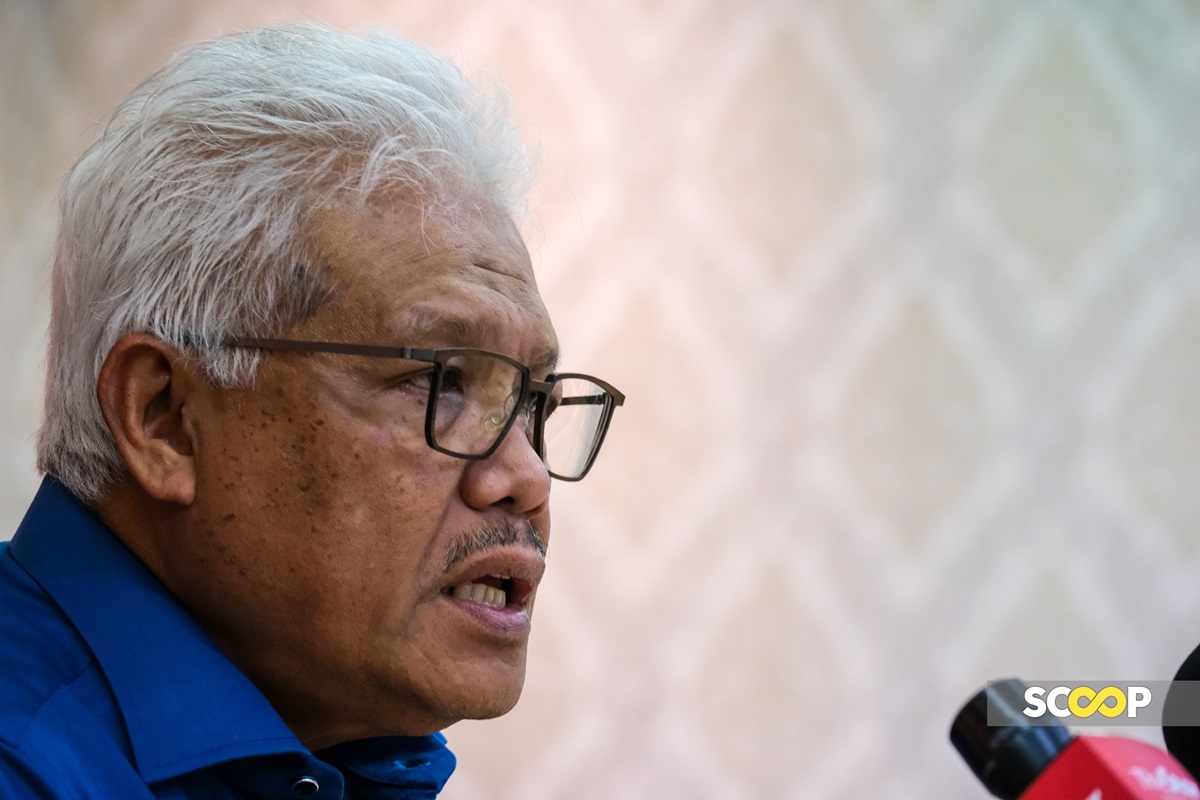

KUALA LUMPUR – Datuk Seri Hamzah Zainudin’s position as Opposition Leader is entering politically uncertain territory, with analysts warning that remaining an Independent MP without formal backing from the opposition bloc would significantly weaken his legitimacy, even if parliamentary convention does not automatically disqualify him.
The uncertainty follows his fallout within Bersatu, raising questions not only about his personal standing but also about the cohesion of the opposition under Perikatan Nasional (PN).
Speaking to Scoop, Professor Syaza Shukri of the International Islamic University of Malaysia said that under Malaysia’s parliamentary practice, the Opposition Leader is typically drawn from the largest opposition bloc in the Dewan Rakyat — currently PN.
“As long as a person commands the support of the majority of opposition MPs in Parliament, he can hold the position,” she said.
However, she stressed that political legitimacy goes beyond mere technical qualification.
“The question now is whether Hamzah remains aligned with the PN in practical terms, because his legitimacy is still rooted in party support. That said, PN itself appears to be without a clear leader or chairman at present. So, until there is a formal decision, he remains Opposition Leader.”
Syaza said Hamzah’s political future now hinges on whether he can translate perceived sympathy into structured backing.
“If we look at his speech last Saturday, it appears that he still has strong support from sections of the Bersatu leadership. If he can capitalise on that support, whether by forming a new party — he may be able to sustain his relevance.
“But there is also the risk that this becomes ‘Pejuang 2.0’. His best option may be to join another party, although I expect he will attempt to remain relevant as the leader of a party or faction,” she added.
She noted that Bersatu itself faces longer-term consequences.
“In the short term, the crisis may subside because those opposing Tan Sri Muhyiddin Yassin have left. But in the long term, the question is whether this consolidation truly strengthens the party.
“The decision to have Datuk Seri Ahmad Faizal Azumu and Datuk Mohd Radzi Md Jidin assume the deputy president’s responsibilities suggests there is no single figure within Bersatu who commands influence comparable to Hamzah. That reflects the weakness of the party’s second-tier leadership,” she said.
Dr Azmi Hassan of the Nusantara Academy for Strategic Research said the determining factor for the Opposition Leader’s post remains parliamentary arithmetic.
“If PAS continues to back Hamzah, based on the number of PAS MPs in Parliament, he can retain the position even as an Independent. The role is ultimately determined by majority support among opposition MPs in the Dewan Rakyat,” he said.
Nevertheless, Azmi described Hamzah’s broader political trajectory as fragile, pointing to the growing number of Bersatu MPs now without party affiliation.
“This creates structural difficulties because they cannot simply move to another party. The key question is where Hamzah goes from here, and it is highly likely he would bring the other MPs with him.
“The most straightforward route to extend his political career would be to join PAS, where there are fewer institutional barriers. Joining UMNO would be more complicated, despite his previous membership,” he said.
Azmi added that although Muhyiddin now exercises firm control over Bersatu, the party’s overall strength has diminished.
“The expulsion of key leaders and MPs has weakened Bersatu’s position in Parliament and within the opposition landscape. While Muhyiddin has consolidated authority internally, there remains the risk of further erosion,” he said.

Beyond questions of numbers and party manoeuvring, the episode raises broader institutional concerns.
Awang Azman Pawi of Universiti Malaya said that the post of Opposition Leader is not expressly provided for in the Federal Constitution but is recognised through parliamentary convention and the Standing Orders of the Dewan Rakyat.
“Typically, the Opposition Leader is the MP who commands the support of the majority of opposition members,” he said.
“In principle, an Independent MP can hold the position if he continues to command majority backing.
“However, in political practice, the role is usually anchored to the largest party or coalition because it involves the whip system, coordination of strategy, and the management of a shadow cabinet.”
Without structured bloc support, Awang cautioned, the authority attached to the post becomes politically fragile.
“What is unfolding is not merely a dispute involving an individual, but a stress test of party institutions and the resilience of the opposition framework itself.
“If this is not managed strategically, it could recalibrate the leadership balance within the opposition ahead of the next general election,” he said. — February 17, 2026