

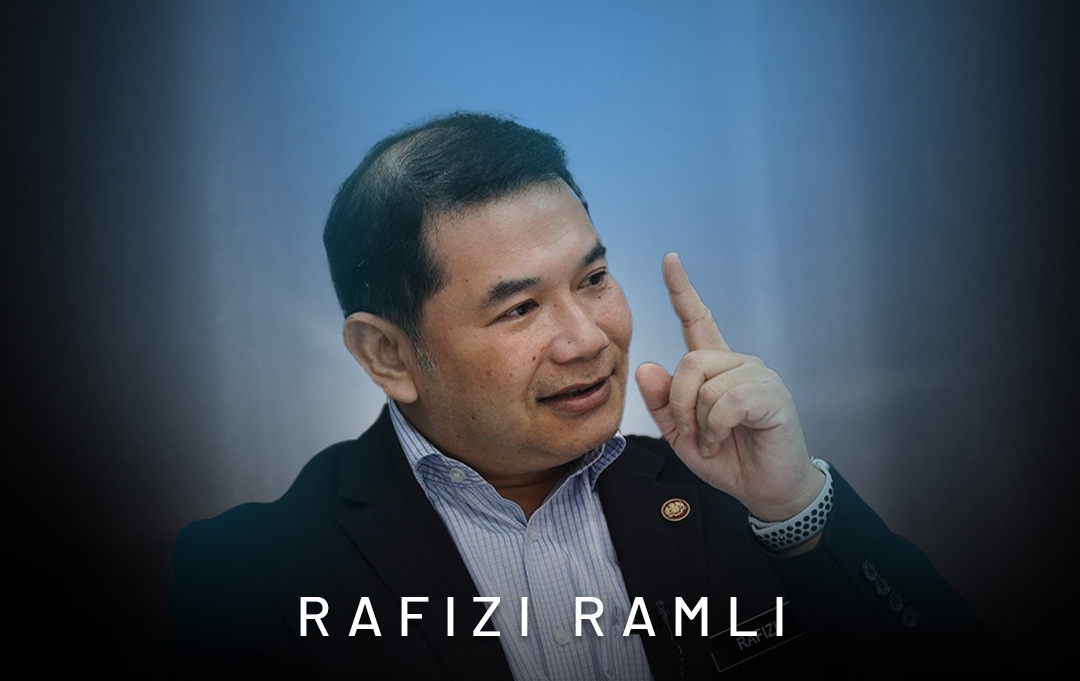
KUALA LUMPUR — Rafizi Ramli’s indication that he may contest Pandan independently at the 16th Malaysian General Election (GE16) has sparked debate among political analysts over whether the move reflects strategic positioning or personal conviction.
Socio-political analyst Datuk Prof Dr Awang Azman Awang Pawi said the development goes beyond a single parliamentary seat.

“This is not merely about a parliamentary seat, but touches on larger questions of political identity, reformist idealism, and the limits of intellectual freedom within party structures,” he said.
Dr Awang urged that the issue be approached rationally rather than emotionally.
“Is it a strategic move, a manifestation of personal conviction, or a combination of both?” he asked, noting that Rafizi’s dissatisfaction after losing the PKR deputy presidency and his increasingly critical tone towards a government he once served in have shaped public perception.
He stressed that Malaysia’s political system remains highly party-centric.
“Without a strong party symbol, the path to victory becomes much narrower,” he said, pointing to constraints faced by independents, including the absence of party machinery, limited financial resources, and difficulty appointing polling agents.
Still, he acknowledged that Pandan presents a unique testing ground.
“If there is any constituency capable of testing the strength of an individual brand, Pandan is the most suitable political laboratory,” he said, describing it as urban, middle-class, and policy-oriented.
Yet he cautioned that Rafizi’s past victories were not built solely on personality but also on coalition strength and organisational structure.
Analysts weigh in
Malaysian geostrategist Prof Dr Azmi Hassan argued that Rafizi’s move may be less optional than it appears.
“I’m sure he won’t be nominated for any seat in GE16. So basically, he needs to go solo in this case,” Azmi said.
He suggested that Pandan or a suburban mixed constituency could offer Rafizi a fighting chance, but downplayed the broader impact.
“Well, Rafizi is a Lone Ranger. He doesn’t affect the political scenario because basically he is alone,” Azmi added, noting that without party backing, influence remains limited.
Drawing a comparison, Azmi said figures such as Khairy Jamaluddin understand the necessity of party structures. “KJ knows that he needs a party,” he said, adding that Rafizi’s decision would not significantly impact the national political landscape.

Meanwhile, senior political analyst Lau Zhe Wei of the International Islamic University Malaysia took an even firmer stance.
“I’ll say it is his personal conviction only. It’s not strategic at all and he wouldn’t be able to win for sure,” Lau said, expressing confidence that PKR would retain the seat.
He emphasised structural realities in Peninsular Malaysia.
“For anybody, no matter how high your ranking, you wouldn’t be able to win the seat on your own capacity,” he said.
Lau dismissed the notion of a clear voter base behind Rafizi, adding that support would likely be fragmented.
“At best, it would be a portion of urban voters here, a segment of older voters there, perhaps some younger voters as well,” he said.
On ideological criticisms directed at PKR, Lau noted that many commentators share similar views about how parties behave differently in government. But he pointed out that Rafizi himself operated under collective responsibility while in Cabinet, only sharpening his criticism after leaving.
“Whatever Rafizi is doing now, it will not affect Malaysia’s overall political landscape, even in the next election, because his power is too weak for one person,” Lau added.
A broader test for Malaysian politics
While analysts differ on Rafizi’s motivations and prospects, they converge on one point: Malaysia’s electoral system remains firmly party-based.
If Rafizi succeeds as an independent, it could challenge the dominance of party symbols and encourage others to consider similar paths. If he fails, it would reinforce the enduring power of party machinery and organisational discipline.
For Dr Awang, the deeper question extends beyond one candidate.
“The real question is whether Malaysian politics has matured enough to prioritise ideas and personalities over party structures,” he said.
As GE16 approaches, Rafizi’s hinted move may not reshape the political map overnight — but it has already reignited debate about reform, loyalty, and the limits of independence within Malaysia’s evolving party system. — February 24, 2026