

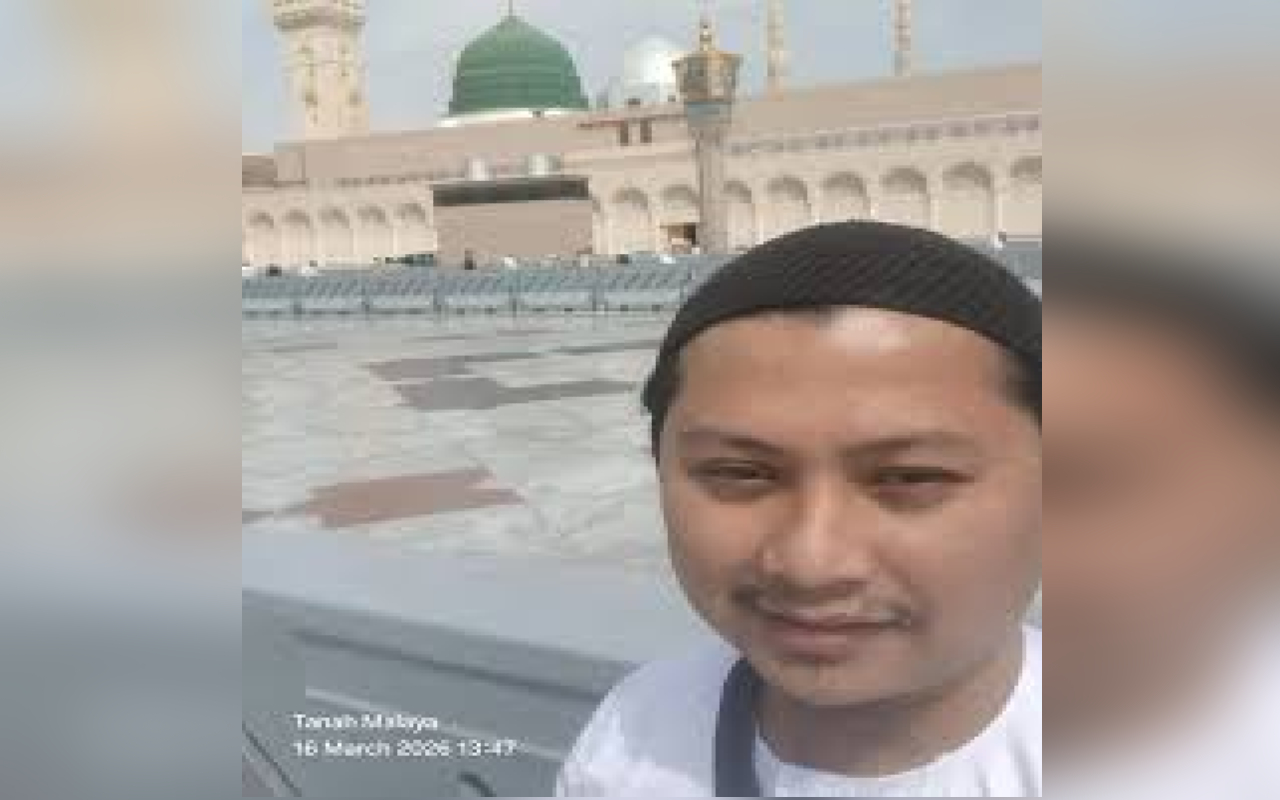
KUALA LUMPUR – Controversial activist Tamim Dahri Abdul Razak has signalled his willingness to return to Malaysia to surrender to the Royal Malaysia Police (PDRM), provided that four unauthorised temples are demolished.
The update was shared on Thursday by the Threads account, tanah.malaya, according to local media.
The temples cited for demolition include Kuil Atas Jalan Pandanmas, Kuil Hospital Bukit Mertajam, Kuil Lama Seafield, and Kuil Jakel. “Why these four locations? That is for everyone to think about,” the post read.
The Langkawi Magistrate’s Court last Tuesday postponed Tamim’s charges to May 15 after it was reported he was in Riyadh, Saudi Arabia.
He faces charges under Section 295 of the Penal Code for allegedly damaging soolam objects, sacred symbols for Hindu devotees, at the former Kuil Sri Maha Muniswarar site in Langkawi, Kedah.
On Monday, Inspector-General of Police Datuk Seri Mohd Khalid Ismail confirmed that four individuals, including Himpunan Gerakan Anti Rumah Ibadat Haram (GARAH) coordinator Zamri Vinoth and activist Arun Dorasamy, would face charges linked to religious provocation on Tuesday.
Alongside Zamri and Arun, Tamim Dahri and P. Mahendra Boopathy are also scheduled to be charged.
Earlier, representatives from Malay and Indian NGOs met on Wednesday for the first time to seek common ground in resolving longstanding tensions between the communities. The discussion was held as part of the Harmoni Madani programme, which lasted about four hours at the Putrajaya International Convention Centre (PICC).
At a press conference, Khalid urged calm over the issue of illegal temples.
“Essentially, this is an administrative issue involving land status, approval from local authorities, and compliance with planning and development laws. However, administrative issues like this can rapidly turn into religious and racial polemics when discussed openly in public spaces and on social media without proper control,” he said.
He added that social media campaigns calling for public gatherings at disputed temples and the circulation of provocative videos could inflame tensions.
“The police continuously pay attention to early indicators that could lead to rising racial tensions.
This approach is important so that any issue can be addressed before it escalates into a more serious conflict. We will take firm action against any individual or group that violates the law or attempts to incite racial tension. However, at the same time, we must also understand that enforcement of the law alone is not sufficient to maintain social harmony. It requires the cooperation of all parties, especially community leaders, NGO figures, and community activists.”
The IGP praised the recent dialogue between Malay and Indian NGOs.
“The police support and greatly appreciate the commitment and spirit of national unity demonstrated by the parties involved. This indirectly helps the authorities maintain racial harmony in order to ensure national stability,” he said.
Khalid also clarified why Zamri Vinoth was brought to court in handcuffs while Arun Dorasamy was not, noting that the nature of offences varies, with some allowing bail and others not.
“When we informed the media about the four arrests in Putrajaya that day, those were under Section 505 of the Penal Code. But there is also another case related to the Sedition Act,” he said.
He stressed that police procedures were in line with legal standards.
“I assure you that such actions are normal in our legal system, and we will continue to implement them as needed according to the requirements of the law itself,” Khalid added.
The two men, involved in a dispute over temple land, were charged separately on Monday with making statements allegedly conducive to public mischief under Section 505(b) of the Penal Code. Zamri is also due to face a sedition charge in Penang for allegedly insulting the Indian community. While sedition and Section 505 offences are generally non-bailable, courts may grant bail under Section 388 of the Criminal Procedure Code at their discretion. – March 19, 2026