

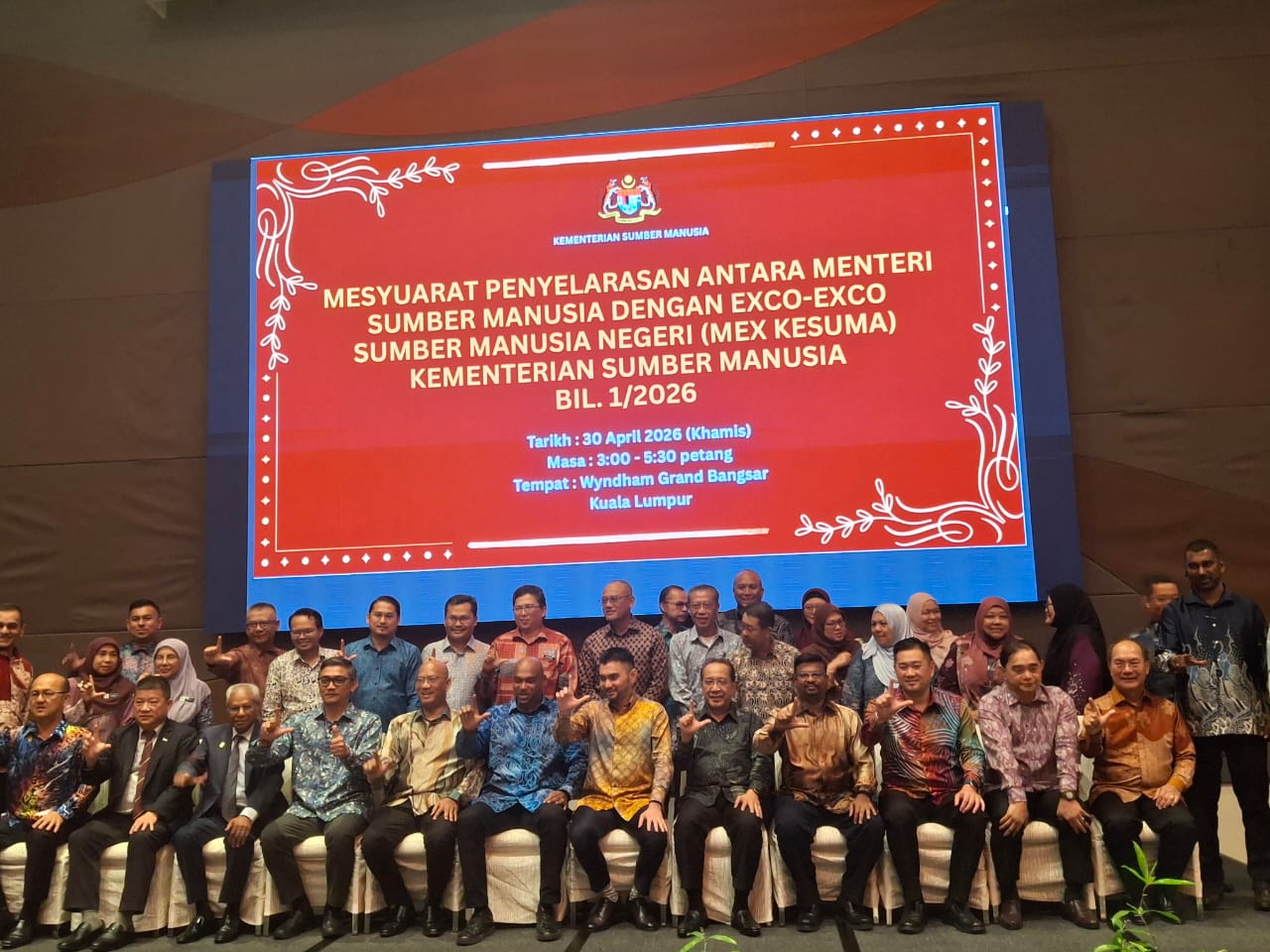
KUALA LUMPUR – The Ministry of Human Resources (Kesuma) will establish a dedicated team to improve coordination and information flow between the Federal Government and State Human Resources Exco members.
Human Resources Minister Datuk Seri Ramanan Ramakrishnan announced the move at a press conference following a meeting with State Human Resources Exco Members (Mex Kesuma).
“Our Ministry will have a small team which is set specially to send whatever information which the agencies have and whatever it is that we are doing, the programmes which we are initiating, which will be sent directly to the offices of each of the Excos,” he said.
The initiative is designed to ensure that state governments can quickly relay information to the ground, enabling citizens to access available programmes more efficiently. The team will also serve as a direct liaison, facilitating faster handling of requests, proposals, and operational matters between Kesuma and state governments.
The meeting addressed a wide range of topics, including initiatives under PERKESO, the Department of Manpower (JTM), and the National Higher Education Fund Corporation (PTPK). State-specific requests were also discussed, such as the establishment of rehabilitation centres, the expansion of Technical and Vocational Education and Training (TVET) opportunities, and improvements to internship-related documentation.
Ramanan highlighted strong participation from states including Sarawak, Sabah, Pahang, Negeri Sembilan, Perak, Melaka, and Perlis, reflecting robust federal-state collaboration.
On policy matters, the minister emphasised that the government is prioritising the implementation of the Gig Workers Act 2025, ongoing labour law reforms, and the expansion of social protection schemes, including PERKESO’s upcoming 24-hour protection programme.
He also acknowledged that foreign worker management remains a concern for several states.
“We are in the works of solving the problem. Just give us some time,” he said, adding that the issue is being addressed in a structured and coordinated manner.
Looking ahead, the new coordination mechanism is expected to enhance delivery efficiency, improve communication between ministries and states, and ensure national workforce policies reach the grassroots effectively. – April 30, 2026