

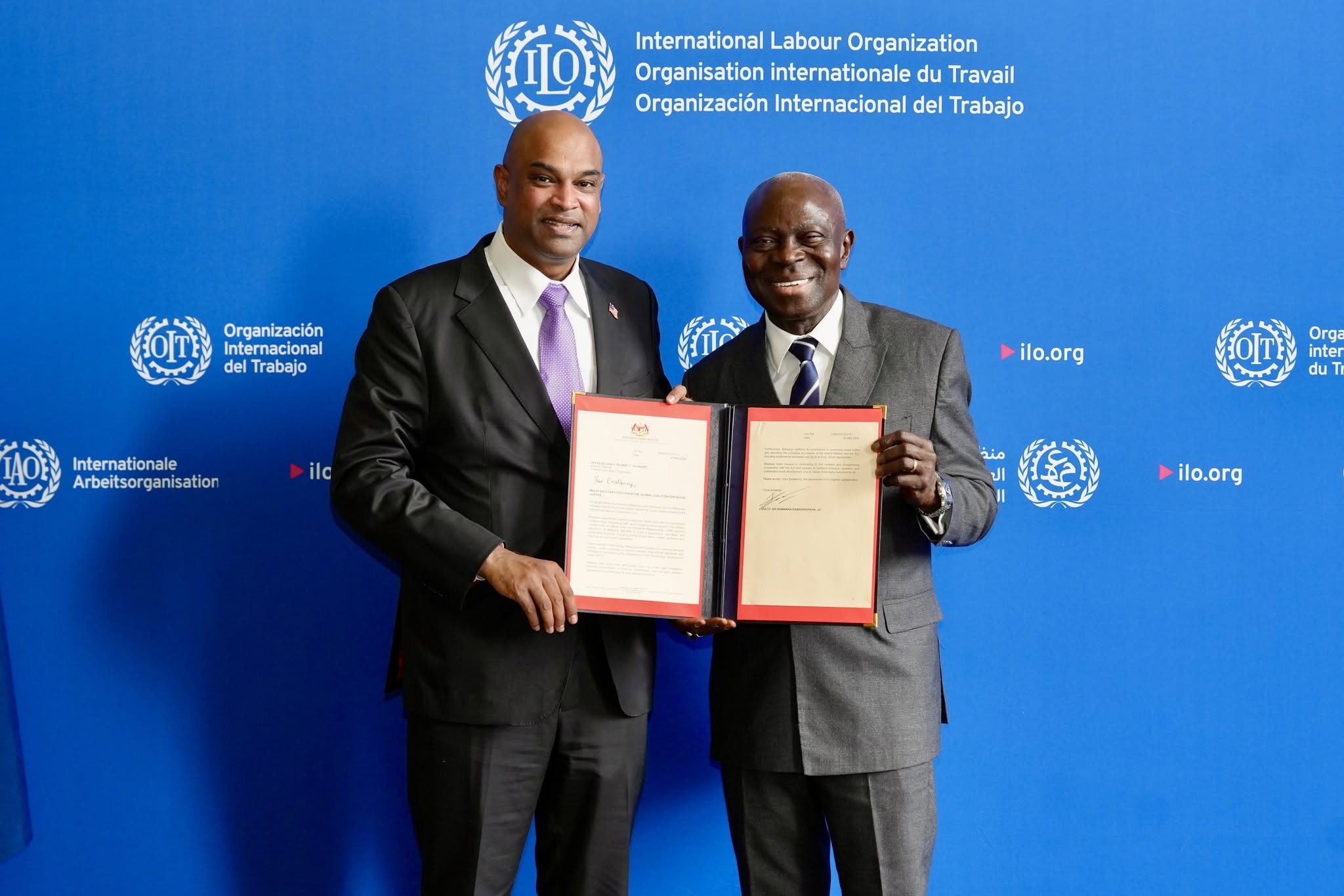
KUALA LUMPUR — Malaysia has officially joined the International Labour Organisation’s (ILO) Global Coalition for Social Justice, reinforcing its commitment to social justice and international labour standards.
Human Resources Minister Datuk Seri R. Ramanan said the move was formalised through the submission of Malaysia’s letter of participation to ILO Director-General Gilbert F. Houngbo today.
“Malaysia’s participation in this initiative reflects the government’s continued commitment to advancing the social justice agenda, expanding worker protection and promoting inclusive and sustainable economic growth in line with the ILO’s Decent Work principles,” he said in a Facebook post.
“This participation reflects the country’s ongoing commitment to strengthening social protection, promoting inclusive and sustainable economic growth, and strengthening employee welfare in line with international labour standards,” Ramanan added.
The meeting was also witnessed by Malaysia’s tripartite partners, namely Malaysian Employers Federation (MEF) president Datuk Dr Syed Hussain Syed Husman, Union Network International-Malaysia Labour Centre (UNI-MLC) president Datuk Mohamed Shafie BP Mammal, and Human Resources Ministry deputy secretary-general (Policy and International) Dr Mohd Shaharin Umar.
Ramanan is currently in Geneva, Switzerland, for the 114th International Labour Conference (ILC). The ILO delegation at the meeting included Assistant Director-General and Regional Director for Asia and the Pacific Kaori Nakamura Osaka and Senior Adviser to the ILO Director-General Hitomi Nakagome.
Ramanan said he also stressed the importance of strengthening a harmonious, inclusive and effective tripartite ecosystem in Malaysia.
He said all parties, including employers’ and workers’ representatives, should continue to prioritise dialogue and constructive engagement in addressing industrial relations issues to safeguard international confidence in the country’s labour system.
In his speech at the conference, Ramanan spoke on the impact of artificial intelligence on the labour force, stressing that Malaysia remains committed to a “human-centred future of work”.
“Malaysia believes AI must serve people, not replace them. With a labour force of more than 17 million people, Malaysia’s priority remains clear, to ensure that every worker is equipped and protected to thrive in an AI-driven economy.
“In the end, technology is only progress when it advances decent work and human dignity,” he said.
Ramanan said AI was being used to support Malaysia’s labour policies and safeguard worker protections.
As examples, he cited the Malaysian Industrial Court’s move to modernise its operations using AI supported technologies, and AI-driven initiatives under the MyFutureJobs platform to match jobseekers with vacancies.
“Malaysia is also advancing workplace safety and health through the Occupational Safety and Health Master Plan 2026–2030 which advances innovation and technology integration to address emerging risks arising from AI, automation, and digitalisation,” Ramanan said.
To face a AI’s future impact on jobs, the government has introduced tax deductions for employers for eligible AI and cybersecurity training expenses, while the MyMahir–National AI Council for Industry supports employers who invest in upskilling and reskilling their workers. – June 9, 2026