

KUALA LUMPUR – The 16th Johor state election has officially moved into its campaign phase following nomination day, revealing a highly fragmented political contest marked by multi-cornered fights, shifting coalition dynamics and an increasing emphasis on governance alignment between state and federal administrations.
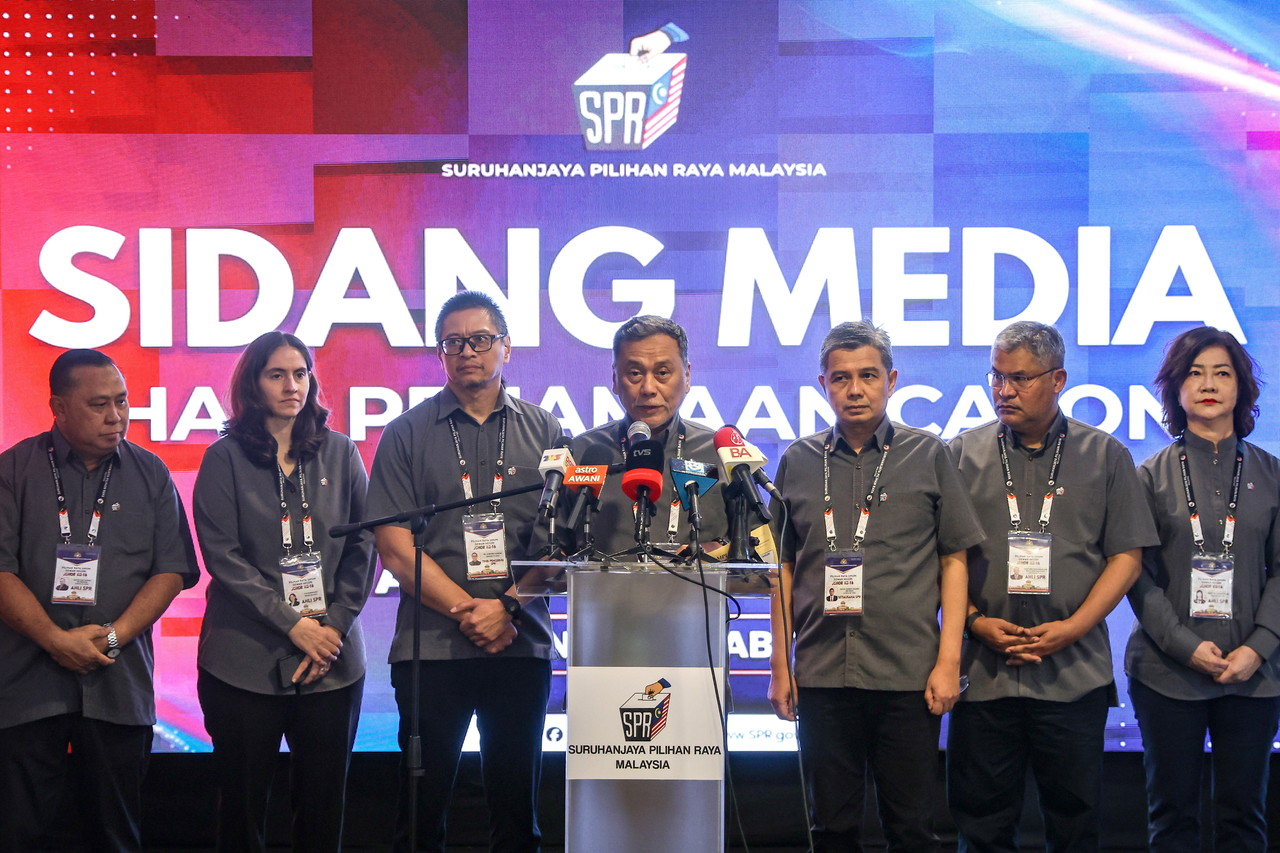
The Election Commission (EC) confirmed that all 172 nomination papers submitted across 56 state constituencies were accepted, with no rejections recorded.
Its chairman Datuk Seri Ramlan Harun said the candidates comprise 138 men and 34 women, reflecting a continued gender gap in electoral representation.
“All 172 nomination papers submitted were accepted after the nomination period closed at 10am, and no candidates were rejected,” he said, as qupted by Berita Harian.
Fragmented field across 56 seats
The distribution of candidates underscores a competitive and fragmented political landscape. Both Barisan Nasional and Pakatan Harapan are fielding 56 candidates each, while Perikatan Nasional is contesting 33 seats.
Smaller parties and independents further widen the field, including MUDA, Parti Bersama Malaysia, Parti Sosialis Malaysia, Parti Orang Asli Malaysia, Parti Ikatan Demokratik Malaysia, and six independent candidates.
Ramlan noted that only 14 constituencies will see straight fights, while 27 seats will have three-cornered contests, 12 will see four-cornered battles, and three constituencies will feature five-cornered contests.
This pattern signals a shift away from traditional two-way electoral contests, replacing them with more complex vote-splitting scenarios that could prove decisive in closely contested seats.
Puteri Wangsa: five-cornered test of influence
One of the most closely watched constituencies is Puteri Wangsa, where former education minister Maszlee Malik is contesting under Pakatan Harapan in a five-cornered fight.
He faces candidates from Barisan Nasional, MUDA, Parti Bersama Malaysia and an independent challenger, making it one of the most crowded battlegrounds of the election.
The seat, previously won by MUDA’s Amira Aisya Abdul Aziz with a strong majority, carries significant symbolic weight given its large electorate of 128,723 voters.
At nomination centre proceedings, senior PKR figures Datuk Seri Amirudin Shari and Datuk Seri Saifuddin Nasution Ismail were present to signal federal-level support for the Pakatan Harapan campaign.
Saifuddin, who also serves as Home Minister, framed the election as part of a broader governance strategy linking state and federal priorities.
He said Pakatan Harapan’s federal administration had already delivered tangible development initiatives for Johor, including major economic and infrastructure projects.
Machap: direct clash involving state leadership
Another key battleground is Machap, where Johor Menteri Besar Datuk Onn Hafiz Ghazi faces a direct challenge from Pakatan Harapan’s Nor Hafiz Roslan in a straight fight.
The contest carries added political weight as it involves the state’s chief executive directly defending his seat.
Onn Hafiz, who also chairs Johor Barisan Nasional, acknowledged the unpredictability of the election.
“In an election like this, anything can happen. So we will fight with full effort to secure the people’s support, God willing,” he said.
His opponent, Nor Hafiz, positioned the contest as an opportunity for political change and policy renewal.
“Since I have been entrusted by Pakatan Harapan to contest in Machap, we are entering this election with strong determination and confidence that we are here to win the seat,” he said.
He added that the coalition would present a dedicated manifesto focused on local development under the “Johor MADANI” framework.
Federal-state alignment becomes key narrative
Beyond constituency-level battles, a broader narrative is emerging around coordination between federal and state governments.
Saifuddin argued that stronger alignment would improve policy implementation and economic outcomes for Johor.
He highlighted ongoing federal initiatives, including the Johor–Singapore Special Economic Zone and efforts to resolve longstanding congestion at the Johor Causeway.
Among the key measures is the RM1 billion National Integrated Immigration System, designed to replace the outdated system and streamline cross-border movement.
Additional upgrades include expanded AutoGate facilities and the upcoming Rapid Transit System Link, which is expected to significantly increase cross-border passenger capacity once operational.
These developments are increasingly being positioned as central to Johor’s economic trajectory, particularly given the state’s close ties with Singapore.
Internal dynamics in Perikatan Nasional
While much attention is focused on the Pakatan Harapan–Barisan Nasional competition, internal dynamics within Perikatan Nasional also feature in the early campaign narrative.
Bersatu president Tan Sri Muhyiddin Yassin acknowledged that Pas will not be assisting the party’s campaign machinery in the Johor election.
He, however, downplayed the impact of the decision.
“It is alright. I did not ask for it either. Whoever wants to help can help, although in principle, as members of Perikatan Nasional, we should support each other,” he said.
Muhyiddin added that Bersatu would continue its campaign independently but remained open to cooperation if required.
With polling set for July 11 and early voting on July 7, the Johor state election is shaping up as a test of coalition strength, voter behaviour and campaign organisation. – June 27, 2026