

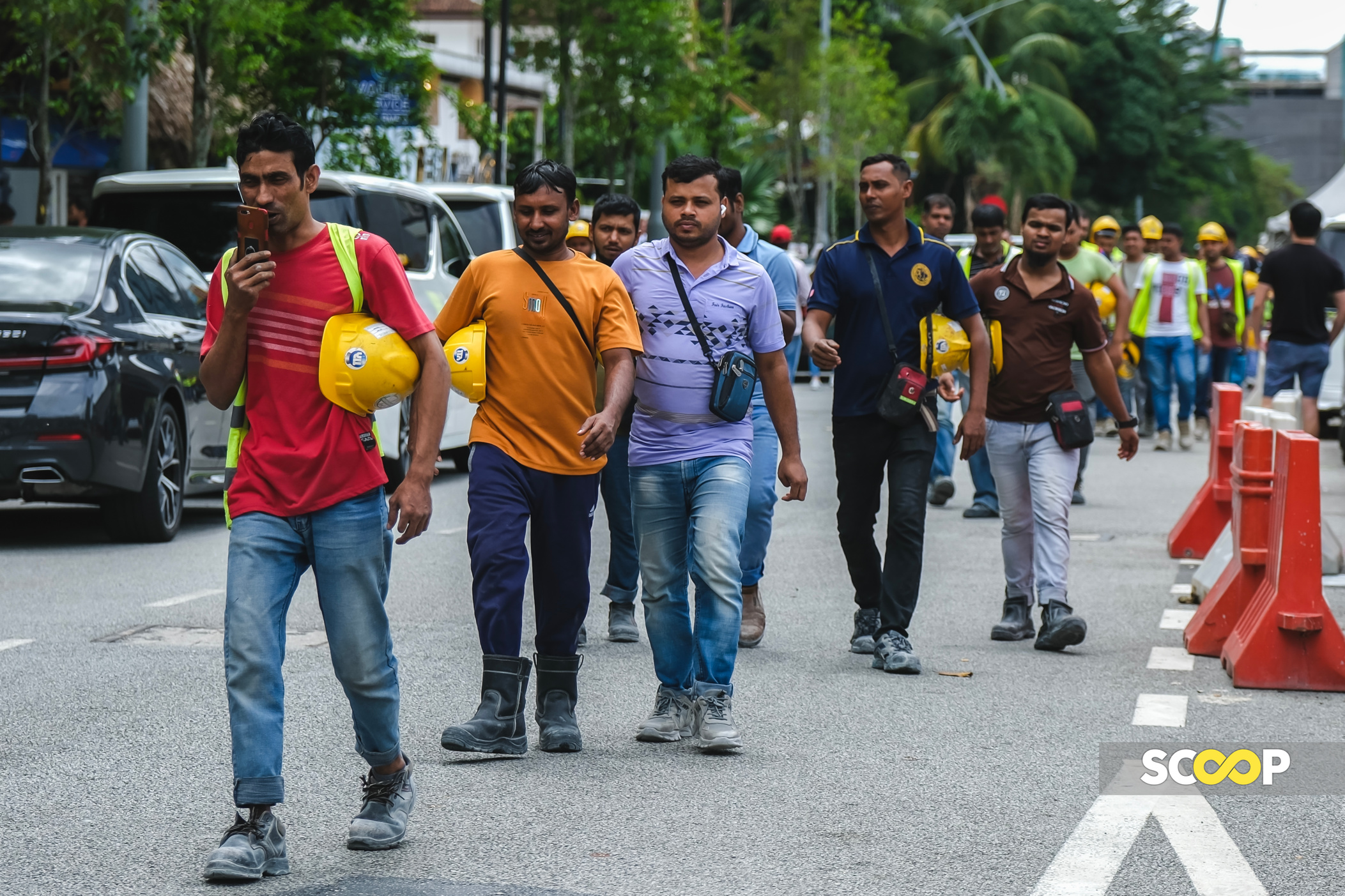
KUALA LUMPUR – The Federation of Malaysian Manufacturing (FMM) has welcomed the government’s decision to centralise foreign worker management under the Human Resources Ministry (Kesuma), but urged a smooth transition to ensure businesses are not disrupted during the implementation of the new system.
FMM president Jacob Lee Chor Kok said the transition must be supported by clear operational guidelines, sufficient system capacity to manage application volumes, and continuous engagement with industry groups to prevent new bottlenecks from emerging.
He said future improvements to the digital recruitment ecosystem should build on, rather than duplicate, the newly consolidated Foreign Workers Centralised Management System (FWCMS)/eQuota single-window platform.
Lee added that the consolidation of foreign worker quota processing under KESUMA presents an opportunity for the government to implement the Multi-Tier Levy Mechanism (MTLM), which FMM has repeatedly called for.
“We have long maintained that MTLM should replace rigid administrative caps and sectoral ratios with a structured, demand-driven approach, allowing companies to hire based on genuine operational need, with tiered levies calibrated to incentivise automation and reduce dependency on foreign labour,” he said in a statement today.
Under FMM’s proposal, companies with foreign workers making up no more than 10% to 15% of their workforce should be considered for preferential levy rates, potentially lower than the current RM1,850 rate.
Meanwhile, companies with higher foreign labour dependency could be subject to progressively higher levies under a transparent formula, with sufficient advance notice given to allow businesses to adjust.
Lee said the mechanism must acknowledge that labour transformation cannot be applied uniformly across all sectors, particularly export-oriented manufacturing industries where operational and semi-skilled workers remain crucial.
“MTLM should serve as an economic and industrial transition tool rather than a restrictive labour access policy, with levy proceeds channelled into automation, workforce development and productivity support, particularly for small and medium enterprises (SMEs),” he said.
On July 1, the Cabinet decided to place the One-Stop Centre (OSC) for foreign worker management fully under KESUMA, with the move taking effect on July 6.
Under the new arrangement, all foreign worker quota applications must be submitted exclusively through the eQuota module under FWCMS, while manual case-by-case processing has been discontinued.
FMM described the move as a long-awaited reform that could streamline Malaysia’s foreign worker recruitment process and address longstanding concerns over fragmented approval procedures involving multiple agencies.
The federation also pledged to continue working closely with KESUMA and relevant agencies to ensure the reform is implemented effectively, while addressing challenges faced by manufacturers in accessing foreign labour.
Human Resources Minister Datuk Seri R. Ramanan said the transition was part of the government’s efforts to strengthen governance in foreign worker recruitment while ensuring industries reliant on foreign labour continue operating without disruption.
He said KESUMA would conduct engagement sessions with relevant stakeholders, including the Home Ministry, and oversee logistical arrangements related to the OSC’s operations.
Ramanan added that foreign worker quota applications would now be processed entirely through the eQuota module under FWCMS, which serves as the government’s single digital platform for managing foreign worker recruitment.
“FWCMS is the single digital platform appointed by the government to manage foreign worker applications in Malaysia. So there is no queue and no congestion,” he said at a press conference here today.
He said KESUMA has full control over the system, including access to the source code and master administrator rights, which are held by the ministry’s secretary-general.
Ramanan said quota applications remained open to all approved source countries.
“Out of the 15 listed countries, the 12 active countries are Bangladesh, India, Nepal, Myanmar, Pakistan, Vietnam, Cambodia, Thailand, Indonesia, the Philippines, Sri Lanka and Laos.
“Uzbekistan, Kazakhstan and Turkmenistan are categorised as inactive countries,” he said.
He added that document screening is now conducted fully online to improve transparency, reduce congestion, speed up processing times, and eliminate the need for queues or third-party involvement.
Ramanan said the ministry has received 22,476 applications involving 548 companies so far.
He stressed that approvals would no longer be based on discretionary case-by-case decisions, but would instead follow a standardised process involving regulatory checks, stakeholder engagements, and evaluations by the OSC before final decisions are made. – July 7, 2026