

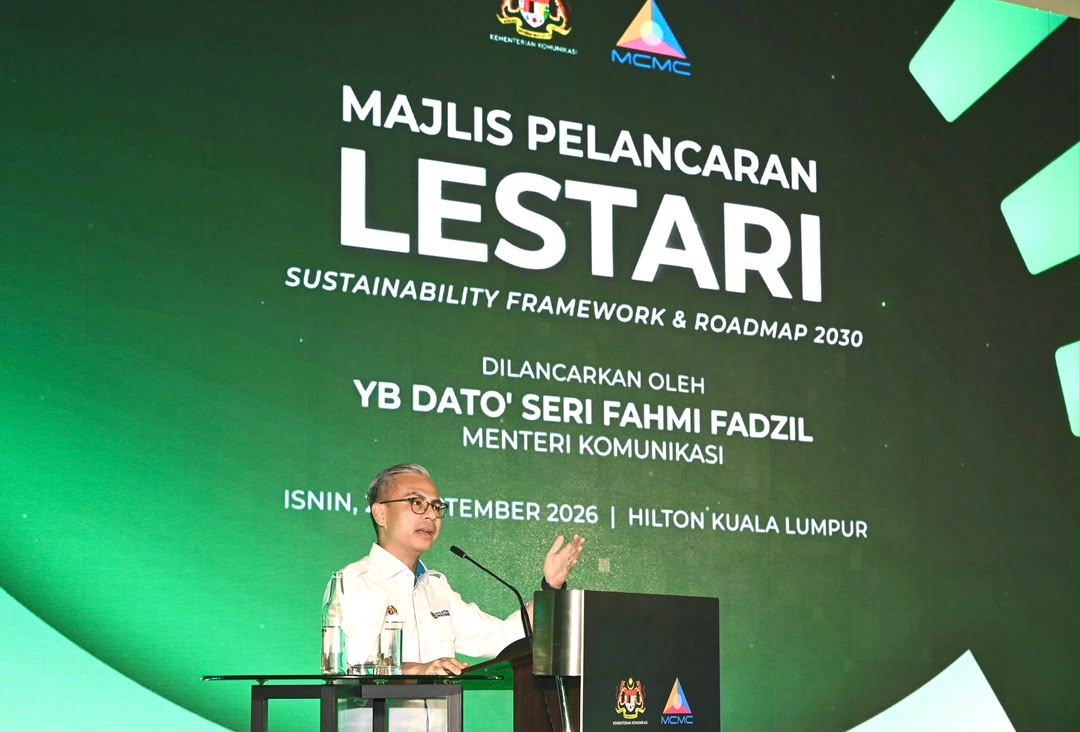

KUALA LUMPUR — Malaysia’s communications and multimedia sector must accelerate efforts to cut energy consumption and its environmental impact, as the country works towards achieving net-zero greenhouse gas emissions by 2050, Communications Minister Datuk Seri Fahmi Fadzil said today.
He said greater attention needs to be given to the energy demands of the sector, particularly telecommunications infrastructure, with Malaysia having about 60,000 towers nationwide, some of which rely on diesel generators in areas without access to the electricity grid.
“Can you imagine the amount of energy required to ensure that 60,000 towers remain active and online?” he said in his speech to launch LESTARI: Sustainability Framework and Roadmap 2030 (SFR2030), at Hilton Kuala Lumpur today.
He said the government, regulators and industry players must work together to identify practical solutions, including possible incentives, to encourage the adoption of more sustainable practices.
“We are bringing together partners whom I regard as strategic partners from different sectors, but each of them has an impact on energy consumption.
“We must think together about how we can organise, mobilise and create a framework, and perhaps introduce incentives, so that they can also make the transition,” he said.
Fahmi said while the communications, broadcasting, telecommunications and postal sectors were important drivers of national development and the people’s economy, their environmental impact could not be overlooked.
“It is meaningless to talk about development and progress if we do not also consider aspects of environmental quality and education about our planet,” he said.
LESTARI: Sustainability Framework and Roadmap 2030 (SFR2030), is a strategic framework by the Malaysian Communications and Multimedia Commission (MCMC) to guide sustainability efforts in the telecommunications, broadcasting, postal and courier sectors through 2030.
LESTARI aims to drive initiatives that deliver tangible benefits to the people and environment, while supporting the sector’s transition towards Malaysia’s net-zero greenhouse gas emissions aspiration by 2050.
It also seeks to strengthen the circular economy by reducing electronic waste, extending the lifespan of devices and increasing access to more affordable technology.
Under the framework, devices that remain usable will be refurbished and reused, helping to reduce ownership costs and widen access to technology, particularly among vulnerable and lower-income groups.
By 2030, LESTARI targets 15 million devices to be managed sustainably through reuse, upgrading, replacement with more energy-efficient technology or responsible recycling.
The initiative is also expected to benefit five million people through social impact programmes implemented by MCMC together with industry players.
Fahmi cited Pos Malaysia’s transition from internal combustion engine vehicles to electric vehicles as an example of the changes taking place within the sector.
He said the transition had been progressing well, although some adjustment was needed as people became accustomed to the quieter electric vehicles used for postal deliveries.
He also highlighted the energy requirements of broadcasting and production facilities, where equipment generates significant heat and requires controlled temperatures.
“We should also consider the carbon emissions produced by the significant energy consumption associated with the use of this equipment in the film and production industry,” he said.
On telecommunications, Fahmi said diesel generators remained necessary for some towers in remote areas without access to the national electricity grid, making energy efficiency an important consideration for the industry.
LESTARI was developed through engagement sessions involving 116 participants from 47 organisations and is built around three main pillars — Climate and Environmental Sustainability; Social Impact and Inclusivity; and Technology and Innovation.
The first pillar covers energy efficiency, carbon emissions reduction, renewable energy, the circular economy and infrastructure resilience.
The second focuses on inclusivity, safety, skills and public wellbeing, while the third promotes the use of technology, artificial intelligence and low-carbon innovation to accelerate sustainability solutions.
Implementation of LESTARI will be monitored regularly based on targets and indicators established jointly with industry players to ensure the initiatives achieve their intended outcomes.
The Net Zero & Circularity Alliance (NZCA) was also introduced as an industry collaboration platform to reduce carbon emissions and strengthen efforts to collect, reuse and recycle devices.
As an initial commitment to the sustainability agenda, 15 organisations from across the digital ecosystem signed pledges supporting LESTARI and NZCA.
They are 3Cat Sdn Bhd, APR Electronics Services Sdn Bhd, Blue Bee Technologies Sdn Bhd (ERTH), CelcomDigi Bhd, CompAsia Sdn Bhd, EDOTCO Group Sdn Bhd, GD Express Sdn Bhd, Maxis Bhd, Measat Broadcast Network Systems Sdn Bhd (Astro), Media Prima Bhd, Pos Malaysia Bhd, Shan Poornam Metals Sdn Bhd, Telekom Malaysia Bhd, Time dotCom Bhd and U Mobile Sdn Bhd.
Fahmi said the transition would require cooperation between the Government and industry, urging companies to put forward proposals that could help accelerate their sustainability efforts under the National Energy Transition Roadmap (NETR).
“This effort may not be easy, but it is necessary.
“If you have suggestions that you would like us to consider to help accelerate your transition under the National Energy Transition Roadmap (NETR) and the energy transition programme, please let us know.
“Let us understand the challenges and let us work together,” he said. – September 28, 2026