

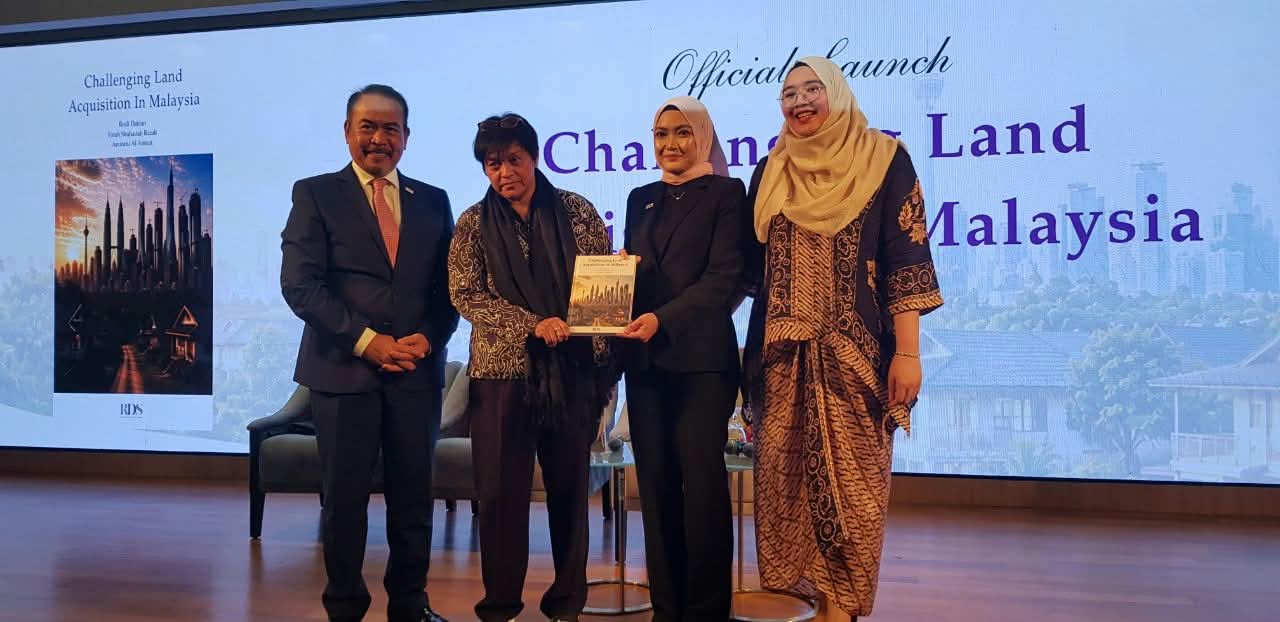
KUALA LUMPUR – Landowners should challenge compulsory land acquisitions if authorities abuse their powers or fail to comply with statutory requirements, says prominent lawyer Rosli Dahlan.
The co-founding partner of law firm Rosli Dahlan Saravana Partnership (RDS) said there had been growing instances of state authorities misusing their acquisition powers, particularly by misrepresenting the purposes for which land was being acquired.
He said this was especially concerning when land intended for economic or industrial development was instead classified as being acquired for public purposes, potentially affecting the compensation awarded to landowners.
“Just because the state wants land, and because there is an Act allowing it to happen, it does not mean they can do it willy-nilly. They have to do it properly,” he told Scoop at the launch of his book, Challenging Land Acquisition in Malaysia, today.
Drawing on nearly three decades of experience in land law and acquisition disputes, Rosli said the Land Acquisition Act 1960 provides for three grounds of compulsory acquisition: public purpose, economic development and industrial development.
Each category carries different legal requirements and safeguards, which he said could be circumvented when authorities misclassify the intended purpose of an acquisition.
“In public purpose, generally the courts tend to allow a lower compensation. I’m not saying that it is all the time,” he said.
He added that the safeguards under Sections 3B and 3C of the Act, which apply to industrial and economic development acquisitions, differed from those governing acquisitions for public purposes.
Rosli also raised concerns over the potential misuse of Section 3(1), warning that it could allow authorities to circumvent statutory controls designed to prevent abuse of acquisition powers.
He said affected landowners could turn to judicial review to challenge the stated purpose of an acquisition and establish whether the relevant authorities had complied with the law.
“When it comes to deprivation of property, the law must be followed strictly. You cannot bypass certain things,” he said.
Rosli emphasised that property ownership was protected under Article 13 of the Federal Constitution, which prohibits the deprivation of property except in accordance with law and requires adequate compensation where compulsory acquisition takes place.
While he considered the compensation framework under the Land Acquisition Act adequate, he said the more pressing concern was how authorities exercised their powers.
“It is important because although you talk about it as a land acquisition, it’s actually about property. And all of us as citizens, we would own property.
“So if you don’t challenge these things, then it would result in the creeping of abuses,” he added.
The need to hold public authorities accountable was also underscored by Minister in the Prime Minister’s Department (Law and Institutional Reform) Datuk Seri Azalina Othman Said, who officiated the book launch.
In her speech, Azalina said questioning how public powers were exercised should not be interpreted as an act of disloyalty, but was fundamental to maintaining the rule of law.
“Challenging the exercise of power is not an act of disloyalty, rather it’s an essential part of the rule of law,” she said.
She noted that Malaysia’s development agenda, encompassing infrastructure modernisation, industrial expansion and sustainable urban development, would require substantial land and infrastructure investment.
However, she said the success of such projects should not be judged solely by their completion speed or economic returns.
“Equally important is ensuring that decisions are made with great transparency, competing interests carefully considered and the process involved complied with the applicable legal framework and statutory safeguards,” she said.
Azalina acknowledged that compulsory land acquisition was a necessary responsibility of the government, but stressed that the institutions exercising such powers must do so responsibly and within the confines of the law.
“Development and constitutional safeguards can and must operate together,” she added.
In his address, Rosli said the book was intended to provide landowners, developers, public authorities and legal practitioners with a better understanding of the laws and procedures governing compulsory acquisitions.
He stressed that the publication was not intended to oppose development or the acquisition of land, but to ensure that such processes could take place without undermining the rule of law.
The book contains seven chapters examining the constitutional and statutory foundations of compulsory acquisition, acquisition procedures, judicial review, compensation principles, challenges to compensation awards, land reference proceedings and constitutional questions concerning federal and state powers.
Rosli said raising public awareness of the legal framework was crucial to ensuring property owners understood their rights and the remedies available when their land was acquired.
“Ownership of property is a fundamental right, just like freedom of belief. So we cannot allow constitutional rights to be eroded just by processes of law,” he said. – November 11, 2026