

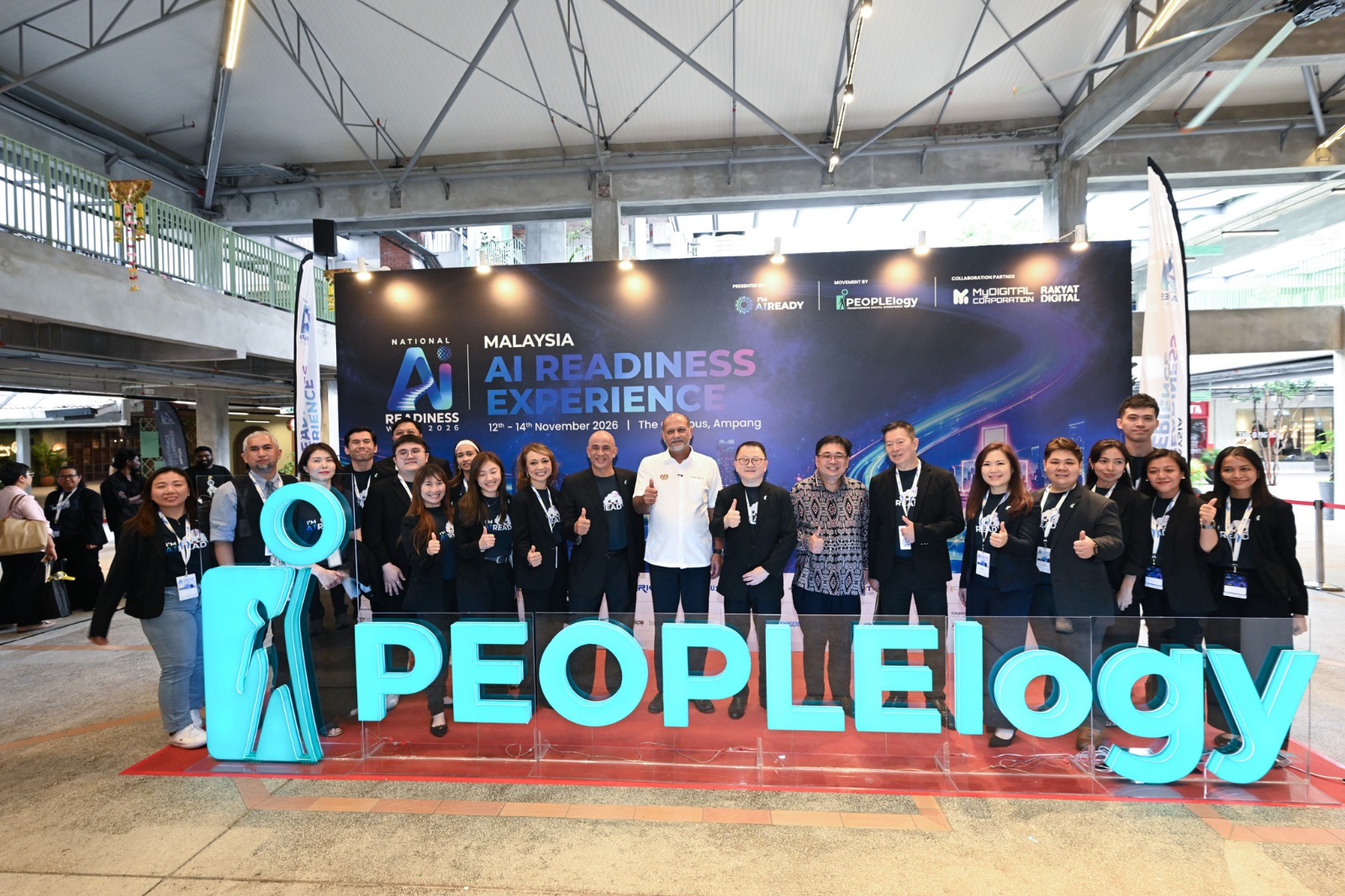

KUALA LUMPUR – PEOPLElogy Berhad is aiming to make five million Malaysians AI-ready by 2030 through a nationwide initiative focused on digital skills, workforce development and the adoption of artificial intelligence (AI).
The target was announced by the company’s founder and managing director, Allen Lee, during the opening of National AI Readiness Week 2026 (NAIRW 2026), officiated by Digital Minister Gobind Singh Deo at The Campus Ampang today.
Lee said the initiative, known as the I’m AI READY movement, was designed to prepare Malaysians for an increasingly AI-driven economy by making the technology and relevant skills more accessible.
“Technology alone does not transform a nation. People do. And that is why we started the I’m AI READY movement,” he said.
The movement has outlined four key targets: encouraging five million Malaysians to declare themselves AI-ready, mobilising an additional RM50 million in scholarships for at least 10,000 Malaysians, helping at least 10,000 small and medium enterprises (SMEs) adopt AI, and establishing an AI workforce alliance across South-east Asia.
“Our ambition is not simply to build an AI-ready Malaysia. We want to contribute towards building an AI-ready ASEAN,” Lee said.
He stressed that access to AI should not be confined to large corporations, arguing that smaller businesses must also be given opportunities to benefit from the technology.
“AI transformation should not be a privilege reserved for large corporations. It must be accessible to businesses of every size,” he said.
The movement will engage Malaysians through nationwide campaigns, free seminars, workshops, online classes and community programmes.
Lee said PEOPLElogy had worked with about 25 government agencies, foundations and enterprises between 2017 and 2025 to mobilise approximately RM70 million in scholarships, benefiting nearly 15,000 Malaysians through its 6D Workforce Transformation Framework.
About 90% of participants were better prepared for employment, based on the company’s programme outcomes.
Gobind, meanwhile, urged Malaysians to embrace AI with confidence, cautioning that growing interest in the technology must be accompanied by the ability to use it responsibly and effectively.
He said AI readiness involved understanding how the technology could improve work, verifying the accuracy of its outputs and maintaining human oversight over decisions that could affect others.
“An answer can sound convincing and still be wrong. The ability to question it is part of being ready,” he said.
He encouraged those uncertain about learning AI to begin with skills relevant to their needs and seek guidance where necessary.
Among the available resources is the Rakyat Digital portal, managed by MyDIGITAL Corporation, which provides free, self-paced courses covering introductory AI, generative AI, AI safety and cybersecurity. Some courses are available in Malay, English, Mandarin and Tamil.
Beyond individual skills development, Gobind said Malaysia must ensure its growing capabilities in AI translate into measurable economic benefits rather than simply improved international rankings.
He said the country had climbed to 27th place among 70 economies in the IMD World Digital and AI Ranking 2026, but stressed that progress should ultimately be assessed by its impact on businesses and society.
“I think there is still a lot more that we need to do, particularly in trying to focus on impact. We can create an AI ecosystem that is ready for next-generation technology. It is an ecosystem that will be able to support industries and society. But ultimately, the question is whether we are able to see returns on that investment,” he said.
Gobind said the priority was to ensure businesses and the wider public could adopt AI meaningfully and use it to improve productivity.
“People adopt technology, use technology and improve with technology,” he said.
The government is also reviewing regulations governing data centres, with a proposed Data Infrastructure Act potentially being tabled in Parliament next quarter.
Gobind said gaps in the existing framework needed to be addressed, particularly the absence of clear reporting requirements when disruptions at data centre facilities affect critical infrastructure and services.
Using flooding as an example, he said there was currently no established mechanism requiring operators to notify the relevant authorities if their facilities were damaged.
“If you have a data centre that’s up and running and there’s a flood that results in damage to the data centre, there is no mechanism requiring the data centre to notify anyone. There’s no authority that can be notified,” he said.
He said the proposed framework would establish clear reporting obligations, including details of incidents, the measures taken to address them and the sectors affected.
The government is also examining the growing demands data centres place on energy and water resources, including the possibility of allowing operators to develop their own supply infrastructure.
Gobind said the option of companies building their own energy and water facilities was among the matters under consideration, although no firm policy decision had been announced.
These issues are being examined by the Data Centre Task Force, co-chaired by Gobind and Investment, Trade and Industry Minister Datuk Seri Johari Abdul Ghani.
The task force is also looking into the sector’s sustainability requirements and differences in approval processes among state authorities.
On AI governance, Gobind said the final draft of the proposed AI Governance Bill had been received and was being circulated to relevant ministries for feedback, with the government targeting to table the legislation in Parliament in the first quarter of 2027.
However, he cautioned that legislation alone would not be sufficient without the institutions and enforcement mechanisms needed to ensure compliance.
“If we have governance but we don’t have agencies or bodies that can enforce this governance, then we have a problem,” he said.
Gobind said clear channels would also need to be established for handling complaints, including identifying the agencies responsible for investigating and resolving them.
“If there’s a complaint, who does it go to? Who looks into it? Who is the one that’s going to deal with the complaint? How do you deal with it?” he said.
The Digital Ministry’s secretary-general, Datuk Fabian Bigar, was also present at the event.
NAIRW 2026, themed “From AI Awareness to AI Readiness: A Purposeful Journey to Sustainable Employment”, runs until November 18, with the I’m AI READY Summit taking place until November 14.
The programme will continue with the Build a Future Team (BAFT) Leaders Conference on November 17 and 18, followed by the Asia AI Excellence Awards 2026 Gala Dinner on November 18, both at Marriott Petaling Jaya.
PEOPLElogy is also providing RM3 million in AI Mastery Scholarships to support the movement.
Gobind said Malaysia’s broader AI ambitions must be underpinned by sustainable infrastructure, effective regulation and enforceable governance to ensure technological progress delivers meaningful benefits to the economy and society. – November 12, 2026