

KUALA LUMPUR – The country’s Early Warning System (EWS) will undergo a simulation at the Parliament building on Nov 23 before being tested nationwide on Nov 29, Communications Minister Datuk Seri Fahmi Fadzil said.
Meanwhile, the Malaysian Communications and Multimedia Commission (MCMC) has urged smartphone users to update their devices’ operating systems ahead of the exercise to ensure they can receive emergency notifications.
Fahmi said MCMC would conduct public awareness campaigns through Public Service Announcements (PSAs) to familiarise users with the appearance and sound of the alerts.
The initiative aims to ensure the public understands that notifications received during the exercises are part of system testing and do not signal an actual emergency.
“We will also request that these messages or public service announcements be broadcast in all cinemas, on television and radio. We will also work with influencers and platforms such as TikTok to raise public awareness about the implementation of the Early Warning System or EWS,” he told reporters after the Communications Ministry’s monthly assembly for November here today.
Fahmi stressed that users would not need to download or install any applications to receive the alerts, as the system would communicate directly with compatible mobile phones.
The EWS uses Cell Broadcast System (CBS) technology to transmit alerts simultaneously to devices within designated geographical areas.
The minister said the system would complement existing warning channels, including short message service (SMS) notifications and sirens installed along rivers by the Department of Irrigation and Drainage (DID).
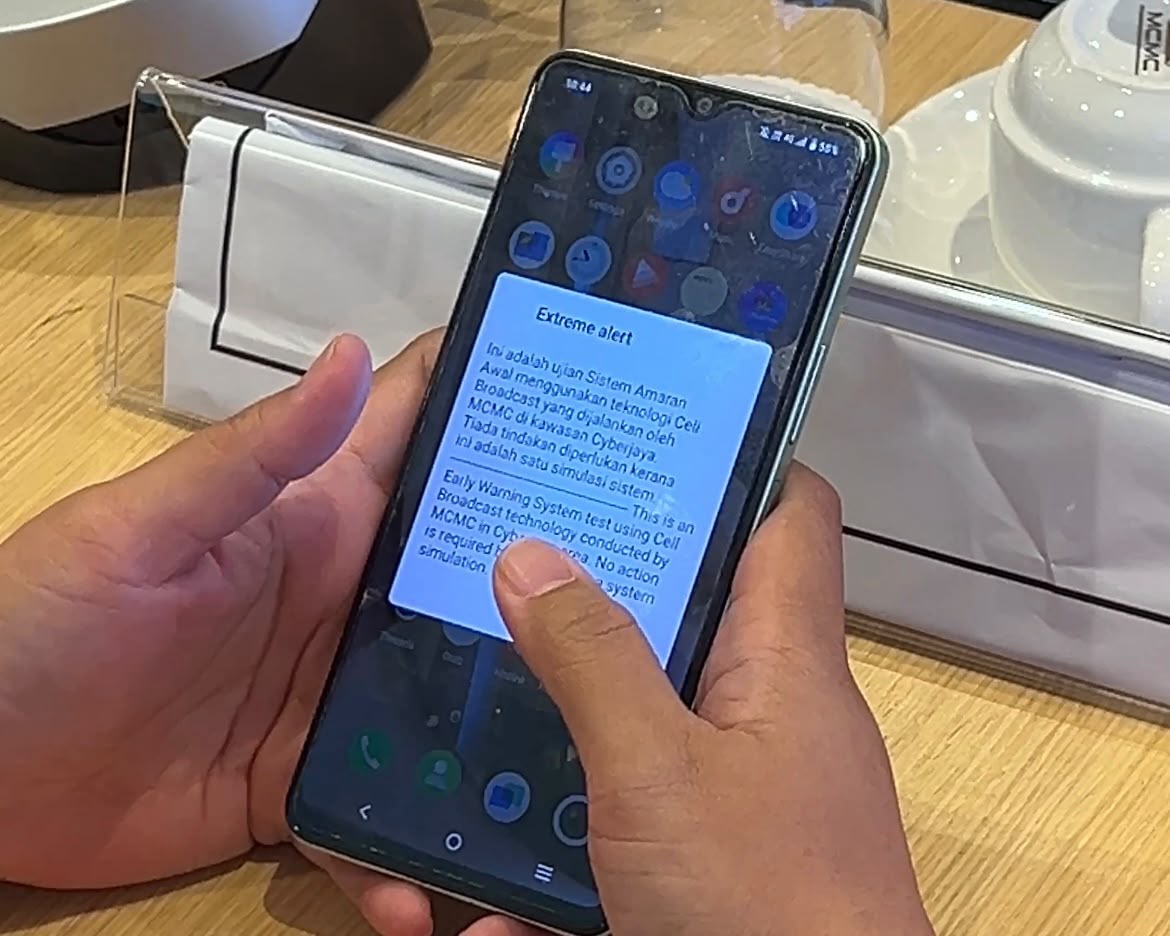
“Older mobile phones will still receive SMS messages, but newer phones will receive information through EWS in the form of a pop-up notification.
“We do not need to install or download any applications because this system communicates directly with mobile phones and does not operate through SMS,” he said.
As a preliminary guide, subject to final technical confirmation, MCMC has outlined the minimum device requirements for receiving EWS notifications:
Apple iPhone: iPhone 11 and newer models running iOS 27.2 or later.
Android: Devices running Android 12 or later.
Huawei: Devices running EMUI 16 or later.
Users are also advised to install the latest software updates, restart their devices after installation and ensure that the ‘Emergency Alerts’ setting is switched on.
MCMC held a special briefing with editors-in-chief and media representatives at its Cyberjaya headquarters today to explain the system’s operation and strengthen public preparedness.
The session included an internal technical demonstration showing a simulated Extreme Alert notification appearing directly on a smartphone screen.
The commission said the exercise was part of internal technical testing to assess and improve the system before wider trials are conducted in stages.
The EWS is a joint initiative involving MCMC, the National Disaster Management Agency (Nadma), relevant technical agencies and telecommunications service providers to ensure emergency information reaches affected communities more quickly and accurately.
Fahmi said the system could be used to alert the public not only to natural disasters such as floods, landslides and earthquakes, but also to matters involving public safety and security.
He said the Royal Malaysia Police (PDRM) and the National Security Council (MKN) could potentially use the platform to disseminate important information, including alerts involving missing persons and children.
“For example, if a missing person is identified in a particular area and cannot be traced, or if information needs to be shared about a missing child, this is practised in several other countries, where they make use of the same information or alert dissemination system.
“We see that this can be used to issue notifications about natural disasters, including floods, landslides and earthquakes. It can also be used for public safety and security matters.
“EWS is geographically based. If something happens in a particular area, the information will reach everyone within that area, although the broadcast will be more general in nature. This means even people in areas that are not directly affected may receive it,” he said.
Commenting on flood warning messages circulated through WhatsApp recently, Fahmi clarified that they were not part of the EWS rollout, as the new system delivers alerts through pop-up notifications rather than SMS or WhatsApp messages.
MCMC has reminded the public to remain alert to official announcements and follow instructions issued by the authorities whenever emergency notifications are received, for their own safety and that of their families. – November 19, 2026